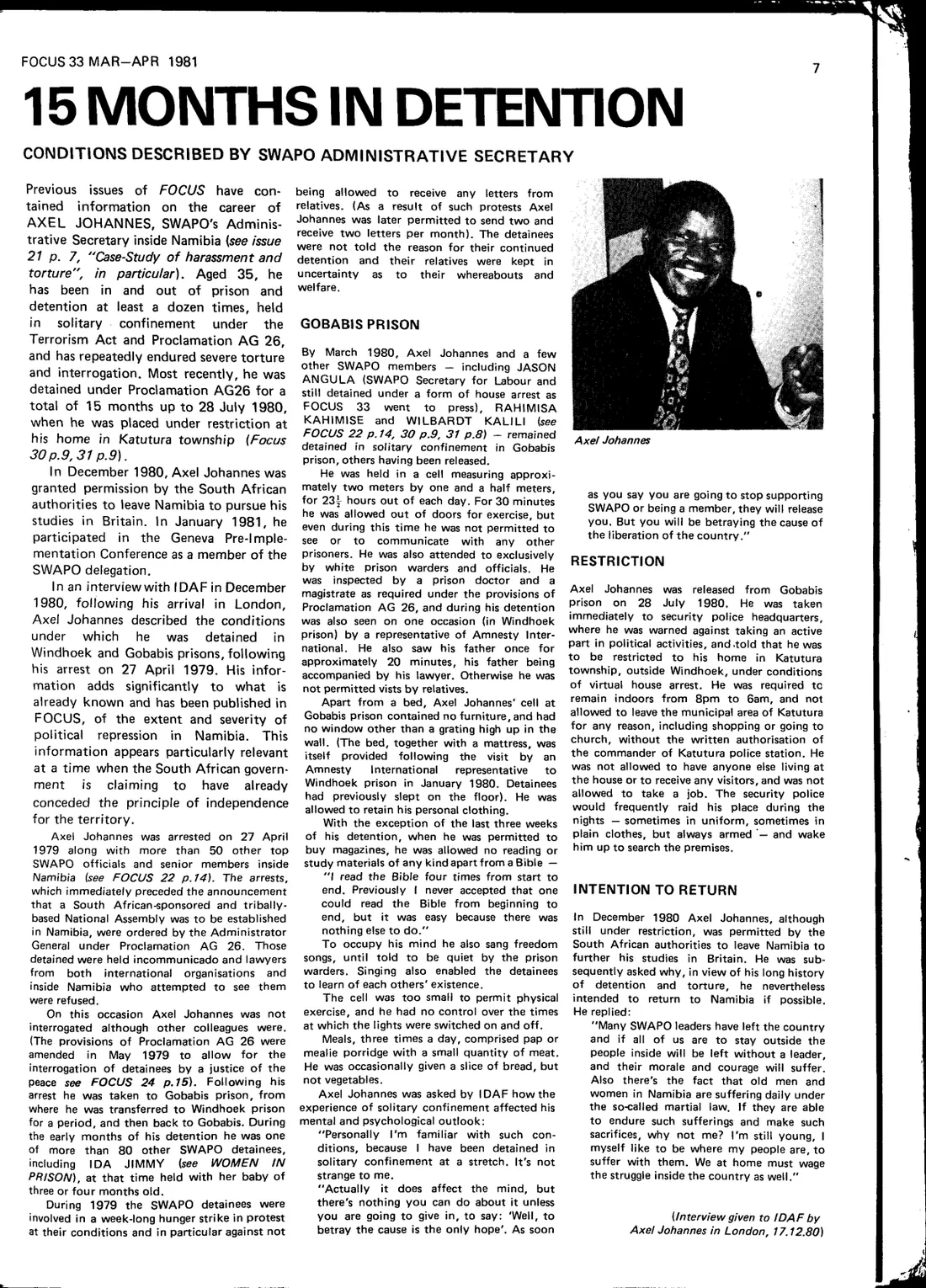
Previous issues of FOCUS have contained information on the career of AXEL JOHANNES, SWAPO's Administrative Secretary inside Namibia. Aged 35, he has been in and out of prison and detention at least a dozen times, held in solitary confinement under the Terrorism Act and Proclamation AG 26, and has repeatedly endured severe torture and interrogation. Most recently, he was detained under Proclamation AG26 for a total of 15 months up to 28 July 1980, when he was placed under restriction at his home in Katutura township.
In December 1980, Axel Johannes was granted permission by the South African authorities to leave Namibia to pursue his studies in Britain. In January 1981, he participated in the Geneva Pre-Implementation Conference as a member of the SWAPO delegation.
In an interview with IDAF in December 1980, following his arrival in London, Axel Johannes described the conditions under which he was detained in Windhoek and Gobabis prisons, following his arrest on 27 April 1979. His information adds significantly to what is already known and has been published in FOCUS, of the extent and severity of political repression in Namibia. This information appears particularly relevant at a time when the South African government is claiming to have already conceded the principle of independence for the territory.
Axel Johannes was arrested on 27 April 1979 along with more than 50 other top SWAPO officials and senior members inside Namibia. The arrests, which immediately preceded the announcement that a South African-sponsored and tribally-based National Assembly was to be established in Namibia, were ordered by the Administrator General under Proclamation AG 26. Those detained were held incomunicado and lawyers from both international organisations and inside Namibia who attempted to see them were refused.
On this occasion Axel Johannes was not interrogated although other colleagues were. Following his arrest he was taken to Gobabis prison, from where he was transferred to Windhoek prison for a period, and then back to Gobabis. During the early months of his detention he was one of more than 80 other SWAPO detainees, including IDA JIMMY, at that time held with her baby of three or four months old.
During 1979 the SWAPO detainees were involved in a week-long hunger strike in protest at their conditions and in particular against not being allowed to receive any letters from relatives. (As a result of such protests Axel Johannes was later permitted to send two and receive two letters per month). The detainees were not told the reason for their continued detention and their relatives were kept in uncertainty as to their whereabouts and welfare.
GOBABIS PRISON
By March 1980, Axel Johannes and a few other SWAPO members - including JASON ANGULA, RAHIMISA KAHIMISE and WILBARDT KALILI - remained detained in solitary confinement in Gobabis prison, others having been released.
He was held in a cell measuring approximately two meters by one and a half meters, for 23½ hours out of each day. For 30 minutes he was allowed out of doors for exercise, but even during this time he was not permitted to see or to communicate with any other prisoners. He was also attended to exclusively by white prison warders and officials. He was inspected by a prison doctor and a magistrate as required under the provisions of Proclamation AG 26, and during his detention was also seen on one occasion (in Windhoek prison) by a representative of Amnesty International. He also saw his father once for approximately 20 minutes, his father being accompanied by his lawyer. Otherwise he was not permitted vists by relatives.
Apart from a bed, Axel Johannes' cell at Gobabis prison contained no furniture, and had no window other than a grating high up in the wall. (The bed, together with a mattress, was itself provided following the visit by an Amnesty International representative to Windhoek prison in January 1980. Detainees had previously slept on the floor). He was allowed to retain his personal clothing.
With the exception of the last three weeks of his detention, when he was permitted to buy magazines, he was allowed no reading or study materials of any kind apart from a Bible -
"I read the Bible four times from start to end. Previously I never accepted that one could read the Bible from beginning to end, but it was easy because there was nothing else to do."
To occupy his mind he also sang freedom songs, until told to be quiet by the prison warders. Singing also enabled the detainees to learn of each others' existence.
The cell was too small to permit physical exercise, and he had no control over the times at which the lights were switched on and off.
Meals, three times a day, comprised pap or mealie porridge with a small quantity of meat. He was occasionally given a slice of bread, but not vegetables.
Axel Johannes was asked by IDAF how the experience of solitary confinement affected his mental and psychological outlook:
"Personally I'm familiar with such conditions, because I have been detained in solitary confinement at a stretch. It's not strange to me.
"Actually it does affect the mind, but there's nothing you can do about it unless you are going to give in, to say: 'Well, to betray the cause is the only hope'. As soon as you say you are going to stop supporting SWAPO or being a member, they will release you. But you will be betraying the cause of the liberation of the country."
RESTRICTION
Axel Johannes was released from Gobabis prison on 28 July 1980. He was taken immediately to security police headquarters, where he was warned against taking an active part in political activities, and told that he was to be restricted to his home in Katutura township, outside Windhoek, under conditions of virtual house arrest. He was required to remain indoors from 8pm to 6am, and not allowed to leave the municipal area of Katutura for any reason, including shopping or going to church, without the written authorisation of the commander of Katutura police station. He was not allowed to have anyone else living at the house or to receive any visitors, and was not allowed to take a job. The security police would frequently raid his place during the nights - sometimes in uniform, sometimes in plain clothes, but always armed - and wake him up to search the premises.
INTENTION TO RETURN
In December 1980 Axel Johannes, although still under restriction, was permitted by the South African authorities to leave Namibia to further his studies in Britain. He was subsequently asked why, in view of his long history of detention and torture, he nevertheless intended to return to Namibia if possible. He replied:
"Many SWAPO leaders have left the country and if all of us are to stay outside the people inside will be left without a leader, and their morale and courage will suffer. Also there's the fact that old men and women in Namibia are suffering daily under the so-called martial law. If they are able to endure such sufferings and make such sacrifices, why not me? I'm still young, I myself like to be where my people are, to suffer with them. We at home must wage the struggle inside the country as well."