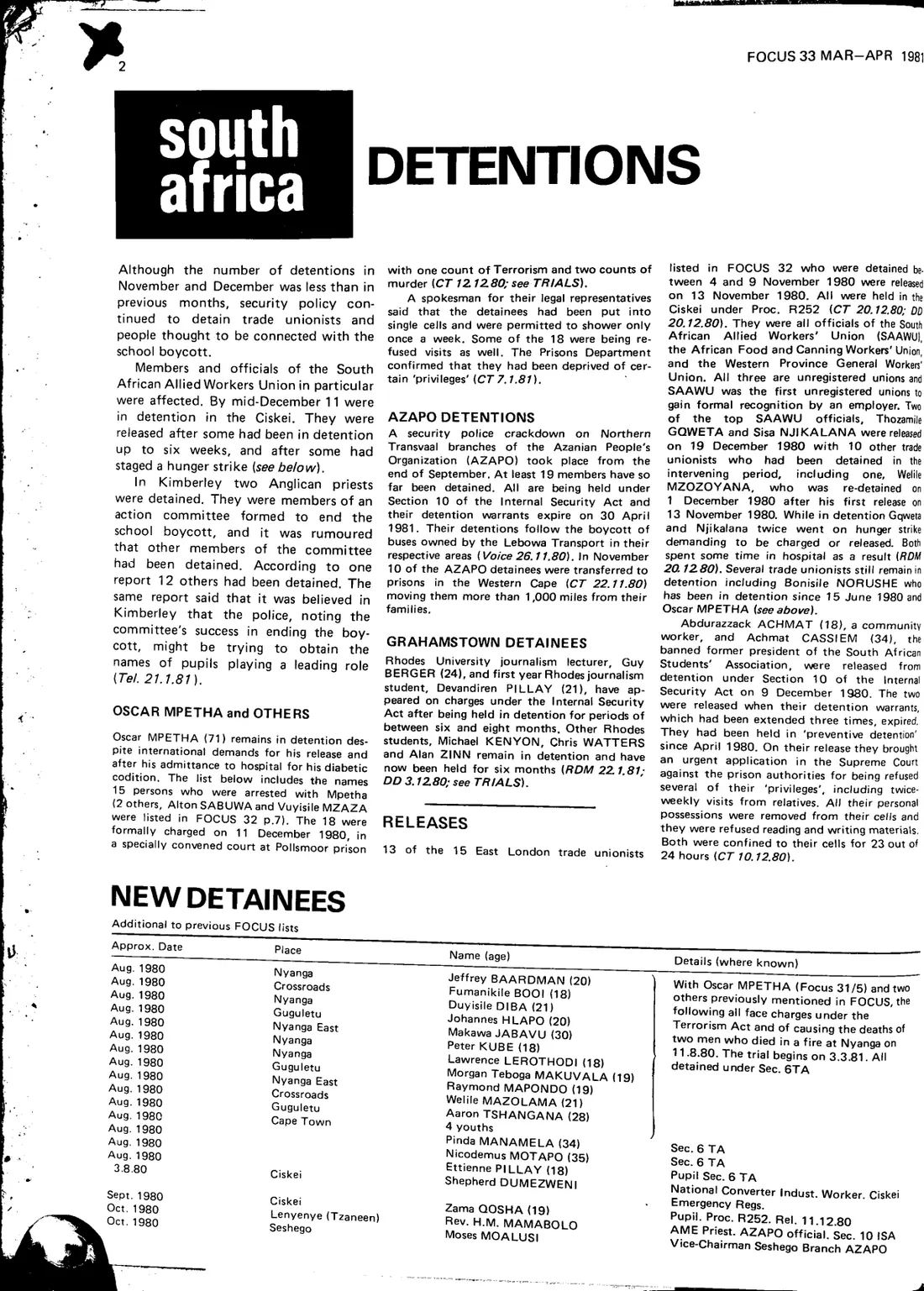
Although the number of detentions in November and December was less than in previous months, security policy continued to detain trade unionists and people thought to be connected with the school boycott.
Members and officials of the South African Allied Workers Union in particular were affected. By mid-December 11 were in detention in the Ciskei. They were released after some had been in detention up to six weeks, and after some had staged a hunger strike.
In Kimberley two Anglican priests were detained. They were members of an action committee formed to end the school boycott, and it was rumoured that other members of the committee had been detained. According to one report 12 others had been detained. The same report said that it was believed in Kimberley that the police, noting the committee's success in ending the boycott, might be trying to obtain the names of pupils playing a leading role.
OSCAR MPETHA and OTHERS
Oscar MPETHA (71) remains in detention despite international demands for his release and after his admittance to hospital for his diabetic codition. The list below includes the names 15 persons who were arrested with Mpetha (2 others, Alton SABUWA and Vuyisile MZAZA were listed in FOCUS 32 p.7). The 18 were formally charged on 11 December 1980, in a specially convened court at Pollsmoor prison with one count of Terrorism and two counts of murder.
A spokesman for their legal representatives said that the detainees had been put into single cells and were permitted to shower only once a week. Some of the 18 were being refused visits as well. The Prisons Department confirmed that they had been deprived of certain 'privileges'.
AZAPO DETENTIONS
A security police crackdown on Northern Transvaal branches of the Azanian People's Organization (AZAPO) took place from the end of September. At least 19 members have so far been detained. All are being held under Section 10 of the Internal Security Act and their detention warrants expire on 30 April 1981. Their detentions follow the boycott of buses owned by the Lebowa Transport in their respective areas. In November 10 of the AZAPO detainees were transferred to prisons in the Western Cape moving them more than 1,000 miles from their families.
GRAHAMSTOWN DETAINES
Rhodes University journalism lecturer, Guy BERGER (24), and first year Rhodes journalism student, Devandiren PILLAY (21), have appeared on charges under the Internal Security Act after being held in detention for periods of between six and eight months, Other Rhodes students, Michael KENYON, Chris WATTERS and Alan ZINN remain in detention and have now been held for six months.
RELEASES
13 of the 15 East London trade unionists listed in FOCUS 32 who were detained between 4 and 9 November 1980 were released on 13 November 1980. All were held in the Ciskei under Proc. R252. They were all officials of the South African Allied Workers' Union (SAAWU), the African Food and Canning Workers' Union, and the Western Province General Workers' Union. All three are unregistered unions and SAAWU was the first unregistered unions to gain formal recognition by an employer. Two of the top SAAWU officials, Thozamile GQWETA and Sisa NJIKALANA were released on 19 December 1980 with 10 other trade unionists who had been detained in the intervening period, including one, Welile MZOZOYANA, who was re-detained on 1 December 1980 after his first release on 13 November 1980. While in detention Gqweta and Njikalana twice went on hunger strike demanding to be charged or released. Both spent some time in hospital as a result. Several trade unionists still remain in detention including Bonisile NORUSHE who has been in detention since 15 June 1980 and Oscar MPETHA.
Abdurazzack ACHMAT (18), a community worker, and Achmat CASSIEM (34), the banned former president of the South African Students' Association, were released from detention under Section 10 of the Internal Security Act on 9 December 1980. The two were released when their detention warrants, which had been extended three times, expired. They had been held in 'preventive detention' since April 1980. On their release they brought an urgent application in the Supreme Court against the prison authorities for being refused several of their 'privileges', including twice-weekly visits from relatives. All their personal possessions were removed from their cells and they were refused reading and writing materials. Both were confined to their cells for 23 out of 24 hours.