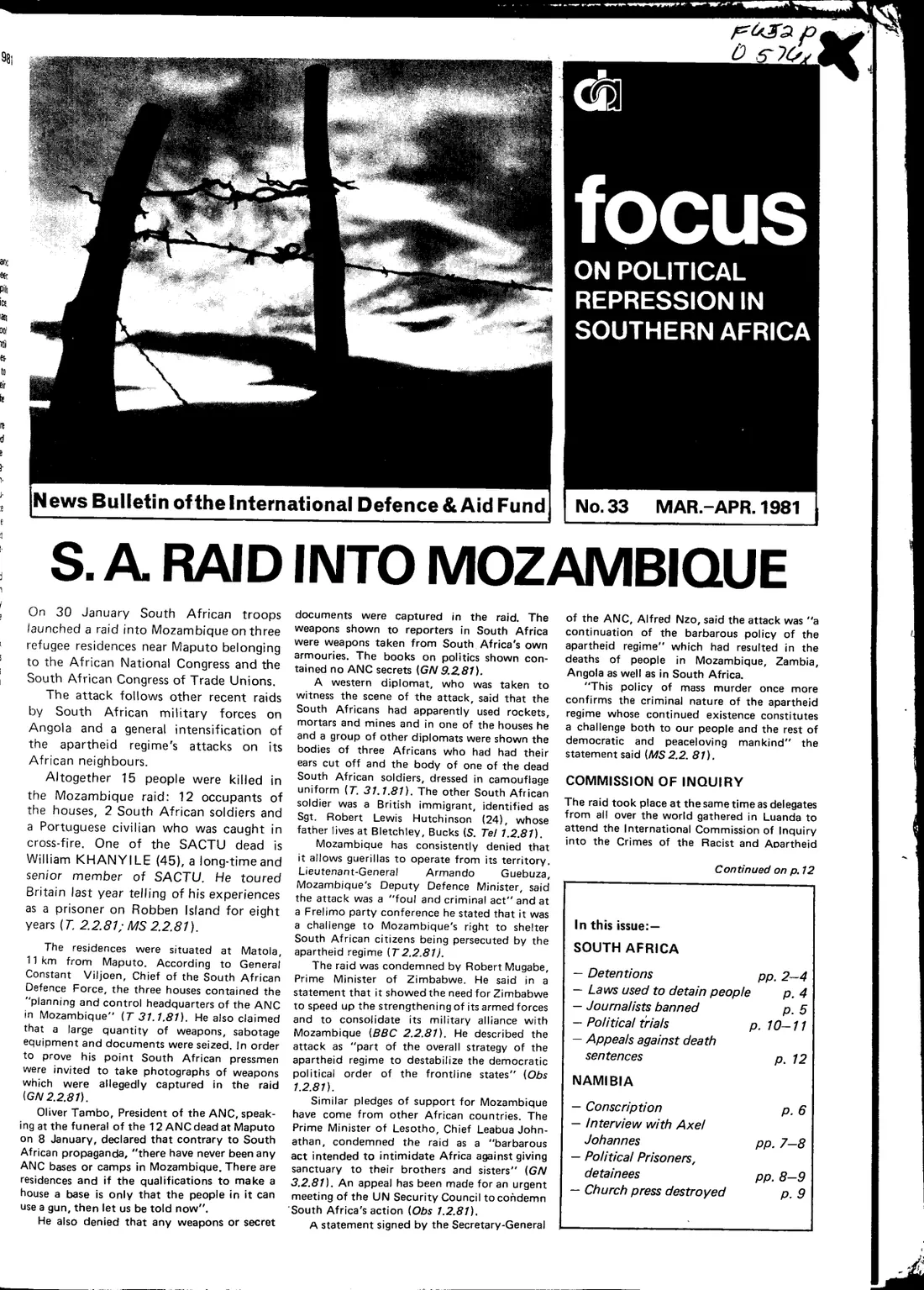
On 30 January South African troops launched a raid into Mozambique on three refugee residences near Maputo belonging to the African National Congress and the South African Congress of Trade Unions.
The attack follows other recent raids by South African military forces on Angola and a general intensification of the apartheid regime's attacks on its African neighbours.
Altogether 15 people were killed in the Mozambique raid: 12 occupants of the houses, 2 South African soldiers and a Portuguese civilian who was caught in cross-fire. One of the SACTU dead is William KHANYILE (45), a long-time and senior member of SACTU. He toured Britain last year telling of his experiences as a prisoner on Robben Island for eight years.
The residences were situated at Matola, 11 km from Maputo. According to General Constant Viljoen, Chief of the South African Defence Force, the three houses contained the "planning and control headquarters of the ANC in Mozambique". He also claimed that a large quantity of weapons, sabotage equipment and documents were seized. In order to prove his point South African pressmen were invited to take photographs of weapons which were allegedly captured in the raid.
Oliver Tambo, President of the ANC, speaking at the funeral of the 12 ANC dead at Maputo on 8 January, declared that contrary to South African propaganda, "there have never been any ANC bases or camps in Mozambique. There are residences and if the qualifications to make a house a base is only that the people in it can use a gun, then let us be told now".
He also denied that any weapons or secret documents were captured in the raid. The weapons shown to reporters in South Africa were weapons taken from South Africa's own armouries. The books on politics shown contained no ANC secrets.
A western diplomat, who was taken to witness the scene of the attack, said that the South Africans had apparently used rockets, mortars and mines and in one of the houses he and a group of other diplomats were shown the bodies of three Africans who had had their ears cut off and the body of one of the dead South African soldiers, dressed in camouflage uniform. The other South African soldier was a British immigrant, identified as Sgt. Robert Lewis Hutchinson (24), whose father lives at Bletchley, Bucks.
Mozambique has consistently denied that it allows guerillas to operate from its territory. Lieutenant-General Armando Guebuza, Mozambique's Deputy Defence Minister, said the attack was a "foul and criminal act" and at a Frelimo party conference he stated that it was a challenge to Mozambique's right to shelter South African citizens being persecuted by the apartheid regime.
The raid was condemned by Robert Mugabe, Prime Minister of Zimbabwe. He said in a statement that it showed the need for Zimbabwe to speed up the strengthening of its armed forces and to consolidate its military alliance with Mozambique. He described the attack as "part of the overall strategy of the apartheid regime to destabilize the democratic political order of the frontline states".
Similar pledges of support for Mozambique have come from other African countries. The Prime Minister of Lesotho, Chief Leabua John-athan, condemned the raid as a "barbarous act intended to intimidate Africa against giving sanctuary to their brothers and sisters". An appeal has been made for an urgent meeting of the UN Security Council to condemn South Africa's action.
A statement signed by the Secretary-General of the ANC, Alfred Nzo, said the attack was "a continuation of the barbarous policy of the apartheid regime" which had resulted in the deaths of people in Mozambique, Zambia, Angola as well as in South Africa.
"This policy of mass murder once more confirms the criminal nature of the apartheid regime whose continued existence constitutes a challenge both to our people and the rest of democratic and peaceloving mankind" the statement said.
COMMISSION OF INQUIRY
The raid took place at the same time as delegates from all over the world gathered in Luanda to attend the International Commission of Inquiry into the Crimes of the Racist and Apartheid Regime of South Africa. The Commission of Inquiry is being held to take evidence of South African aggression against frontline states.
Addressing the opening session, Henrique Santos, secretary for juridical affairs of the MPLA Workers' Party Central Committee, said that in a period of only three years Angola's sovereignty and integrity had been violated about 1,400 times by South African aircraft carrying out reconnaissance flights. During the same period South African troops had carried out 290 bombing attacks, 50 helicopter-borne troop landings and 40 ground attacks. South African attacks on Angola since 1975 had caused damage estimated at 7,000 million dollars. He reaffirmed his country's support for the South African and Namibian peoples.
The proceedings of the Inquiry include visits by the Commission to areas of Angola which have been under attack by South African forces. A team of observers were taken on a visit to the Cuamato area where they walked through a village that was napalmed on 15 January — the day of the collapse of the Geneva talks on the future of Namibia.