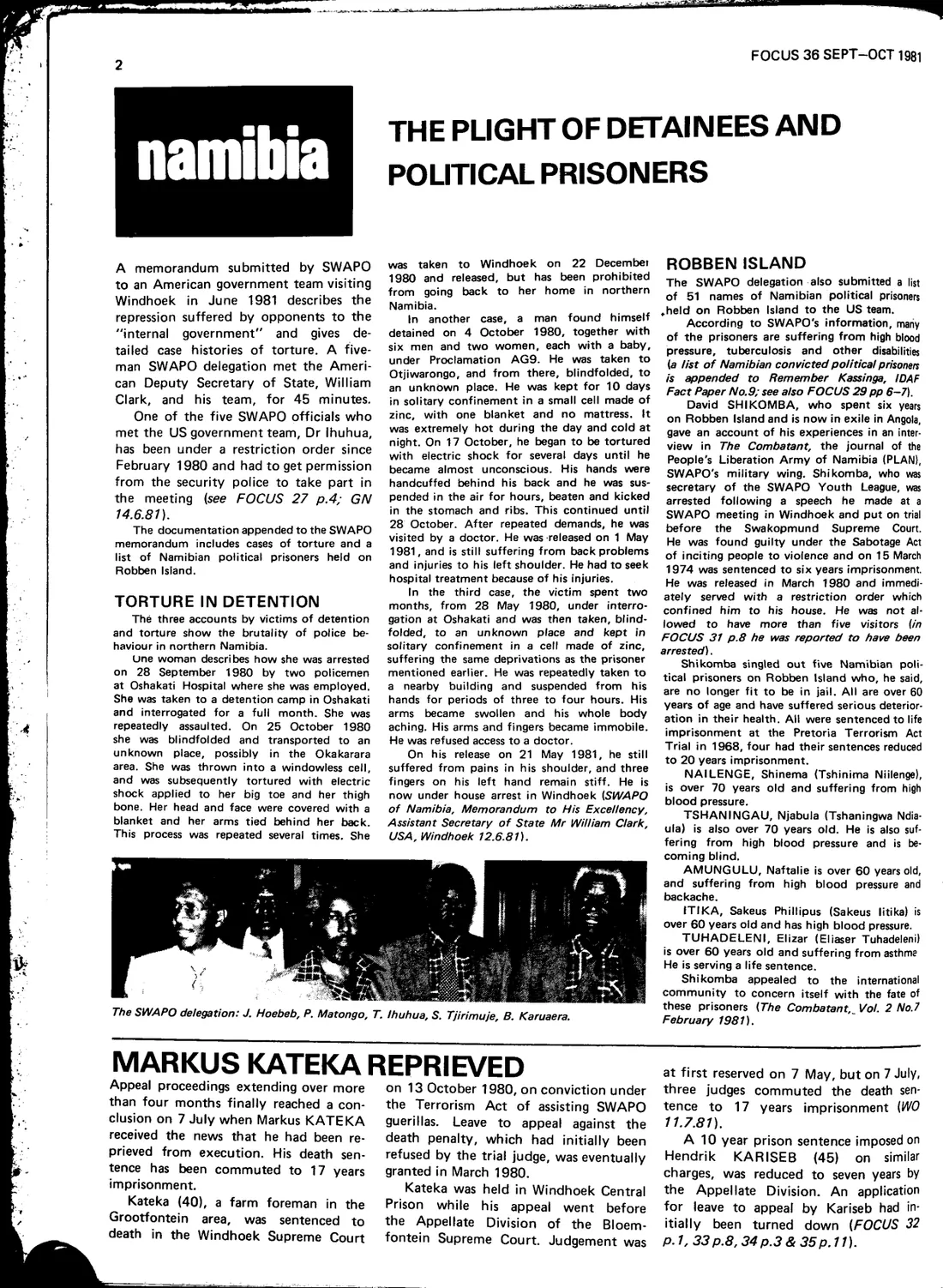
A memorandum submitted by SWAPO to an American government team visiting Windhoek in June 1981 describes the repression suffered by opponents to the "internal government" and gives detailed case histories of torture. A five-man SWAPO delegation met the American Deputy Secretary of State, William Clark, and his team, for 45 minutes.
One of the five SWAPO officials who met the US government team, Dr Ihuhua, has been under a restriction order since February 1980 and had to get permission from the security police to take part in the meeting.
The documentation appended to the SWAPO memorandum includes cases of torture and a list of Namibian political prisoners held on Robben Island.
TORTURE IN DETENTION The three accounts by victims of detention and torture show the brutality of police behaviour in northern Namibia.
One woman describes how she was arrested on 28 September 1980 by two policemen at Oshakati Hospital where she was employed. She was taken to a detention camp in Oshakati and interrogated for a full month. She was repeatedly assaulted. On 25 October 1980 she was blindfolded and transported to an unknown place, possibly in the Okakarara area. She was thrown into a windowless cell, and was subsequently tortured with electric shock applied to her big toe and her thigh bone. Her head and face were covered with a blanket and her arms tied behind her back. This process was repeated several times. She was taken to Windhoek on 22 December 1980 and released, but has been prohibited from going back to her home in northern Namibia.
In another case, a man found himself detained on 4 October 1980, together with six men and two women, each with a baby, under Proclamation AG9. He was taken to Otjiwarongo, and from there, blindfolded, to an unknown place. He was kept for 10 days in solitary confinement in a small cell made of zinc, with one blanket and no mattress. It was extremely hot during the day and cold at night. On 17 October, he began to be tortured with electric shock for several days until he became almost unconscious. His hands were handcuffed behind his back and he was suspended in the air for hours, beaten and kicked in the stomach and ribs. This continued until 28 October. After repeated demands, he was visited by a doctor. He was released on 1 May 1981, and is still suffering from back problems and injuries to his left shoulder. He had to seek hospital treatment because of his injuries.
In the third case, the victim spent two months, from 28 May 1980, under interrogation at Oshakati and was then taken, blindfolded, to an unknown place and kept in solitary confinement in a cell made of zinc, suffering the same deprivations as the prisoner mentioned earlier. He was repeatedly taken to a nearby building and suspended from his hands for periods of three to four hours. His arms became swollen and his whole body aching. His arms and fingers became immobile. He was refused access to a doctor.
On his release on 21 May 1981, he still suffered from pains in his shoulder, and three fingers on his left hand remain stiff. He is now under house arrest in Windhoek.
ROBBEN ISLAND The SWAPO delegation also submitted a list of 51 names of Namibian political prisoners held on Robben Island to the US team.
According to SWAPO's information, many of the prisoners are suffering from high blood pressure, tuberculosis and other disabilities.
David SHIKOMBA, who spent six years on Robben Island and is now in exile in Angola, gave an account of his experiences in an interview in The Combatant, the journal of the People's Liberation Army of Namibia (PLAN), SWAPO's military wing. Shikomba, who was secretary of the SWAPO Youth League, was arrested following a speech he made at a SWAPO meeting in Windhoek and put on trial before the Swakopmund Supreme Court. He was found guilty under the Sabotage Act of inciting people to violence and on 15 March 1974 was sentenced to six years imprisonment. He was released in March 1980 and immediately served with a restriction order which confined him to his house. He was not allowed to have more than five visitors.
Shikomba singled out five Namibian political prisoners on Robben Island who, he said, are no longer fit to be in jail. All are over 60 years of age and have suffered serious deterioration in their health. All were sentenced to life imprisonment at the Pretoria Terrorism Act Trial in 1968, four had their sentences reduced to 20 years imprisonment.
NAILENGE, Shinema (Tshinima Niilenge), is over 70 years old and suffering from high blood pressure.
TSHANINGAU, Njabula (Tshaningwa Ndiaula) is also over 70 years old. He is also suffering from high blood pressure and is becoming blind.
AMUNGULU, Naftalie is over 60 years old, and suffering from high blood pressure and backache.
ITIKA, Sakeus Phillipus (Sakeus litika) is over 60 years old and has high blood pressure.
TUHADELENI, Elizar (Eliaser Tuhadeleni) is over 60 years old and suffering from asthma. He is serving a life sentence.
Shikomba appealed to the international community to concern itself with the fate of these prisoners.