GROWING OPPOSITION TO CISKEI "INDEPENDENCE"
REPRESSION IN A SOUTH AFRICAN BANTUSTAN
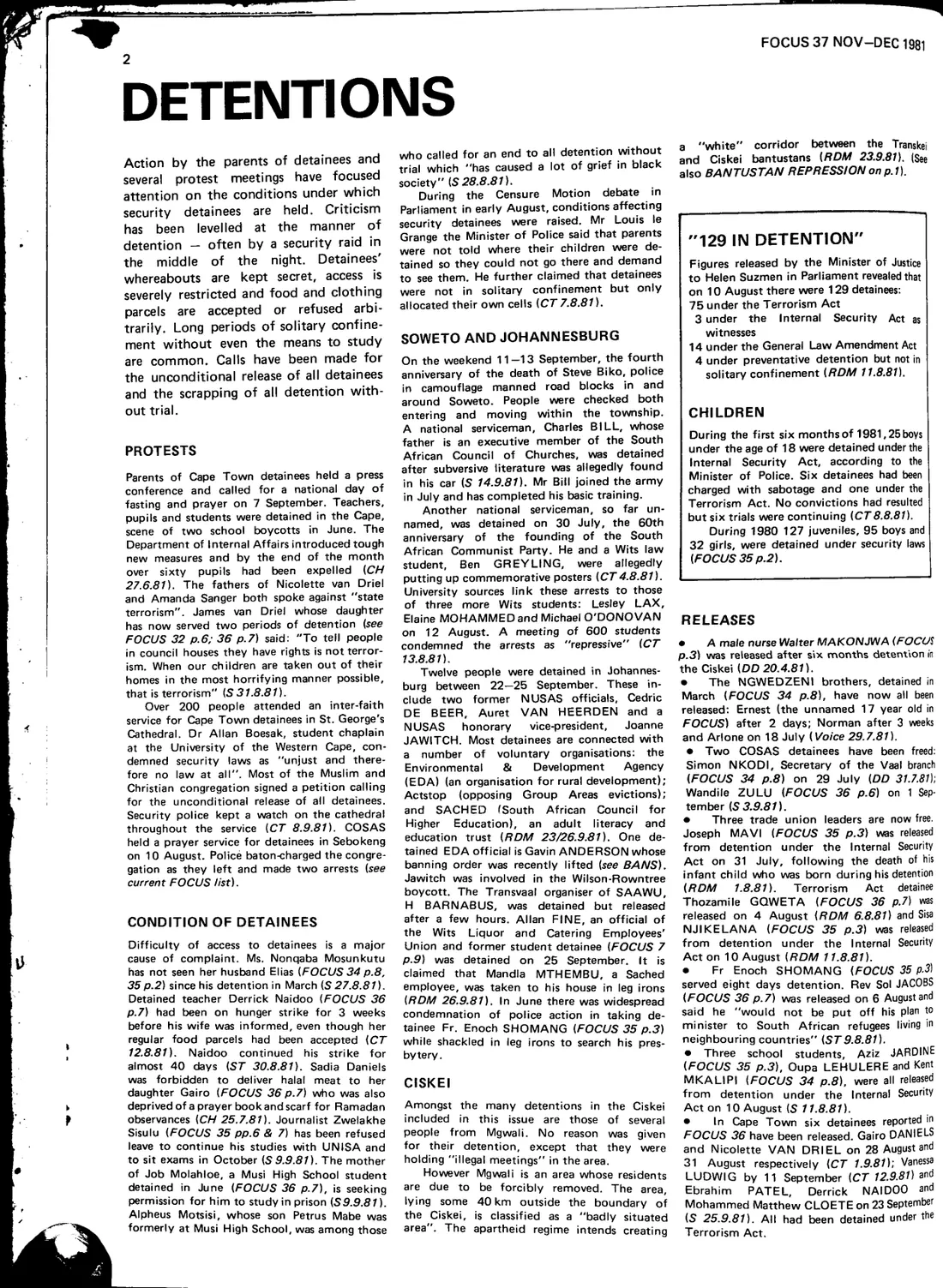
Mass detentions and other repressive actions, together with the plight of people forcibly removed from the Western Cape, has focussed attention on the Ciskei bantustan in the Eastern Cape. As the apartheid regime prepared with the cooperation of the bantustan leaders to impose "independence" on the area on 4 December and to declare another two million Africans "foreigners" in South Africa, there were growing signs of organised opposition to the move.
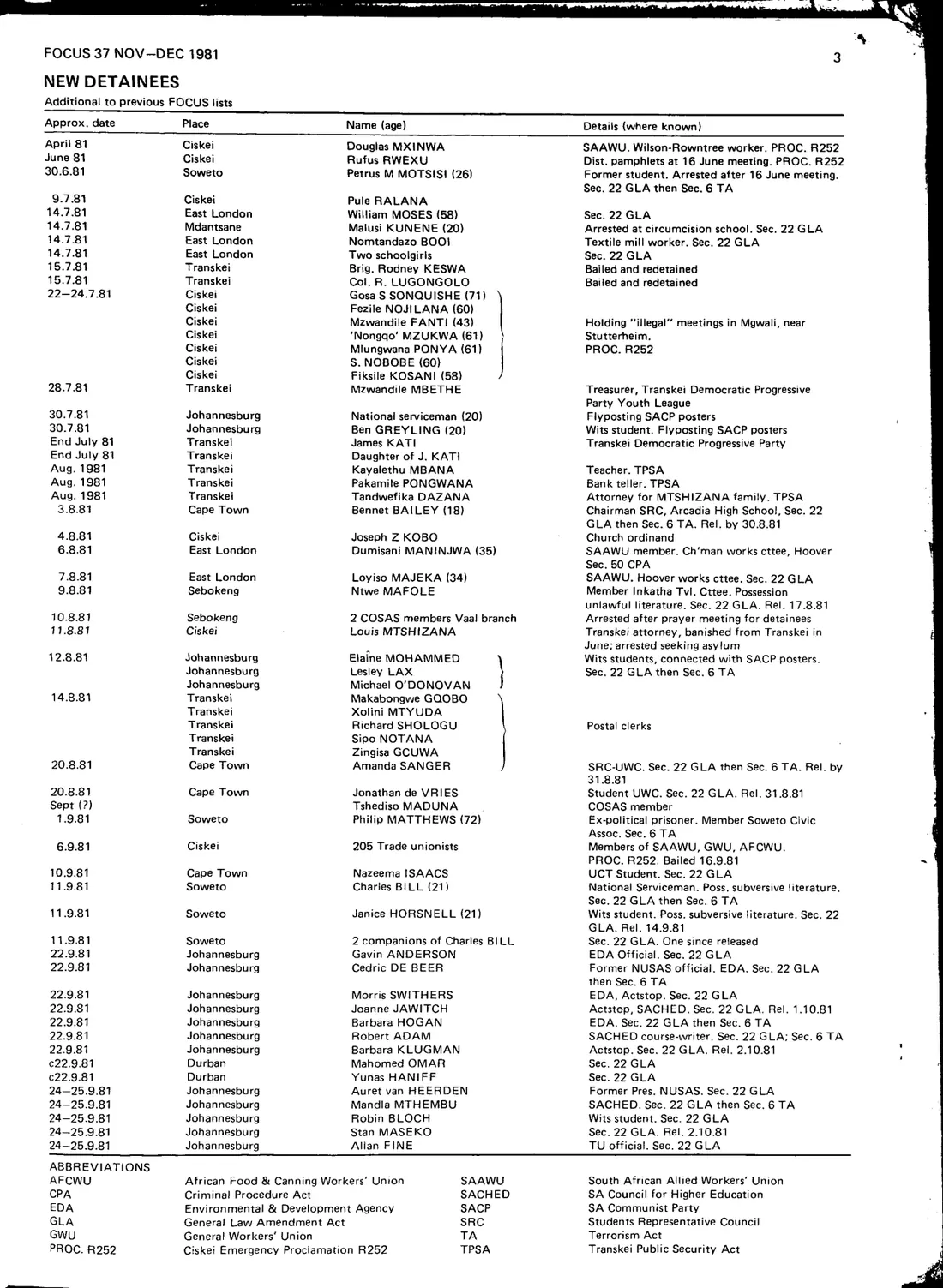
Already this year over 320 people have been detained under security laws which give the Ciskei bantustan authorities power to detain people without trial for up to three months. Last year the figure was at least 157 (SAIRR 1980 Survey; see DETENTIONS and previous issues of FOCUS).
During July, as well as declaring himself against trade unions, Chief Sebe, Chief Minister of the Ciskei, introduced a bill to curb the growth of new opposition parties. Parties with less than 10,000 members will be denied registration (FT 15.7.81).
At the same time Chief Sebe's brother who heads the Ciskean security forces, told the 141 Battalion when it arrived back from training at the South African army base at Lenz, that it had arrived at a critical time: "This is a time of upheaval in the Ciskei and it will be your duty to quell that upheaval" (Cit 9.7.81).
The great majority of those detained have been trade unionists, including 205 detained on 6 September. This mass detention marked an intensification of a sustained attack on trade unionists, in which the South African Allied Workers Union (SAAWU) has been most severely affected.
The 205 workers were arrested when returning to the township of Mdantsane after a meeting in East London, where they worked. Although Mdantsane is where most of East London's African workers live, and only a short distance from East London, it is formally part of the Ciskei territory. The Ciskean authorities have played a major part in the apartheid regime's attack on the rapidly growing trade union movement in the East London area.
The attack on SAAWU has also been a consequence of the union's forceful opposition to Ciskean "independence". At its conference in May the union declared its rejection of "the abhorrent system of bantustanisation which makes foreigners of us in the land of our birth" There is strong support for this position in Mdantsane (CT 11.5.81; DD 25.6.81; RDM 31.7.81).
The legislation to confer the status of "independence" on the Ciskei will have the consequence that Ciskei citizenship will be forced on all those whom apartheid policy declares belong to the Ciskei. Underdeveloped and impoverished, and acting as a labour pool for the Eastern Cape, the Ciskei has two thirds of its population living or working outside its borders (Star 9.8.81; GN 17.9.81).
Fears have been expressed that after December 4 the apartheid regime will make use of the immigration laws to evict people from "white" urban areas (see TOUGHER RACE LAWS).
Opposition to "independence" is strong. The Quail Commission, appointed by the Ciskean authorities themselves, found that 90 per cent of those who would be affected were in favour of universal adult suffrage in an unitary political system for the whole country. Although a large majority of those voting in a referendum on the issue voted for "independence", an observer, Prof Schlemmer of the University of Natal, concluded that a combination of fear and boycotts of the referendum produced the result, including "a veiled threat of possible imprisonment" for any who voted against it (SAIRR 1980 Survey pp. 402, 404).
Opposition to "independence" has taken a more organised form since July, when a new community organisation, the Border Civic Organisation (BCO) was founded. At a mass meeting of residents of Mdantsane and Duncan Village, attended by representatives of several organisations, rejection of Ciskeian "independence" was adopted as a policy.
Observers believe there is powerful and widespread support for the BCO, which also has the organized support of unions, including SAAWU.
Against this background it is believed that there will be growing opposition expressed to the "independence" due on 4 December (RDM 31.7.81).