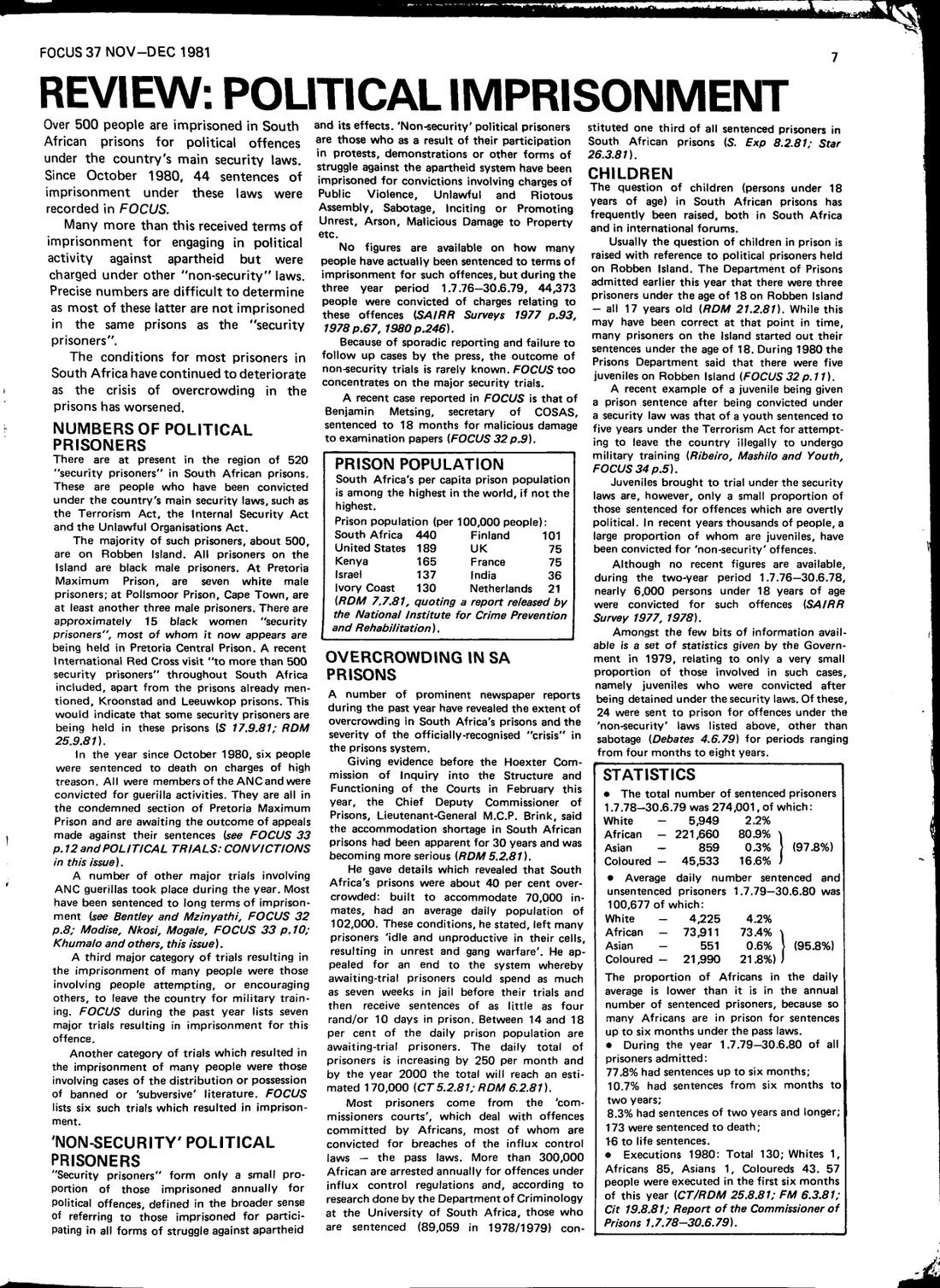
REVIEW: POLITICAL IMPRISONMENT
Over 500 people are imprisoned in South African prisons for political offences under the country's main security laws. Since October 1980, 44 sentences of imprisonment under these laws were recorded in FOCUS.
Many more than this received terms of imprisonment for engaging in political activity against apartheid but were charged under other "non-security" laws. Precise numbers are difficult to determine as most of these latter are not imprisoned in the same prisons as the "security prisoners".
The conditions for most prisoners in South Africa have continued to deteriorate as the crisis of overcrowding in the prisons has worsened.
NUMBERS OF POLITICAL PRISONERS
There are at present in the region of 520 "security prisoners" in South African prisons. These are people who have been convicted under the country's main security laws, such as the Terrorism Act, the Internal Security Act and the Unlawful Organisations Act.
The majority of such prisoners, about 500, are on Robben Island. All prisoners on the Island are black male prisoners. At Pretoria Maximum Prison, are seven white male prisoners; at Pollsmoor Prison, Cape Town, are at least another three male prisoners. There are approximately 15 black women "security prisoners", most of whom it now appears are being held in Pretoria Central Prison. A recent International Red Cross visit "to more than 500 security prisoners" throughout South Africa included, apart from the prisons already mentioned, Kroonstad and Leeuwkop prisons. This would indicate that some security prisoners are being held in these prisons (S 17.9.81; RDM 25.9.81).
In the year since October 1980, six people were sentenced to death on charges of high treason. All were members of the ANC and were convicted for guerilla activities. They are all in the condemned section of Pretoria Maximum Prison and are awaiting the outcome of appeals made against their sentences (see FOCUS 33 p.12 and POLITICAL TRIALS: CONVICTIONS in this issue).
A number of other major trials involving ANC guerillas took place during the year. Most have been sentenced to long terms of imprisonment (see Bentley and Mzinyathi, FOCUS 32 p.8; Modise, Nkosi, Mogale, FOCUS 33 p.10; Khumalo and others, this issue).
A third major category of trials resulting in the imprisonment of many people were those involving people attempting, or encouraging others, to leave the country for military training. FOCUS during the past year lists seven major trials resulting in imprisonment for this offence.
Another category of trials which resulted in the imprisonment of many people were those involving cases of the distribution or possession of banned or 'subversive' literature. FOCUS lists six such trials which resulted in imprisonment.
'NON-SECURITY' POLITICAL PRISONERS
"Security prisoners" form only a small proportion of those imprisoned annually for political offences, defined in the broader sense of referring to those imprisoned for participating in all forms of struggle against apartheid and its effects. 'Non-security' political prisoners are those who as a result of their participation in protests, demonstrations or other forms of struggle against the apartheid system have been imprisoned for convictions involving charges of Public Violence, Unlawful and Riotous Assembly, Sabotage, Inciting or Promoting Unrest, Arson, Malicious Damage to Property etc.
No figures are available on how many people have actually been sentenced to terms of imprisonment for such offences, but during the three year period 1.7.76–30.6.79, 44,373 people were convicted of charges relating to these offences (SAIRR Surveys 1977 p.93, 1978 p.67, 1980 p.246).
Because of sporadic reporting and failure to follow up cases by the press, the outcome of non-security trials is rarely known. FOCUS too concentrates on the major security trials.
A recent case reported in FOCUS is that of Benjamin Metsing, secretary of COSAS, sentenced to 18 months for malicious damage to examination papers (FOCUS 32 p.9).
PRISON POPULATION
South Africa's per capita prison population is among the highest in the world, if not the highest.
Prison population (per 100,000 people):
[Table omitted]
OVERCROWDING IN SA PRISONS
A number of prominent newspaper reports during the past year have revealed the extent of overcrowding in South Africa's prisons and the severity of the officially-recognised "crisis" in the prisons system.
Giving evidence before the Hoexter Commission of Inquiry into the Structure and Functioning of the Courts in February this year, the Chief Deputy Commissioner of Prisons, Lieutenant-General M.C.P. Brink, said the accommodation shortage in South African prisons had been apparent for 30 years and was becoming more serious (RDM 5.2.81).
He gave details which revealed that South Africa's prisons were about 40 per cent overcrowded: built to accommodate 70,000 inmates, had an average daily population of 102,000. These conditions, he stated, left many prisoners 'idle and unproductive in their cells, resulting in unrest and gang warfare'. He appealed for an end to the system whereby awaiting-trial prisoners could spend as much as seven weeks in jail before their trials and then receive sentences of as little as four rand/or 10 days in prison. Between 14 and 18 per cent of the daily prison population are awaiting-trial prisoners. The daily total of prisoners is increasing by 250 per month and by the year 2000 the total will reach an estimated 170,000 (CT 5.2.81; RDM 6.2.81).
Most prisoners come from the 'commissioners courts', which deal with offences committed by Africans, most of whom are convicted for breaches of the influx control laws — the pass laws. More than 300,000 Africans are arrested annually for offences under influx control regulations and, according to research done by the Department of Criminology at the University of South Africa, those who are sentenced (89,059 in 1978/1979) constituted one third of all sentenced prisoners in South African prisons (S. Exp 8.2.81; Star 26.3.81).
CHILDREN
The question of children (persons under 18 years of age) in South African prisons has frequently been raised, both in South Africa and in international forums.
Usually the question of children in prison is raised with reference to political prisoners held on Robben Island. The Department of Prisons admitted earlier this year that there were three prisoners under the age of 18 on Robben Island — all 17 years old (RDM 21.2.81). While this may have been correct at that point in time, many prisoners on the Island started out their sentences under the age of 18. During 1980 the Prisons Department said that there were five juveniles on Robben Island (FOCUS 32 p.11).
A recent example of a juvenile being given a prison sentence after being convicted under a security law was that of a youth sentenced to five years under the Terrorism Act for attempting to leave the country illegally to undergo military training (Ribeiro, Mashilo and Youth, FOCUS 34 p.5).
Juveniles brought to trial under the security laws are, however, only a small proportion of those sentenced for offences which are overtly political. In recent years thousands of people, a large proportion of whom are juveniles, have been convicted for 'non-security' offences.
Although no recent figures are available, during the two-year period 1.7.76–30.6.78, nearly 6,000 persons under 18 years of age were convicted for such offences (SAIRR Survey 1977, 1978).
Amongst the few bits of information available is a set of statistics given by the Government in 1979, relating to only a very small proportion of those involved in such cases, namely juveniles who were convicted after being detained under the security laws. Of these, 24 were sent to prison for offences under the 'non-security' laws listed above, other than sabotage (Debates 4.6.79) for periods ranging from four months to eight years.
STATISTICS
[Statistics omitted]