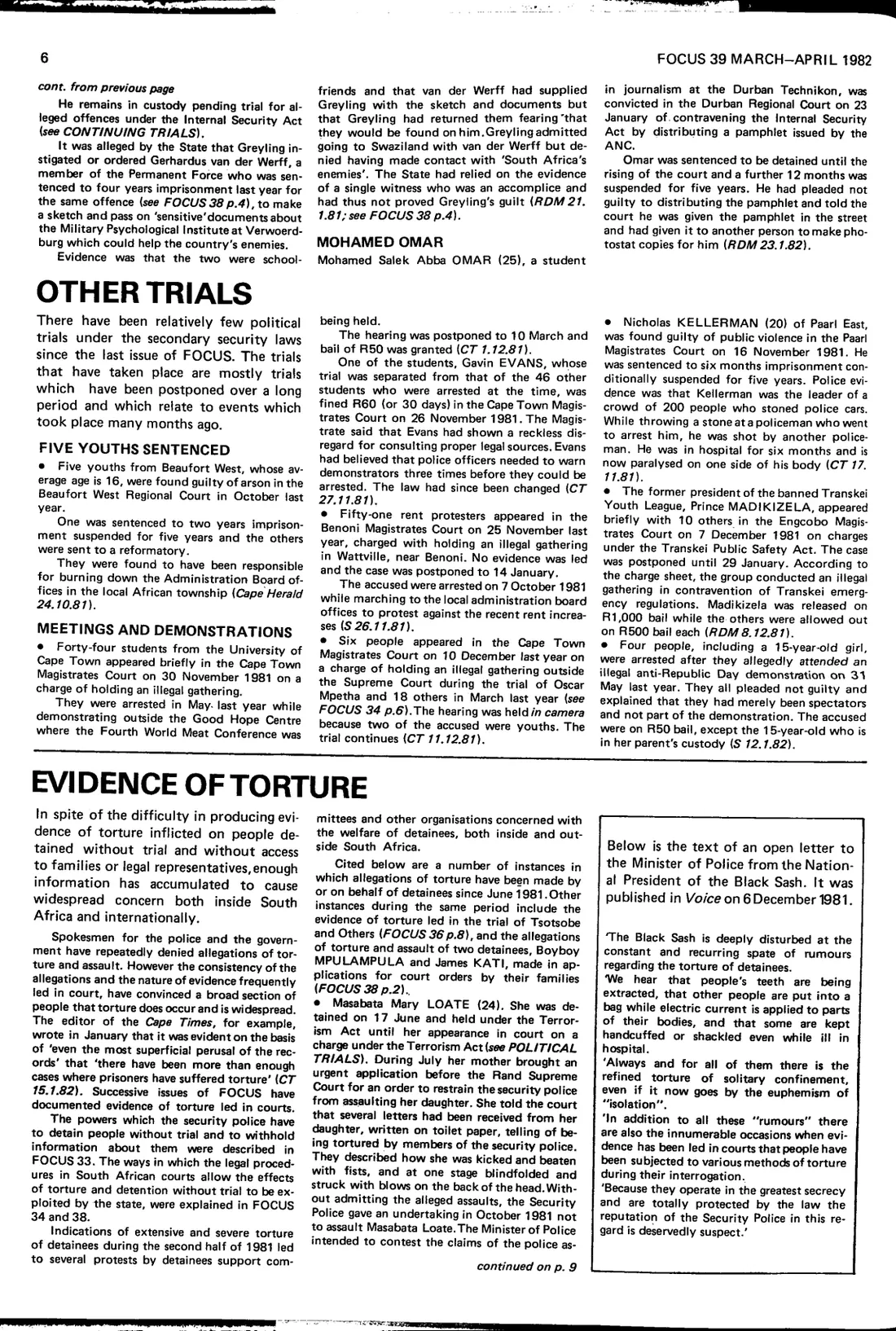
In spite of the difficulty in producing evidence of torture inflicted on people detained without trial and without access to families or legal representatives, enough information has accumulated to cause widespread concern both inside South Africa and internationally.
Spokesmen for the police and the government have repeatedly denied allegations of torture and assault. However the consistency of the allegations and the nature of evidence frequently led in court, have convinced a broad section of people that torture does occur and is widespread. The editor of the Cape Times, for example, wrote in January that it was evident on the basis of 'even the most superficial perusal of the records' that 'there have been more than enough cases where prisoners have suffered torture'. Successive issues of FOCUS have documented evidence of torture led in courts.
The powers which the security police have to detain people without trial and to withhold information about them were described in FOCUS 33. The ways in which the legal procedures in South African courts allow the effects of torture and detention without trial to be exploited by the state, were explained in FOCUS 34 and 38.
Indications of extensive and severe torture of detainees during the second half of 1981 led to several protests by detainees support committees and other organisations concerned with the welfare of detainees, both inside and outside South Africa.
Cited below are a number of instances in which allegations of torture have been made by or on behalf of detainees since June 1981. Other instances during the same period include the evidence of torture led in the trial of Tsotsobe and Others, and the allegations of torture and assault of two detainees, Boyboy MPULAMPULA and James KATI, made in applications for court orders by their families.
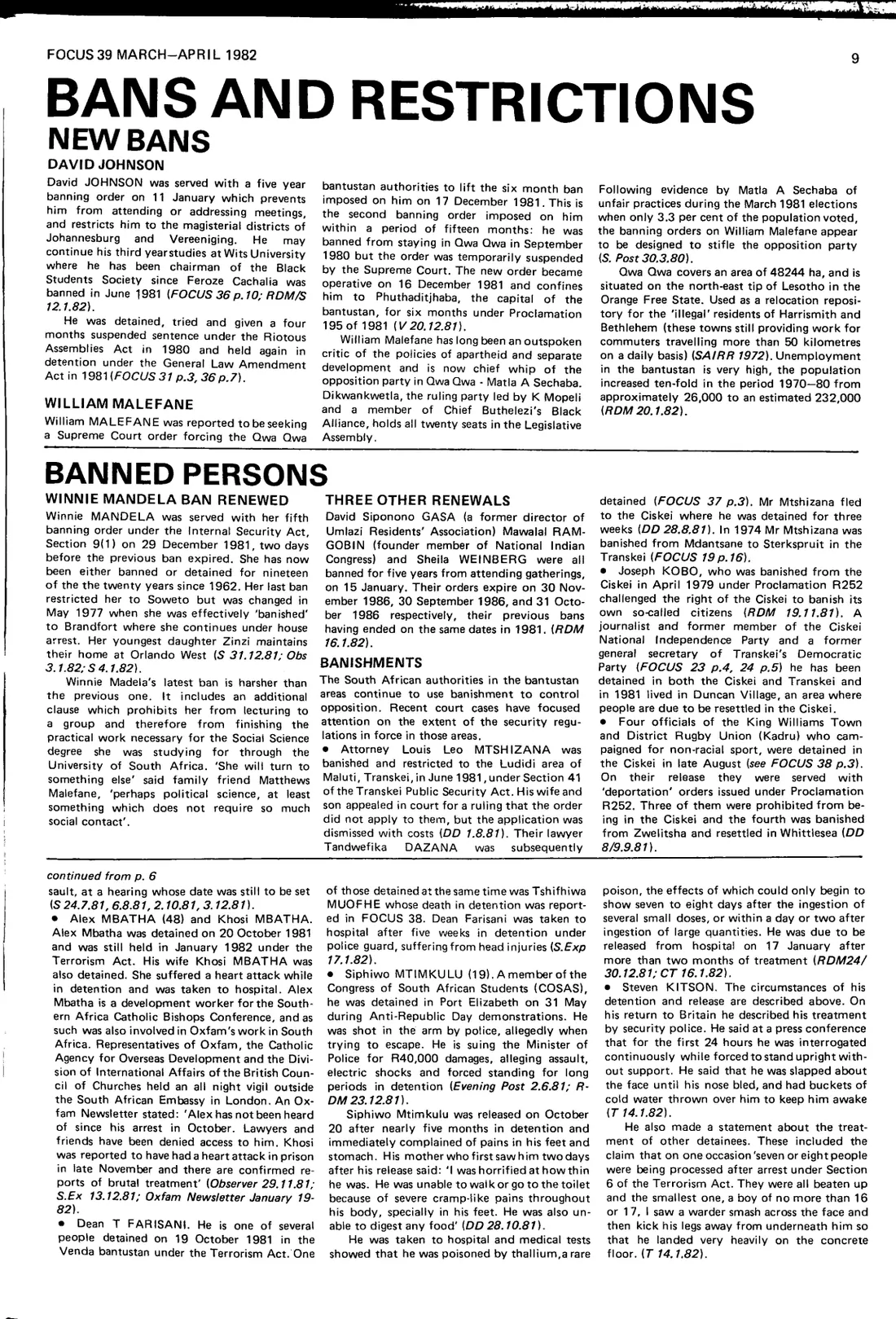
Masabata Mary LOATE (24). She was detained on 17 June and held under the Terrorism Act until her appearance in court on a charge under the Terrorism Act. During July her mother brought an urgent application before the Rand Supreme Court for an order to restrain the security police from assaulting her daughter. She told the court that several letters had been received from her daughter, written on toilet paper, telling of being tortured by members of the security police. They described how she was kicked and beaten with fists, and at one stage blindfolded and struck with blows on the back of the head. Without admitting the alleged assaults, the Security Police gave an undertaking in October 1981 not to assault Masabata Loate. The Minister of Police intended to contest the claims of the police assault, at a hearing whose date was still to be set.
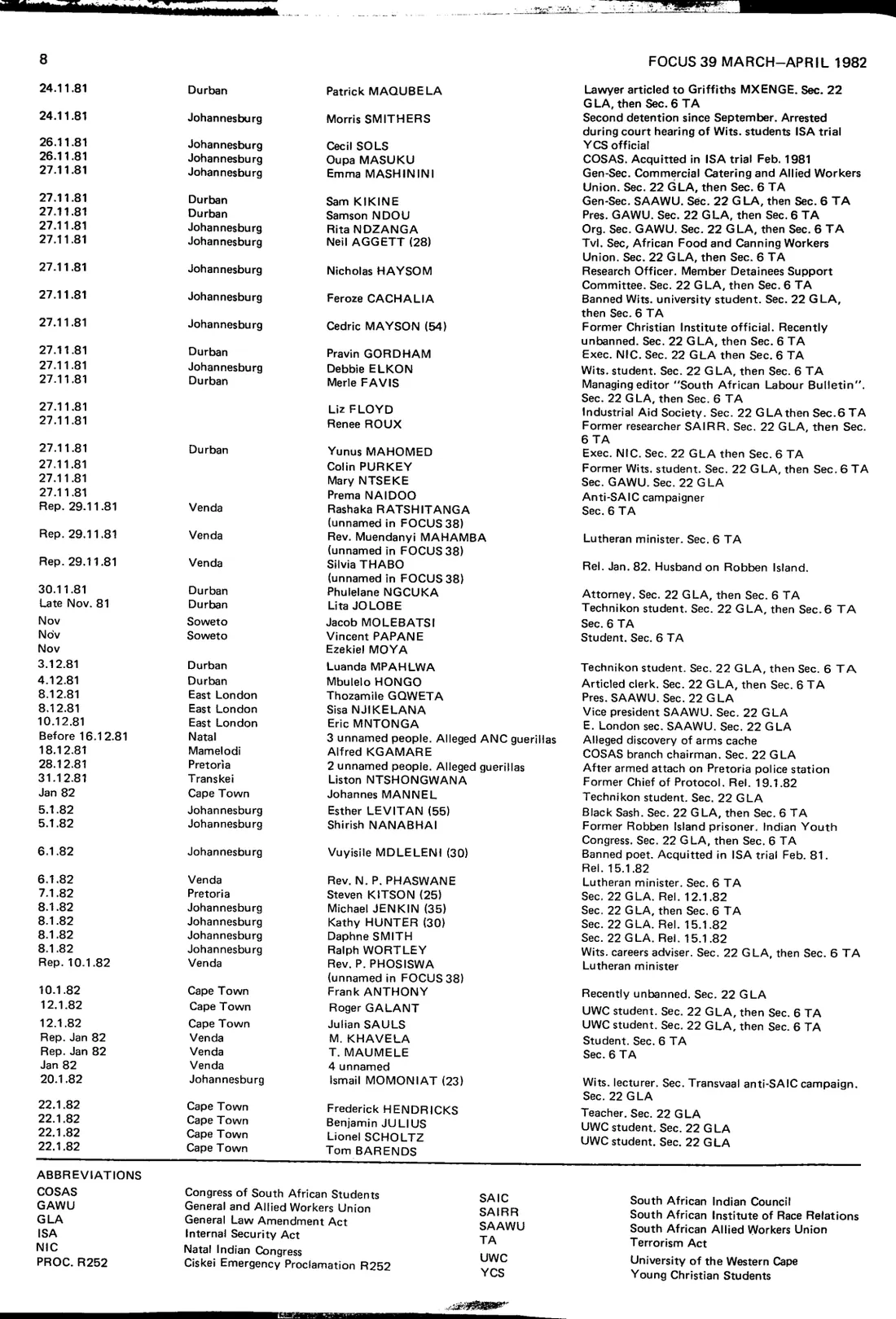
Alex MBATHA (48) and Khosi MBATHA. Alex Mbatha was detained on 20 October 1981 and was still held in January 1982 under the Terrorism Act. His wife Khosi MBATHA was also detained. She suffered a heart attack while in detention and was taken to hospital. Alex Mbatha is a development worker for the Southern Africa Catholic Bishops Conference, and as such was also involved in Oxfam's work in South Africa. Representatives of Oxfam, the Catholic Agency for Overseas Development and the Division of International Affairs of the British Council of Churches held an all night vigil outside the South African Embassy in London. An Oxfam Newsletter stated: 'Alex has not been heard of since his arrest in October. Lawyers and friends have been denied access to him. Khosi was reported to have had a heart attack in prison in late November and there are confirmed reports of brutal treatment'.
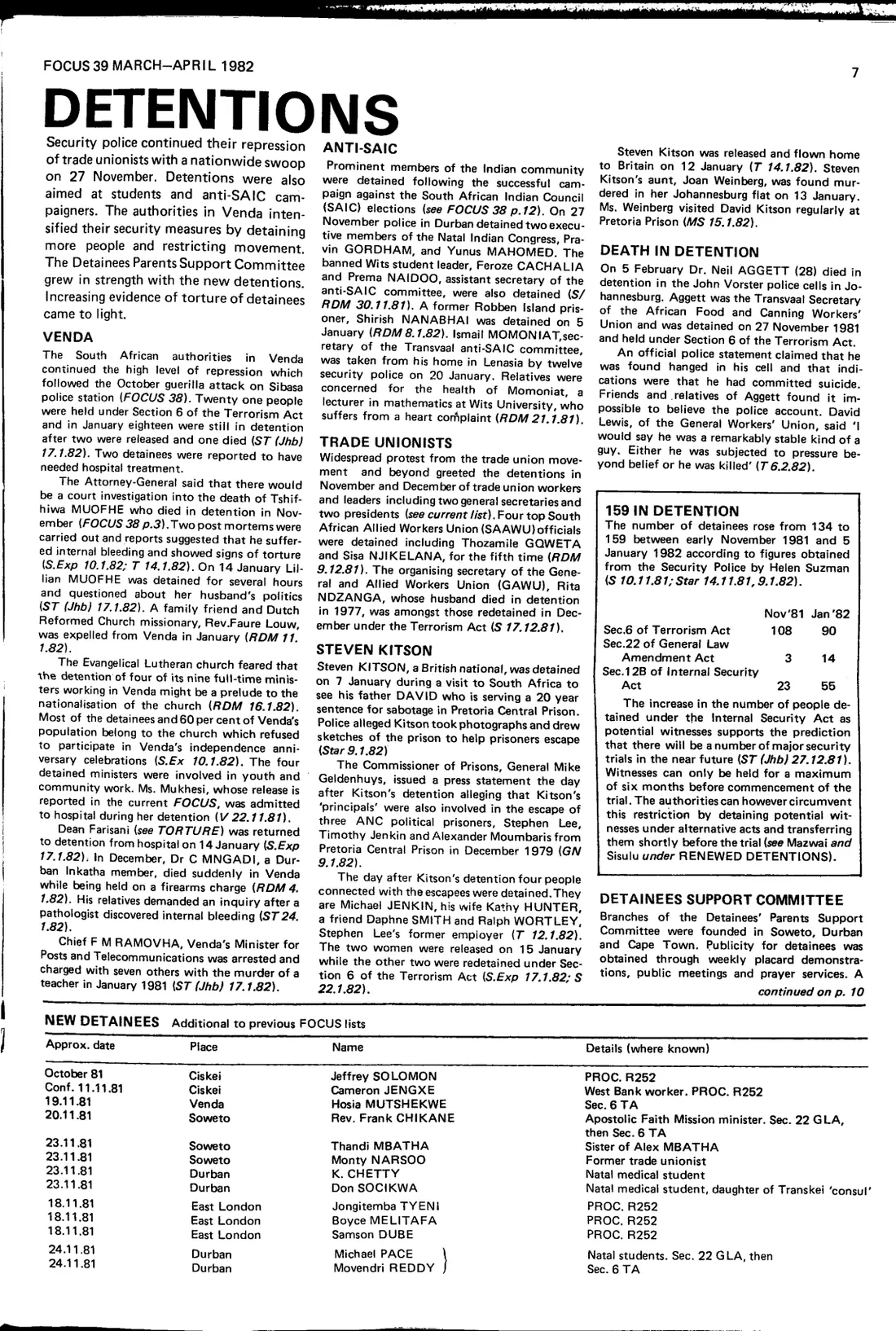
Dean T FARISANI. He is one of several people detained on 19 October 1981 in the Venda bantustan under the Terrorism Act. One of those detained at the same time was Tshifhiwa MUOFHE whose death in detention was reported in FOCUS 38. Dean Farisani was taken to hospital after five weeks in detention under police guard, suffering from head injuries.
Siphiwo MTIMKULU (19). A member of the Congress of South African Students (COSAS), he was detained in Port Elizabeth on 31 May during Anti-Republic Day demonstrations. He was shot in the arm by police, allegedly when trying to escape. He is suing the Minister of Police for R40,000 damages, alleging assault, electric shocks and forced standing for long periods in detention. Siphiwo Mtimkulu was released on October 20 after nearly five months in detention and immediately complained of pains in his feet and stomach. His mother who first saw him two days after his release said: 'I was horrified at how thin he was. He was unable to walk or go to the toilet because of severe cramp-like pains throughout his body, specially in his feet. He was also unable to digest any food'. He was taken to hospital and medical tests showed that he was poisoned by thallium, a rare poison, the effects of which could only begin to show seven to eight days after the ingestion of several small doses, or within a day or two after ingestion of large quantities. He was due to be released from hospital on 17 January after more than two months of treatment.
Steven KITSON. The circumstances of his detention and release are described above. On his return to Britain he described his treatment by security police. He said at a press conference that for the first 24 hours he was interrogated continuously while forced to stand upright without support. He said that he was slapped about the face until his nose bled, and had buckets of cold water thrown over him to keep him awake. He also made a statement about the treatment of other detainees. These included the claim that on one occasion 'seven or eight people were being processed after arrest under Section 6 of the Terrorism Act. They were all beaten up and the smallest one, a boy of no more than 16 or 17, I saw a warder smash across the face and then kick his legs away from underneath him so that he landed very heavily on the concrete floor.'
Below is the text of an open letter to the Minister of Police from the National President of the Black Sash. It was published in Voice on 6 December 1981.
'The Black Sash is deeply disturbed at the constant and recurring spate of rumours regarding the torture of detainees.
'We hear that people's teeth are being extracted, that other people are put into a bag while electric current is applied to parts of their bodies, and that some are kept handcuffed or shackled even while ill in hospital.
'Always and for all of them there is the refined torture of solitary confinement, even if it now goes by the euphemism of "isolation".
'In addition to all these "rumours" there are also the innumerable occasions when evidence has been led in courts that people have been subjected to various methods of torture during their interrogation.
'Because they operate in the greatest secrecy and are totally protected by the law the reputation of the Security Police in this regard is deservedly suspect.'