TERRORISM ACT
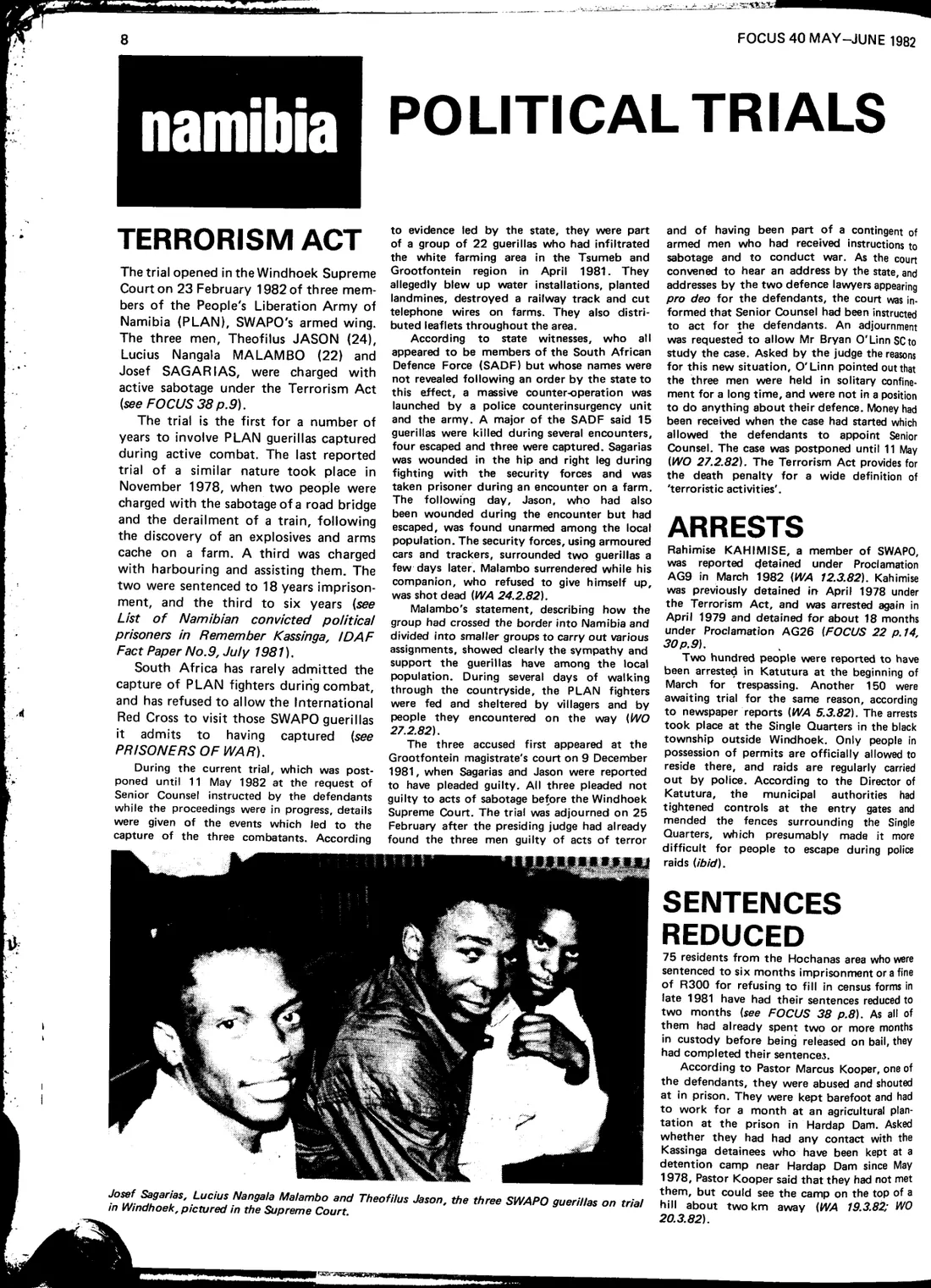
The trial opened in the Windhoek Supreme Court on 23 February 1982 of three members of the People's Liberation Army of Namibia (PLAN), SWAPO's armed wing. The three men, Theofilus JASON (24), Lucius Nangala MALAMBO (22) and Josef SAGARIAS, were charged with active sabotage under the Terrorism Act.
The trial is the first for a number of years to involve PLAN guerillas captured during active combat. The last reported trial of a similar nature took place in November 1978, when two people were charged with the sabotage of a road bridge and the derailment of a train, following the discovery of an explosives and arms cache on a farm. A third was charged with harbouring and assisting them. The two were sentenced to 18 years imprisonment, and the third to six years.
South Africa has rarely admitted the capture of PLAN fighters during combat, and has refused to allow the International Red Cross to visit those SWAPO guerillas it admits to having captured.
During the current trial, which was postponed until 11 May 1982 at the request of Senior Counsel instructed by the defendants while the proceedings were in progress, details were given of the events which led to the capture of the three combatants. According to evidence led by the state, they were part of a group of 22 guerillas who had infiltrated the white farming area in the Tsumeb and Grootfontein region in April 1981. They allegedly blew up water installations, planted landmines, destroyed a railway track and cut telephone wires on farms. They also distributed leaflets throughout the area.
According to state witnesses, who all appeared to be members of the South African Defence Force (SADF) but whose names were not revealed following an order by the state to this effect, a massive counter-operation was launched by a police counterinsurgency unit and the army. A major of the SADF said 15 guerillas were killed during several encounters, four escaped and three were captured. Sagarias was wounded in the hip and right leg during fighting with the security forces and was taken prisoner during an encounter on a farm. The following day, Jason, who had also been wounded during the encounter but had escaped, was found unarmed among the local population. The security forces, using armoured cars and trackers, surrounded two guerillas a few days later. Malambo surrendered while his companion, who refused to give himself up, was shot dead.
Malambo's statement, describing how the group had crossed the border into Namibia and divided into smaller groups to carry out various assignments, showed clearly the sympathy and support the guerillas have among the local population. During several days of walking through the countryside, the PLAN fighters were fed and sheltered by villagers and by people they encountered on the way.
The three accused first appeared at the Grootfontein magistrate's court on 9 December 1981, when Sagarias and Jason were reported to have pleaded guilty. All three pleaded not guilty to acts of sabotage before the Windhoek Supreme Court. The trial was adjourned on 25 February after the presiding judge had already found the three men guilty of acts of terror and of having been part of a contingent of armed men who had received instructions to sabotage and to conduct war. As the court convened to hear an address by the state, and addresses by the two defence lawyers appearing pro deo for the defendants, the court was informed that Senior Counsel had been instructed to act for the defendants. An adjournment was requested to allow Mr Bryan O'Linn SC to study the case. Asked by the judge the reasons for this new situation, O'Linn pointed out that the three men were held in solitary confinement for a long time, and were not in a position to do anything about their defence. Money had been received when the case had started which allowed the defendants to appoint Senior Counsel. The case was postponed until 11 May. The Terrorism Act provides for the death penalty for a wide definition of 'terroristic activities'.