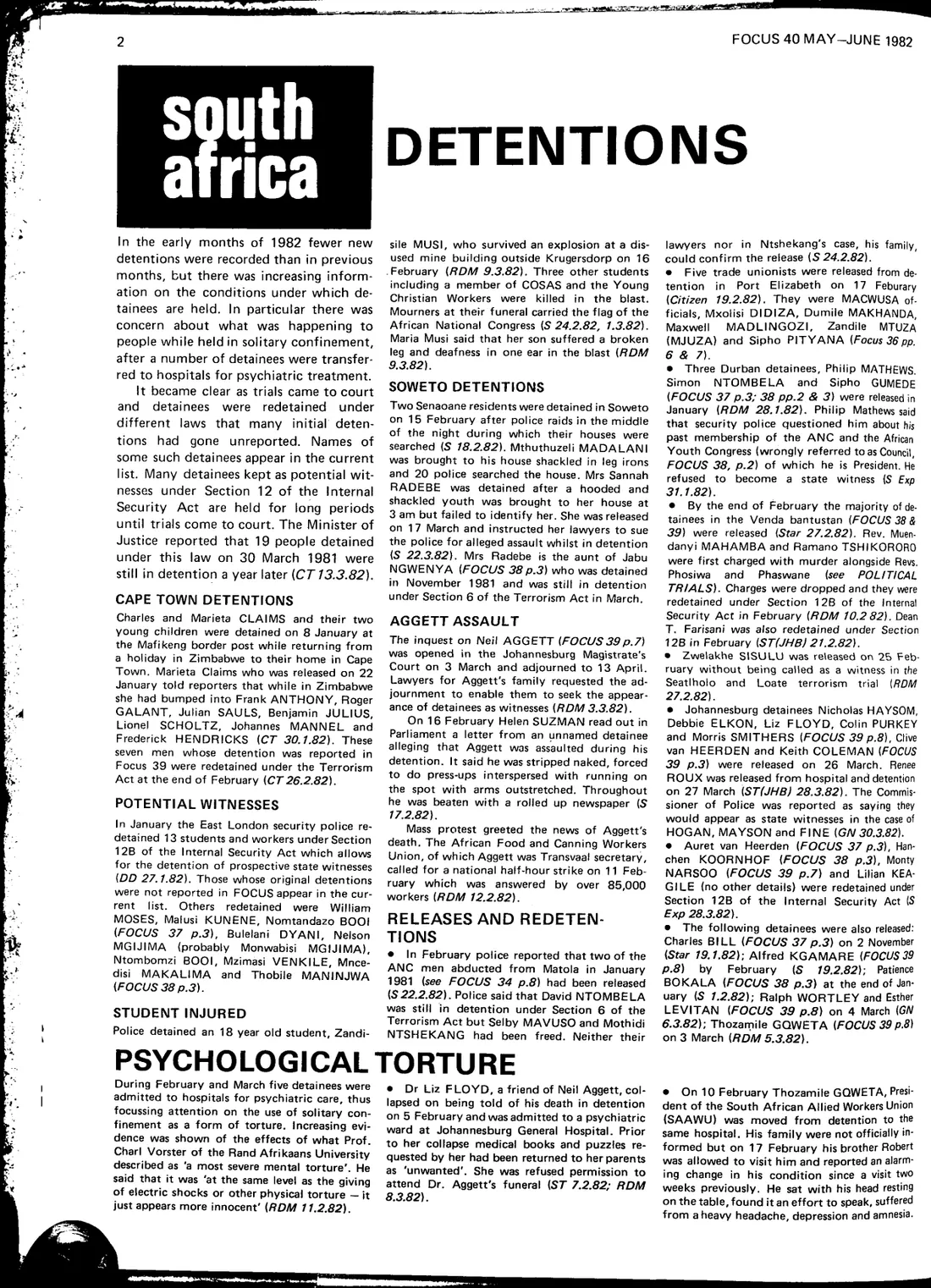
During February and March five detainees were admitted to hospitals for psychiatric care, thus focussing attention on the use of solitary confinement as a form of torture. Increasing evidence was shown of the effects of what Prof. Charl Vorster of the Rand Afrikaans University described as 'a most severe mental torture'. He said that it was 'at the same level as the giving of electric shocks or other physical torture - it just appears more innocent'.
- Dr Liz FLOYD, a friend of Neil Aggett, collapsed on being told of his death in detention on 5 February and was admitted to a psychiatric ward at Johannesburg General Hospital. Prior to her collapse medical books and puzzles requested by her had been returned to her parents as 'unwanted'. She was refused permission to attend Dr. Aggett's funeral.
- On 10 February Thozamile GQWETA, President of the South African Allied Workers Union (SAAWU) was moved from detention to the same hospital. His family were not officially informed but on 17 February his brother Robert was allowed to visit him and reported an alarming change in his condition since a visit two weeks previously. He sat with his head resting on the table, found it an effort to speak, suffered from a heavy headache, depression and amnesia. His eyes were bloodshot, at one time he cried and he complained that his brother spoke too loudly. He had been having nightmares about the deaths of his mother and uncle in a house fire in 1981 and was severely worried about his four-year-old daughter Amandla.
Thozamile Gqweta had been detained for the fifth time on 8 December 1981. H. Barnabus, a SAAWU national organiser, expressed concern, because he had 'outlived' previous detentions without physical or mental collapse. Gqweta was released on 3 March and said that this was for health reasons as his doctor had refused to treat him if he was returned to detention. On 4 March the Ciskei Intelligence Services detained him for several hours. Friends said he would receive psychiatric care in East London.
- Another SAAWU official, Sam KIKINE, the general secretary, was admitted to a psychiatric ward in Durban on 26 February and was described by relatives as being in a 'bad psychological state'. He was returned from hospital to detention on 10 March. Earlier a spokesman for the family said he would be discharged from hospital on condition he was not held in isolation.
- Pravin GORDHAN, an executive member of the Natal Indian Congress, who was detained on 27 November, was admitted to a psychiatric ward of St. Augustine's Hospital, Durban, in March. He was treated by an eye surgeon and a psychiatrist. It was reported that Mrs Pravina Gordhan had not been allowed, to see her husband either in detention or in hospital.
- Dean Farisani whose first admission to hospital in the Venda bantustan was reported in FOCUS, 39 was readmitted to hospital twice during February. He first received psychiatric care and was later readmitted with critical head injuries. Dean Farisani was redetained in February as a prospective state witness in the murder trial of Revs. Phaswane and Phosiwa.
- Two Johannesburg detainees, Esther LEVITAN and Renee ROUX were also taken to hospital. Mrs Levitan was treated for high blood pressure and stomach erosion caused by anxiety and tension; she had previously never needed hospital treatment in her life. After her release from detention on 4 March she received physiotherapy and psychotherapy. Renee Roux was admitted to hospital in February suffering from vomiting and fainting and was treated for potassium deficiency until her release from hospital and detention on 27 March.
These developments gave rise to considerable academic, medical and other opposition to the practice of keeping detainees in solitary confinement. Protests were made by, among others, the Board of Deputies of South African Jews, Lawyers for Human Rights, the Witwatersrand University Medical Faculty and the Department of Psychology at the University of Cape Town. The South African Psychological Association called on the Ministers of Police and Justice to treat statements made by detainees in solitary confinement in the same way as those obtained under physical duress. Many political trials rely on statements made by detainees as their main source of evidence. General Coetsee, chief of security police, claimed that an unfinished statement made by Neil Aggett on the day of his death would be used as evidence in a future trial.
The Detainees' Parents Support Committee demanded that detainees should be seen by an independent panel of doctors but this request was refused by the Minister of Police. They appealed to over 180 South African and overseas medical associations, calling for support for their demands to safeguard detainees' health. They based their appeal on the 1975 Declaration of Tokyo which was adopted by the World Medical Association.