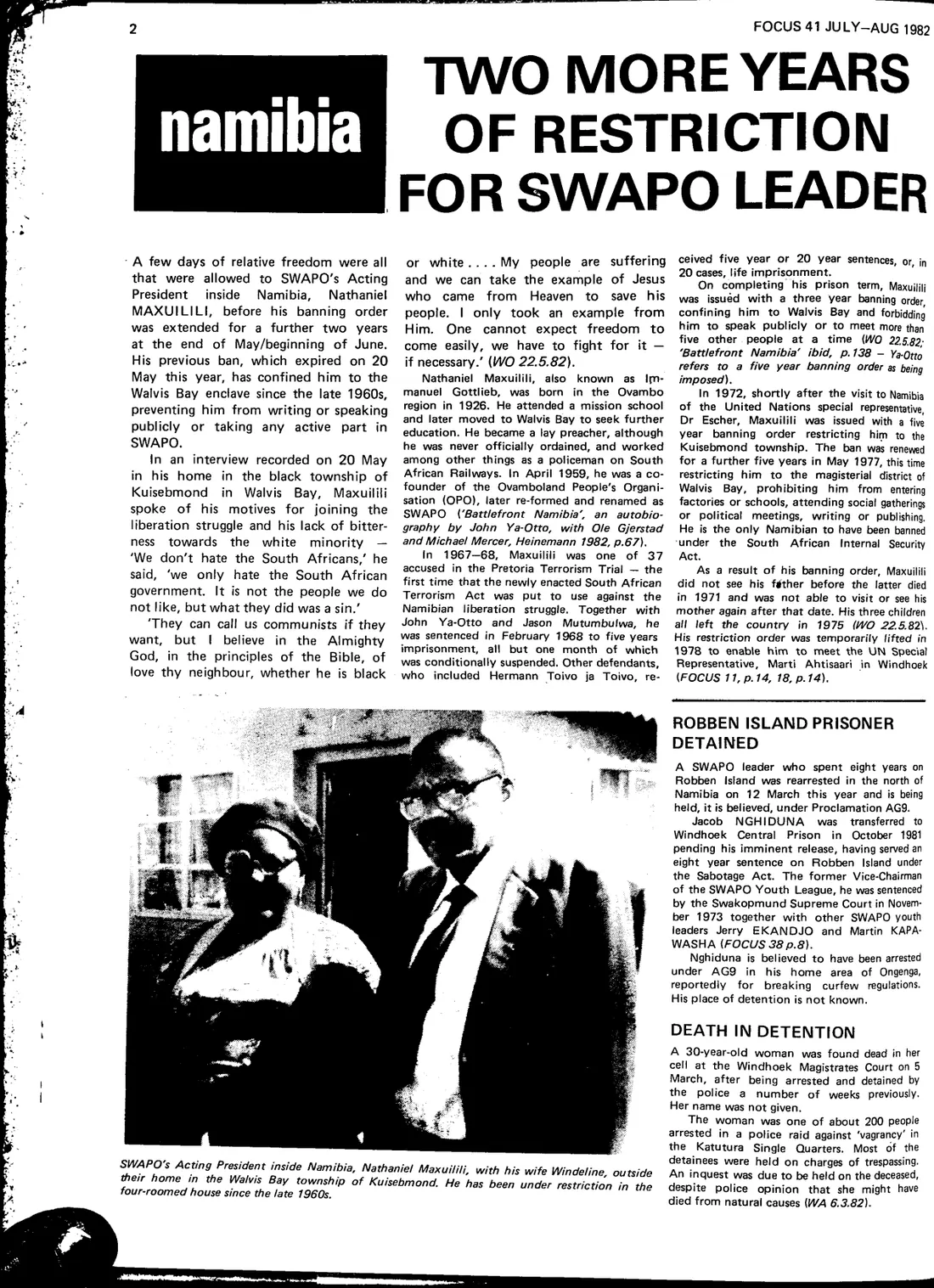
A few days of relative freedom were all that were allowed to SWAPO's Acting President inside Namibia, Nathaniel MAXUILILI, before his banning order was extended for a further two years at the end of May/beginning of June. His previous ban, which expired on 20 May this year, has confined him to the Walvis Bay enclave since the late 1960s, preventing him from writing or speaking publicly or taking any active part in SWAPO.
In an interview recorded on 20 May in his home in the black township of Kuisebmond in Walvis Bay, Maxuilili spoke of his motives for joining the liberation struggle and his lack of bitterness towards the white minority — 'We don't hate the South Africans,' he said, 'we only hate the South African government. It is not the people we do not like, but what they did was a sin.'
'They can call us communists if they want, but I believe in the Almighty God, in the principles of the Bible, of love thy neighbour, whether he is black or white.... My people are suffering and we can take the example of Jesus who came from Heaven to save his people. I only took an example from Him. One cannot expect freedom to come easily, we have to fight for it — if necessary.'
Nathaniel Maxuilili, also known as Immanuel Gottlieb, was born in the Ovambo region in 1926. He attended a mission school and later moved to Walvis Bay to seek further education. He became a lay preacher, although he was never officially ordained, and worked among other things as a policeman on South African Railways. In April 1959, he was a co-founder of the Ovamboland People's Organisation (OPO), later re-formed and renamed as SWAPO.
In 1967–68, Maxuilili was one of 37 accused in the Pretoria Terrorism Trial — the first time that the newly enacted South African Terrorism Act was put to use against the Namibian liberation struggle. Together with John Ya-Otto and Jason Mutumbulwa, he was sentenced in February 1968 to five years imprisonment, all but one month of which was conditionally suspended. Other defendants, who included Hermann Toivo ja Toivo, received five year or 20 year sentences, or, in 20 cases, life imprisonment.
On completing his prison term, Maxuilili was issued with a three year banning order, confining him to Walvis Bay and forbidding him to speak publicly or to meet more than five other people at a time.
In 1972, shortly after the visit to Namibia of the United Nations special representative, Dr Escher, Maxuilili was issued with a five year banning order restricting him to the Kuisebmond township. The ban was renewed for a further five years in May 1977, this time restricting him to the magisterial district of Walvis Bay, prohibiting him from entering factories or schools, attending social gatherings or political meetings, writing or publishing. He is the only Namibian to have been banned under the South African Internal Security Act.
As a result of his banning order, Maxuilili did not see his father before the latter died in 1971 and was not able to visit or see his mother again after that date. His three children all left the country in 1975. His restriction order was temporarily lifted in 1978 to enable him to meet the UN Special Representative, Marti Ahtisaari in Windhoek.