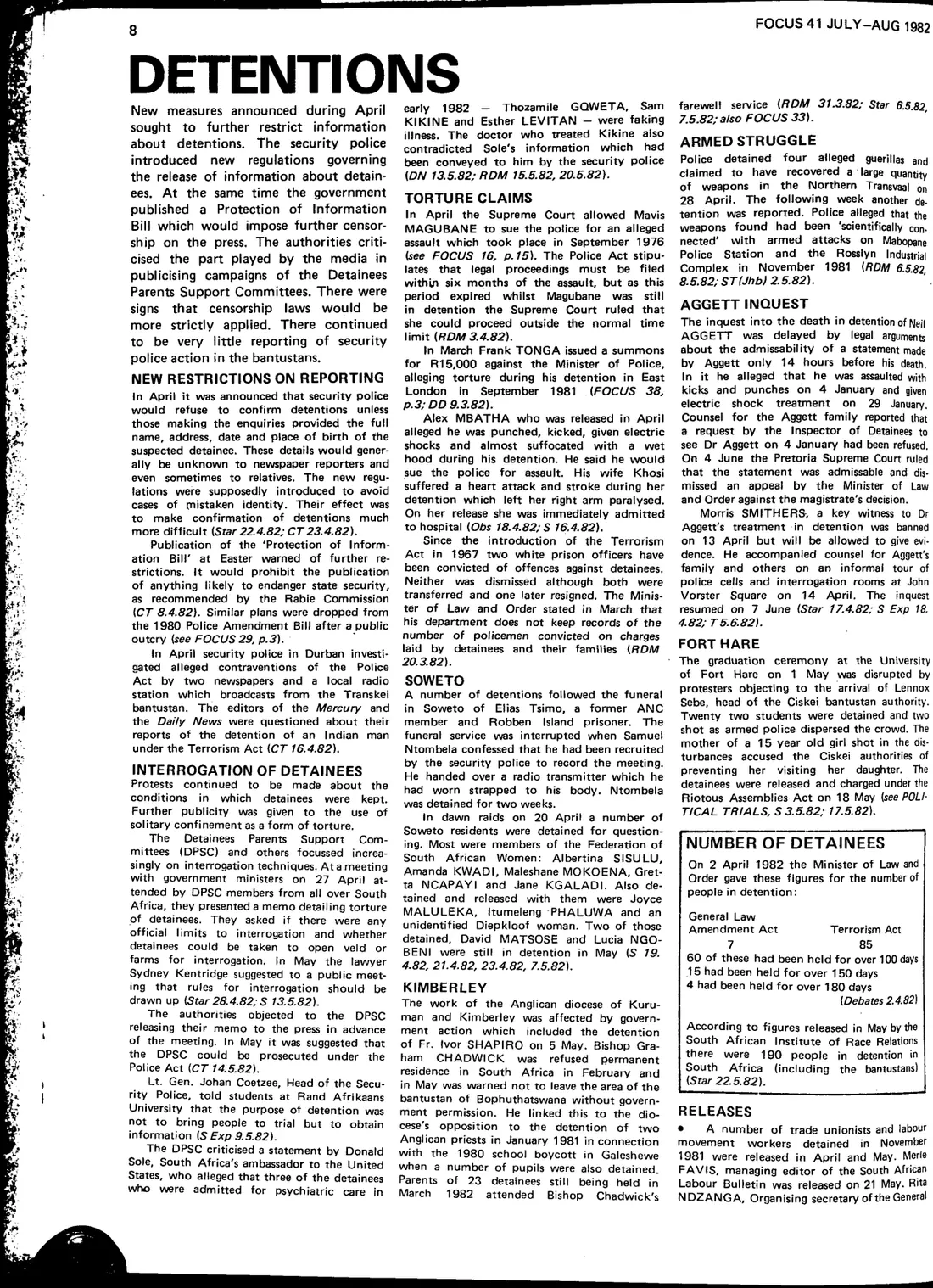
New measures announced during April sought to further restrict information about detentions. The security police introduced new regulations governing the release of information about detainees. At the same time the government published a Protection of Information Bill which would impose further censorship on the press. The authorities criticised the part played by the media in publicising campaigns of the Detainees Parents Support Committees. There were signs that censorship laws would be more strictly applied. There continued to be very little reporting of security police action in the bantustans.
NEW RESTRICTIONS ON REPORTING
In April it was announced that security police would refuse to confirm detentions unless those making the enquiries provided the full name, address, date and place of birth of the suspected detainee. These details would generally be unknown to newspaper reporters and even sometimes to relatives. The new regulations were supposedly introduced to avoid cases of mistaken identity. Their effect was to make confirmation of detentions much more difficult.
Publication of the 'Protection of Information Bill' at Easter warned of further restrictions. It would prohibit the publication of anything likely to endanger state security, as recommended by the Rabie Commission. Similar plans were dropped from the 1980 Police Amendment Bill after a public outcry.
In April security police in Durban investigated alleged contraventions of the Police Act by two newspapers and a local radio station which broadcasts from the Transkei bantustan. The editors of the Mercury and the Daily News were questioned about their reports of the detention of an Indian man under the Terrorism Act.
INTERROGATION OF DETAINES
Protests continued to be made about the conditions in which detainees were kept. Further publicity was given to the use of solitary confinement as a form of torture.
The Detainees Parents Support Committees (DPSC) and others focussed increasingly on interrogation techniques. At a meeting with government ministers on 27 April attended by DPSC members from all over South Africa, they presented a memo detailing torture of detainees. They asked if there were any official limits to interrogation and whether detainees could be taken to open veld or farms for interrogation. In May the lawyer Sydney Kentridge suggested to a public meeting that rules for interrogation should be drawn up.
The authorities objected to the DPSC releasing their memo to the press in advance of the meeting. In May it was suggested that the DPSC could be prosecuted under the Police Act.
Lt. Gen. Johan Coetzee, Head of the Security Police, told students at Rand Afrikaans University that the purpose of detention was not to bring people to trial but to obtain information.
The DPSC criticised a statement by Donald Sole, South Africa's ambassador to the United States, who alleged that three of the detainees who were admitted for psychiatric care in early 1982 - Thozamile GQWETA, Sam KIKINE and Esther LEVITAN - were faking illness. The doctor who treated Kikine also contradicted Sole's information which had been conveyed to him by the security police.
TORTURE CLAIMS
In April the Supreme Court allowed Mavis MAGUBANE to sue the police for an alleged assault which took place in September 1976. The Police Act stipulates that legal proceedings must be filed within six months of the assault, but as this period expired whilst Magubane was still in detention the Supreme Court ruled that she could proceed outside the normal time limit.
In March Frank TONGA issued a summons for R15,000 against the Minister of Police, alleging torture during his detention in East London in September 1981.
Alex MBATHA who was released in April alleged he was punched, kicked, given electric shocks and almost suffocated with a wet hood during his detention. He said he would sue the police for assault. His wife Khosi suffered a heart attack and stroke during her detention which left her right arm paralysed. On her release she was immediately admitted to hospital.
Since the introduction of the Terrorism Act in 1967 two white prison officers have been convicted of offences against detainees. Neither was dismissed although both were transferred and one later resigned. The Minister of Law and Order stated in March that his department does not keep records of the number of policemen convicted on charges laid by detainees and their families.
SOWETO
A number of detentions followed the funeral in Soweto of Elias Tsimo, a former ANC member and Robben Island prisoner. The funeral service was interrupted when Samuel Ntombela confessed that he had been recruited by the security police to record the meeting. He handed over a radio transmitter which he had worn strapped to his body. Ntombela was detained for two weeks.
In dawn raids on 20 April a number of Soweto residents were detained for questioning. Most were members of the Federation of South African Women: Albertina SISULU, Amanda KWADI, Maleshane MOKOENA, Gretta NCAPAYI and Jane KGALADI. Also detained and released with them were Joyce MALULEKA, Itumeleng PHALUWA and an unidentified Diepkloof woman. Two of those detained, David MATSOSE and Lucia NGOBENI were still in detention in May.
KIMBERLEY
The work of the Anglican diocese of Kuruman and Kimberley was affected by government action which included the detention of Fr. Ivor SHAPIRO on 5 May. Bishop Graham CHADWICK was refused permanent residence in South Africa in February and in May was warned not to leave the area of the bantustan of Bophuthatswana without government permission. He linked this to the diocese's opposition to the detention of two Anglican priests in January 1981 in connection with the 1980 school boycott in Galeshewe when a number of pupils were also detained. Parents of 23 detainees still being held in March 1982 attended Bishop Chadwick's farewell service.
ARMED STRUGGLE
Police detained four alleged guerillas and claimed to have recovered a large quantity of weapons in the Northern Transvaal on 28 April. The following week another detention was reported. Police alleged that the weapons found had been 'scientifically connected' with armed attacks on Mabopane Police Station and the Rosslyn Industrial Complex in November 1981.
AGGETT INQUEST
The inquest into the death in detention of Neil AGGETT was delayed by legal arguments about the admissability of a statement made by Aggett only 14 hours before his death. In it he alleged that he was assaulted with kicks and punches on 4 January and given electric shock treatment on 29 January. Counsel for the Aggett family reported that a request by the Inspector of Detainees to see Dr Aggett on 4 January had been refused. On 4 June the Pretoria Supreme Court ruled that the statement was admissible and dismissed an appeal by the Minister of Law and Order against the magistrate's decision.
Morris SMITHERS, a key witness to Dr Aggett's treatment in detention was banned on 13 April but will be allowed to give evidence. He accompanied counsel for Aggett's family and others on an informal tour of police cells and interrogation rooms at John Vorster Square on 14 April. The inquest resumed on 7 June.
FORT HARE
The graduation ceremony at the University of Fort Hare on 1 May was disrupted by protesters objecting to the arrival of Lennox Sebe, head of the Ciskei bantustan authority. Twenty two students were detained and two shot as armed police dispersed the crowd. The mother of a 15 year old girl shot in the disturbances accused the Ciskei authorities of preventing her visiting her daughter. The detainees were released and charged under the Riotous Assemblies Act on 18 May.
NUMBER OF DETAINES
On 2 April 1982 the Minister of Law and Order gave these figures for the number of people in detention:
General Law Amendment Act: 7 Terrorism Act: 85 60 of these had been held for over 100 days 15 had been held for over 150 days 4 had been held for over 180 days
According to figures released in May by the South African Institute of Race Relations there were 190 people in detention in South Africa (including the bantustans).
RELEASES
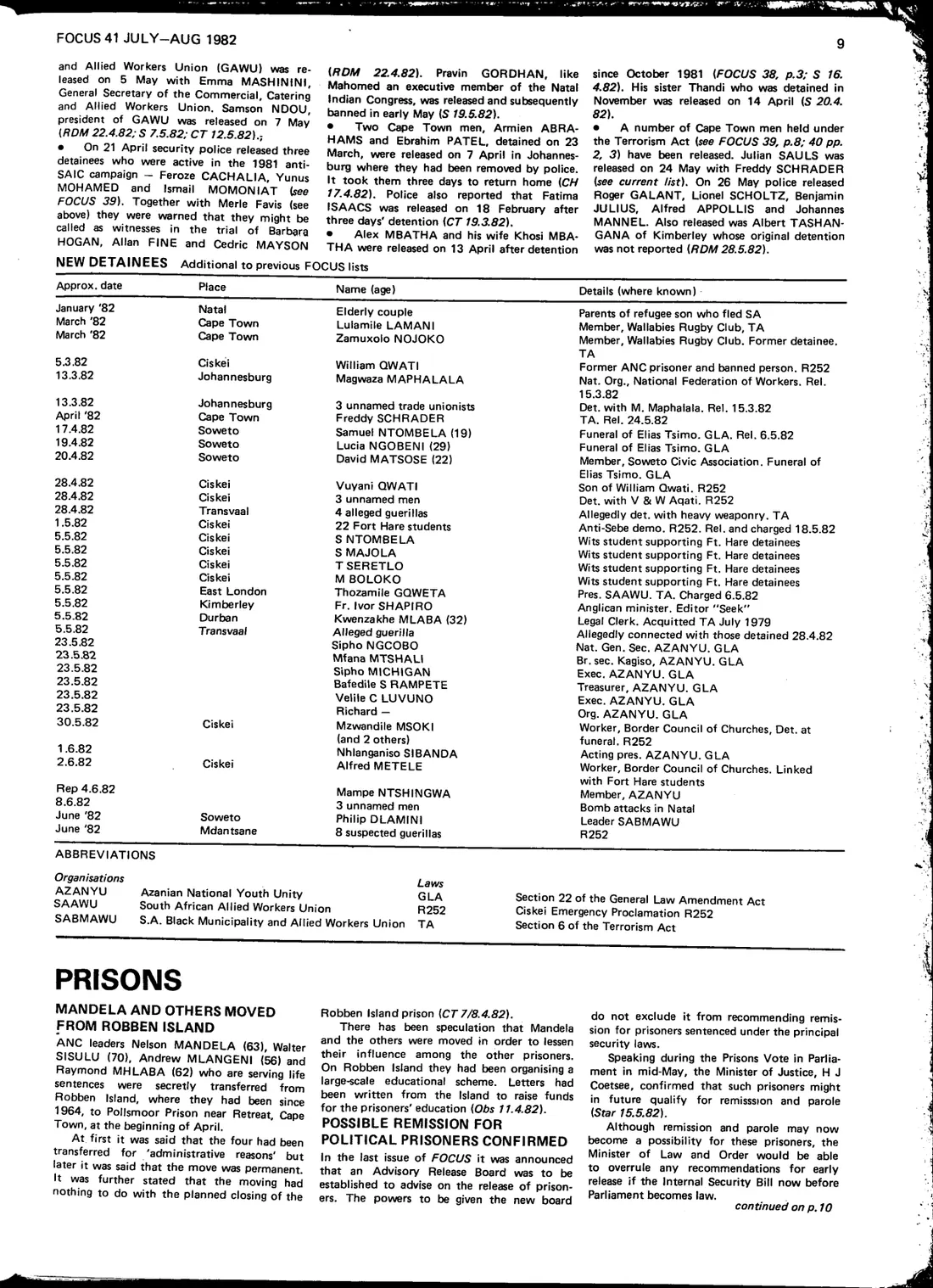
- A number of trade unionists and labour movement workers detained in November 1981 were released in April and May. Merle FAVIS, managing editor of the South African Labour Bulletin was released on 21 May. Rita NDZANGA, Organising secretary of the General and Allied Workers Union (GAWU) was released on 5 May with Emma MASHININI, General Secretary of the Commercial, Catering and Allied Workers Union. Samson NDOU, president of GAWU was released on 7 May.
- On 21 April security police released three detainees who were active in the 1981 anti-SAIC campaign — Feroze CACHALIA, Yunus MOHAMED and Ismail MOMONIAT. Together with Merle Favis they were warned that they might be called as witnesses in the trial of Barbara HOGAN, Allan FINE and Cedric MAYSON. Pravin GORDHAN, like Mahomed an executive member of the Natal Indian Congress, was released and subsequently banned in early May.
- Two Cape Town men, Armien ABRAHAMS and Ebrahim PATEL, detained on 23 March, were released on 7 April in Johannesburg where they had been removed by police. It took them three days to return home. Police also reported that Fatima ISAACS was released on 18 February after three days' detention.
- Alex MBATHA and his wife Khosi MATHA were released on 13 April after detention since October 1981. His sister Thandi who was detained in November was released on 14 April.
- A number of Cape Town men held under the Terrorism Act have been released. Julian SAULS was released on 24 May with Freddy SCHRADER. On 26 May police released Roger GALANT, Lionel SCHOLTZ, Benjamin JULIUS, Alfred APPOLLIS and Johannes MANNEL. Also released was Albert TASHANGANA of Kimberley whose original detention was not reported.