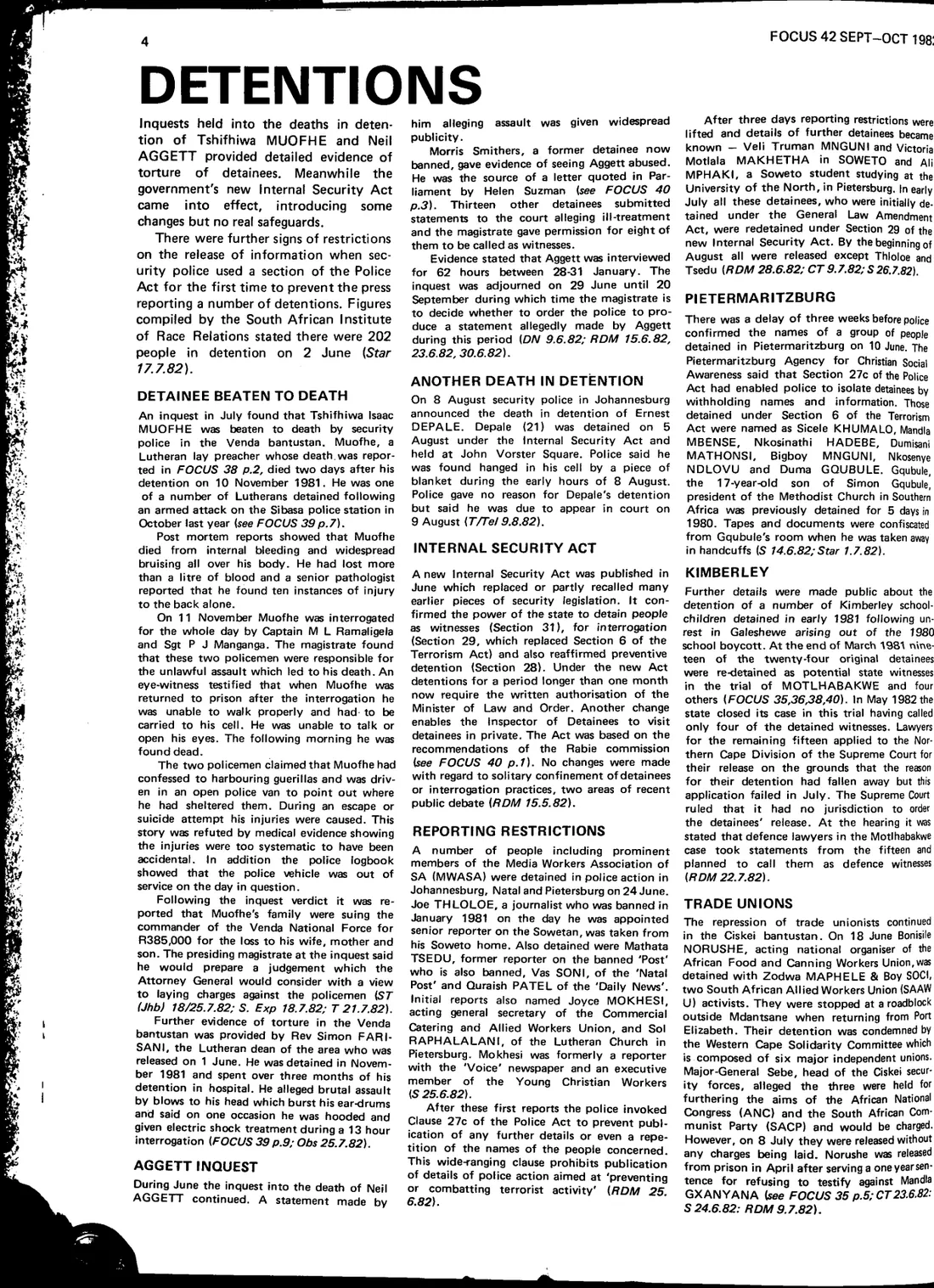
Inquests held into the deaths in detention of Tshifhiwa MUOFHE and Neil AGGETT provided detailed evidence of torture of detainees. Meanwhile the government's new Internal Security Act came into effect, introducing some changes but no real safeguards.
There were further signs of restrictions on the release of information when security police used a section of the Police Act for the first time to prevent the press reporting a number of detentions. Figures compiled by the South African Institute of Race Relations stated there were 202 people in detention on 2 June.
DETAINEE BEATEN TO DEATH
An inquest in July found that Tshifhiwa Isaac MUOFHE was beaten to death by security police in the Venda bantustan. Muofhe, a Lutheran lay preacher whose death was reported in FOCUS 38 p.2, died two days after his detention on 10 November 1981. He was one of a number of Luthunders detained following an armed attack on the Sibasa police station in October last year.
Post mortem reports showed that Muofhe died from internal bleeding and widespread bruising all over his body. He had lost more than a litre of blood and a senior pathologist reported that he found ten instances of injury to the back alone.
On 11 November Muofhe was interrogated for the whole day by Captain M L Ramaligela and Sgt P J Manganga. The magistrate found that these two policemen were responsible for the unlawful assault which led to his death. An eye-witness testified that when Muofhe was returned to prison after the interrogation he was unable to walk properly and had to be carried to his cell. He was unable to talk or open his eyes. The following morning he was found dead.
The two policemen claimed that Muofhe had confessed to harbouring guerillas and was driven in an open police van to point out where he had sheltered them. During an escape or suicide attempt his injuries were caused. This story was refuted by medical evidence showing the injuries were too systematic to have been accidental. In addition the police logbook showed that the police vehicle was out of service on the day in question.
Following the inquest verdict it was reported that Muofhe's family were suing the commander of the Venda National Force for R385,000 for the loss to his wife, mother and son. The presiding magistrate at the inquest said he would prepare a judgement which the Attorney General would consider with a view to laying charges against the policemen.
Further evidence of torture in the Venda bantustan was provided by Rev Simon FARISANI, the Lutheran dean of the area who was released on 1 June. He was detained in November 1981 and spent over three months of his detention in hospital. He alleged brutal assault by blows to his head which burst his ear-drums and said on one occasion he was hooded and given electric shock treatment during a 13 hour interrogation.
AGGETT INQUEST
During June the inquest into the death of Neil AGGETT continued. A statement made by him alleging assault was given widespread publicity.
Morris Smithers, a former detainee now banned, gave evidence of seeing Aggett abused. He was the source of a letter quoted in Parliament by Helen Suzman. Thirteen other detainees submitted statements to the court alleging ill-treatment and the magistrate gave permission for eight of them to be called as witnesses.
Evidence stated that Aggett was interviewed for 62 hours between 28-31 January. The inquest was adjourned on 29 June until 20 September during which time the magistrate is to decide whether to order the police to produce a statement allegedly made by Aggett during this period.
ANOTHER DEATH IN DETENTION
On 8 August security police in Johannesburg announced the death in detention of Ernest DEPALE. Depale (21) was detained on 5 August under the Internal Security Act and held at John Vorster Square. Police said he was found hanged in his cell by a piece of blanket during the early hours of 8 August. Police gave no reason for Depale's detention but said he was due to appear in court on 9 August.
INTERNAL SECURITY ACT
A new Internal Security Act was published in June which replaced or partly recalled many earlier pieces of security legislation. It confirmed the power of the state to detain people as witnesses (Section 31), for interrogation (Section 29, which replaced Section 6 of the Terrorism Act) and also reaffirmed preventive detention (Section 28). Under the new Act detentions for a period longer than one month now require the written authorisation of the Minister of Law and Order. Another change enables the Inspector of Detainees to visit detainees in private. The Act was based on the recommendations of the Rabie commission. No changes were made with regard to solitary confinement of detainees or interrogation practices, two areas of recent public debate.
REPORTING RESTRICTIONS
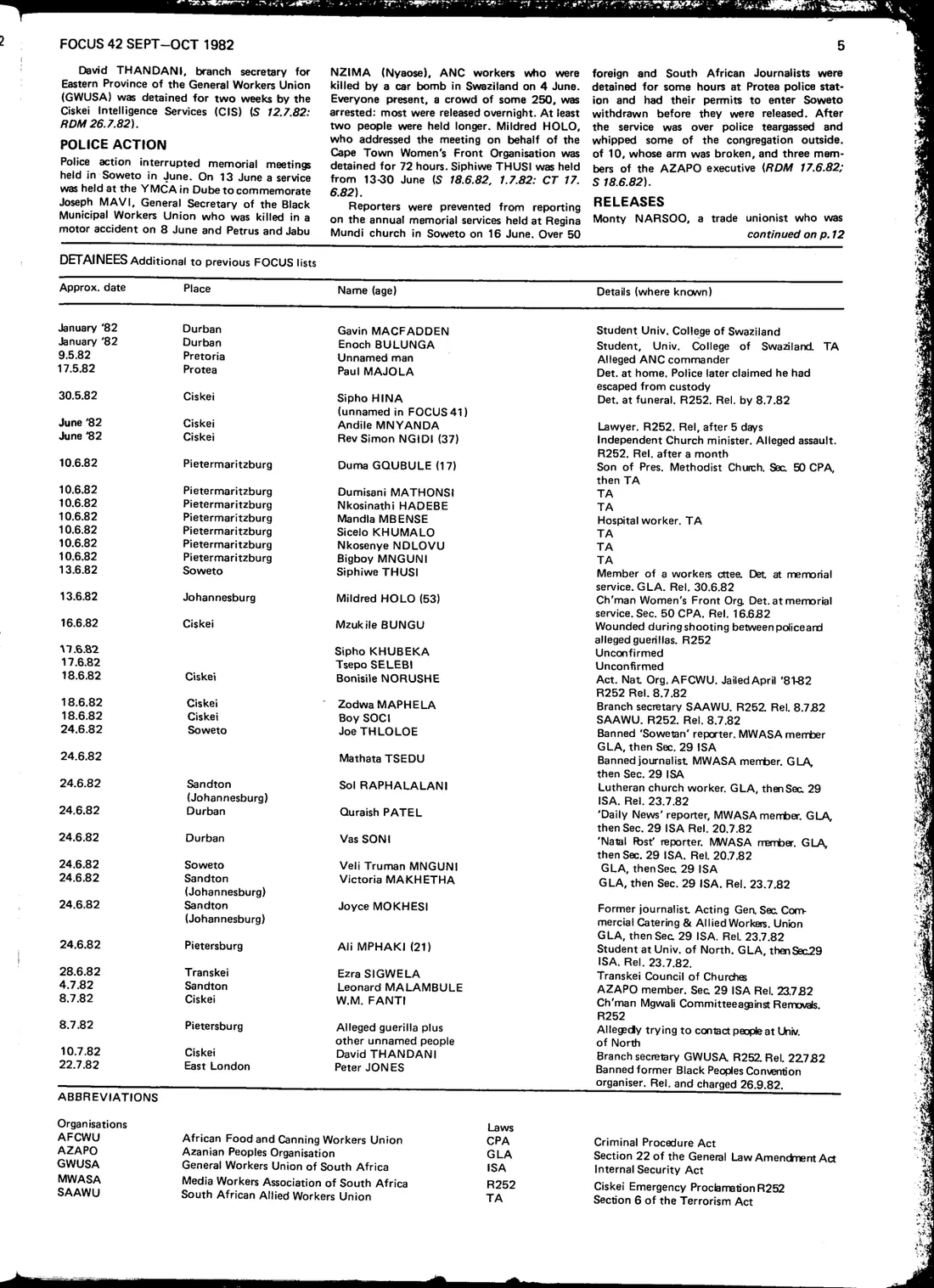
A number of people including prominent members of the Media Workers Association of SA (MWASA) were detained in police action in Johannesburg, Natal and Pietersburg on 24 June. Joe THLOLOE, a journalist who was banned in January 1981 on the day he was appointed senior reporter on the Sowetan, was taken from his Soweto home. Also detained were Mathata TSEDU, former reporter on the banned 'Post' who is also banned, Vas SONI, of the 'Natal Post' and Quraish PATEL of the 'Daily News'. Initial reports also named Joyce MOKHESI, acting general secretary of the Commercial Catering and Allied Workers Union, and Sol RAPHALALANI, of the Lutheran Church in Pietersburg. Mokhesi was formerly a reporter with the 'Voice' newspaper and an executive member of the Young Christian Workers.
After these first reports the police invoked Clause 27c of the Police Act to prevent publication of any further details or even a repetition of the names of the people concerned. This wide-ranging clause prohibits publication of details of police action aimed at 'preventing or combatting terrorist activity'.
After three days reporting restrictions were lifted and details of further detainees became known - Veli Truman MNGUNI and Victoria Motlala MAKHETHA in SOWETO and Ali MPHAKI, a Soweto student studying at the University of the North, in Pietersburg. In early July all these detainees, who were initially detained under the General Law Amendment Act, were redetained under Section 29 of the new Internal Security Act. By the beginning of August all were released except Thloloe and Tsedu.
PIETERMARITZBURG
There was a delay of three weeks before police confirmed the names of a group of people detained in Pietermaritzburg on 10 June. The Pietermaritzburg Agency for Christian Social Awareness said that Section 27c of the Police Act had enabled police to isolate detainees by withholding names and information. Those detained under Section 6 of the Terrorism Act were named as Sicele KHUMALO, Mandla MBENSE, Nkosinathi HADEBE, Dumsani MATHONSI, Bigboy MNGUNI, Nkosenye NDLOVU and Duma GQUBULE. Gqubule, the 17-year-old son of Simon Gqubule, president of the Methodist Church in Southern Africa was previously detained for 5 days in 1980. Tapes and documents were confiscated from Gqubule's room when he was taken away in handcuffs.
KIMBERLEY
Further details were made public about the detention of a number of Kimberley schoolchildren detained in early 1981 following unrest in Galeshewe arising out of the 1980 school boycott. At the end of March 1981 nineteen of the twenty-four original detainees were re-detained as potential state witnesses in the trial of MOTLHABAKWE and four others. In May 1982 the state closed its case in this trial having called only four of the detained witnesses. Lawyers for the remaining fifteen applied to the Northern Cape Division of the Supreme Court for their release on the grounds that the reason for their detention had fallen away but this application failed in July. The Supreme Court ruled that it had no jurisdiction to order the detainees' release. At the hearing it was stated that defence lawyers in the Motlhabakwe case took statements from the fifteen and planned to call them as defence witnesses.
TRADE UNIONS
The repression of trade unionists continued in the Ciskei bantustan. On 18 June Bonisile NORUSHE, acting national organiser of the African Food and Canning Workers Union, was detained with Zodwa MAPHELE & Boy SOCI, two South African Allied Workers Union (SAAW) activists. They were stopped at a roadblock outside Mdantsane when returning from Port Elizabeth. Their detention was condemned by the Western Cape Solidarity Committee which is composed of six major independent unions. Major-General Sebe, head of the Ciskei security forces, alleged the three were held for furthering the aims of the African National Congress (ANC) and the South African Communist Party (SACP) and would be charged. However, on 8 July they were released without any charges being laid. Norushe was released from prison in April after serving a one year sentence for refusing to testify against Mandla GXANYANA.
David THANDANI, branch secretary for Eastern Province of the General Workers Union (GWUSA) was detained for two weeks by the Ciskei Intelligence Services (CIS).
POLICE ACTION
Police action interrupted memorial meetings held in Soweto in June. On 13 June a service was held at the YMCA in Dube to commemorate Joseph MAVI, General Secretary of the Black Municipal Workers Union who was killed in a motor accident on 8 June and Petrus and Jabu NZIMA (Nyaose), ANC workers who were killed by a car bomb in Swaziland on 4 June. Everyone present, a crowd of some 250, was arrested: most were released overnight. At least two people were held longer. Mildred HOLO, who addressed the meeting on behalf of the Cape Town Women's Front Organisation was detained for 72 hours. Siphiwe THUSI was held from 13-30 June.
Reporters were prevented from reporting on the annual memorial services held at Regina Mundi church in Soweto on 16 June. Over 50 foreign and South African Journalists were detained for some hours at Protea police station and had their permits to enter Soweto withdrawn before they were released. After the service was over police teargassed and whipped some of the congregation outside. of 10, whose arm was broken, and three members of the AZAPO executive.