ROBBEN ISLAND RELEASES
Three Namibians were among a number of political prisoners released in South Africa under a widely publicised parole in early July. All three, who had been serving their sentences on Robben Island, had virtually completed their terms of imprisonment. They had been transferred to Windhoek Central Prison and were released on 6 July. The three are Sakaria Nashandi (34), Michael Shikongo (42) and Nabot Imene (43).
Nashandi was serving a six year term for aiding guerillas in northern Namibia. He was due to be released on 4 September. Shikongo was sentenced to five years imprisonment in July 1977, for allegedly providing food to SWAPO guerillas and carrying a message for SWAPO. He was due to be released a week after being let out under the parole. Imene was arrested in November 1976 and tried in the Windhoek Supreme Court in July 1977 on a charge of aiding and abetting SWAPO guerillas. He was sentenced to five years imprisonment under the Terrorism Act. On 9 December 1977, in the presence of a Commissioner of Oaths, Imene signed a declaration describing his torture during the nine months he was held in custody before his trial. According to his testimony, he was given electric shocks, suspended on an iron rod between two petrol drums and repeatedly assaulted. His appeal against his conviction and sentence was dismissed by the Blomfontein appeal court in March 1978. Imene was due for release in August.
A spokesman for the Prisons Department in Windhoek said that 43 Namibian political prisoners are still serving sentences on Robben Island.
DISAPPEARANCES
Three persons have been reported missing after having spent a period in detention, according to SWAPO. They are Victor Iyambo SHIKONGO, a teacher at Ekamba in northern Namibia, who was arrested in April 1981, Kasita KAMBUNDU, also a teacher in northern Namibia who spent 15 months in detention, and Jeremia KANGONGA, a worker at the Lutheran Church press in Oniipa who spent about eight months in detention. The authorities reportedly claim that the three men escaped from prison, but they have not been heard of for some time.
There have been a number of mysterious disappearances of people, particularly in the north. A case recently come to light was that of Johannes Kakuva, who disappeared while being held in detention. Fellow detainees testified that he died in detention as a result of torture, while the police claimed that he escaped. The case was scheduled to be heard in court in September.
POPULATION CENSUS
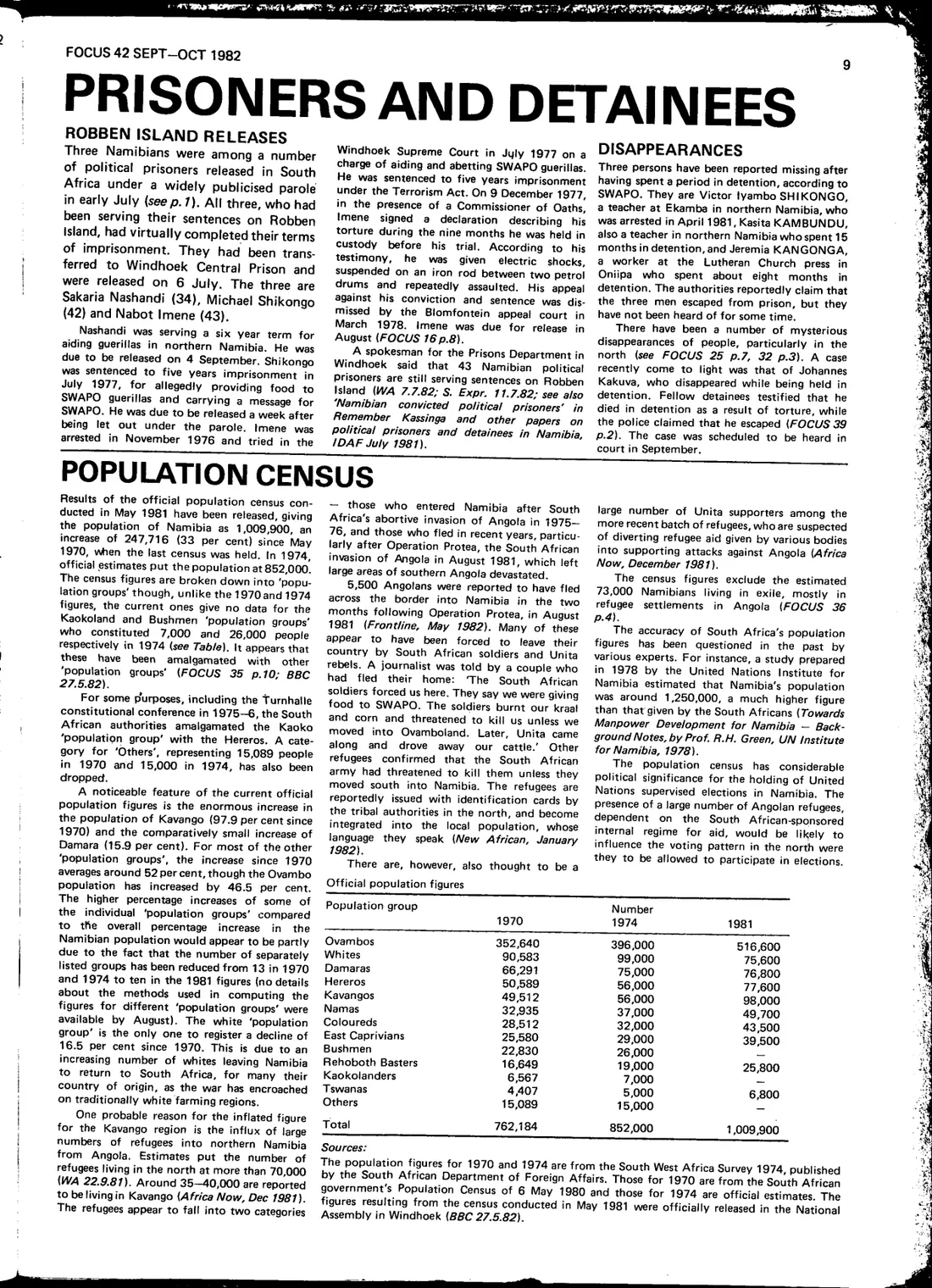
Results of the official population census conducted in May 1981 have been released, giving the population of Namibia as 1,009,900, an increase of 247,716 (33 per cent) since May 1970, when the last census was held. In 1974, official estimates put the population at 852,000. The census figures are broken down into 'population groups' though, unlike the 1970 and 1974 figures, the current ones give no data for the Kaokoland and Bushmen 'population groups' who constituted 7,000 and 26,000 people respectively in 1974. It appears that these have been amalgamated with other 'population groups'.
For some purposes, including the Turnhalle constitutional conference in 1975-6, the South African authorities amalgamated the Kaoko 'population group' with the Hereros. A category for 'Others', representing 15,089 people in 1970 and 15,000 in 1974, has also been dropped.
A noticeable feature of the current official population figures is the enormous increase in the population of Kavango (97.9 per cent since 1970) and the comparatively small increase of Damara (15.9 per cent). For most of the other 'population groups', the increase since 1970 averages around 52 per cent, though the Ovambo population has increased by 46.5 per cent. The higher percentage increases of some of the individual 'population groups' compared to the overall percentage increase in the Namibian population would appear to be partly due to the fact that the number of separately listed groups has been reduced from 13 in 1970 and 1974 to ten in the 1981 figures. The white 'population group' is the only one to register a decline of 16.5 per cent since 1970. This is due to an increasing number of whites leaving Namibia to return to South Africa, for many their country of origin, as the war has encroached on traditionally white farming regions.
One probable reason for the inflated figure for the Kavango region is the influx of large numbers of refugees into northern Namibia from Angola. Estimates put the number of refugees living in the north at more than 70,000. Around 35-40,000 are reported to be living in Kavango. The refugees appear to fall into two categories — those who entered Namibia after South Africa's abortive invasion of Angola in 1975-76, and those who fled in recent years, particularly after Operation Protea, the South African invasion of Angola in August 1981, which left large areas of southern Angola devastated.
5,500 Angolans were reported to have fled across the border into Namibia in the two months following Operation Protea, in August 1981. Many of these appear to have been forced to leave their country by South African soldiers and Unita rebels. A journalist was told by a couple who had fled their home: 'The South African soldiers forced us here. They say we were giving food to SWAPO. The soldiers burnt our kraal and corn and threatened to kill us unless we moved into Ovamboland. Later, Unita came along and drove away our cattle.' Other refugees confirmed that the South African army had threatened to kill them unless they moved south into Namibia. The refugees are reportedly issued with identification cards by the tribal authorities in the north, and become integrated into the local population, whose language they speak.
There are, however, also thought to be a large number of Unita supporters among the more recent batch of refugees, who are suspected of diverting refugee aid given by various bodies into supporting attacks against Angola.
The census figures exclude the estimated 73,000 Namibians living in exile, mostly in refugee settlements in Angola.
The accuracy of South Africa's population figures has been questioned in the past by various experts. For instance, a study prepared in 1978 by the United Nations Institute for Namibia estimated that Namibia's population was around 1,250,000, a much higher figure than that given by the South Africans.
The population census has considerable political significance for the holding of United Nations supervised elections in Namibia. The presence of a large number of Angolan refugees, dependent on the South African-sponsored internal regime for aid, would be likely to influence the voting pattern in the north were they to be allowed to participate in elections.