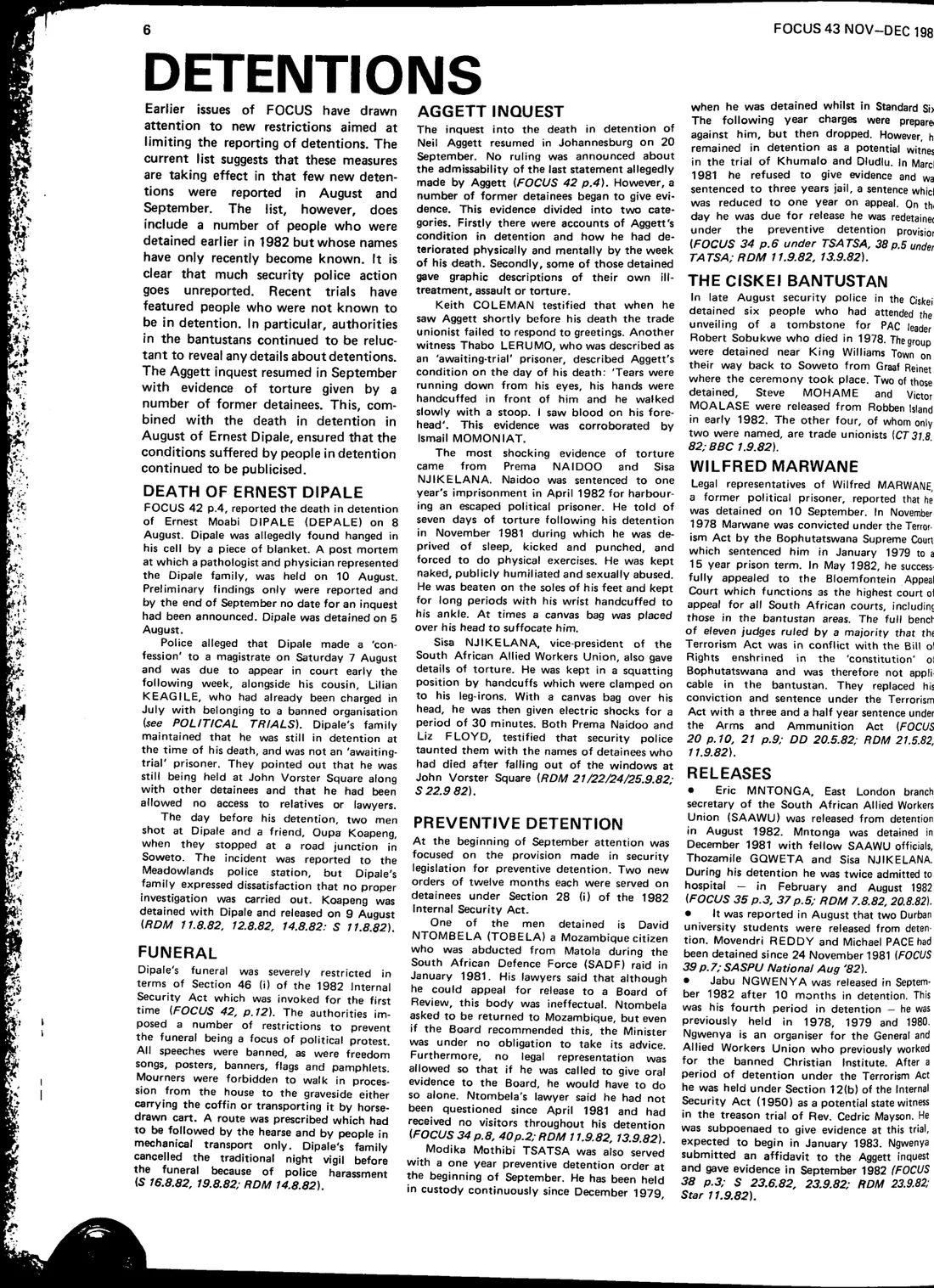
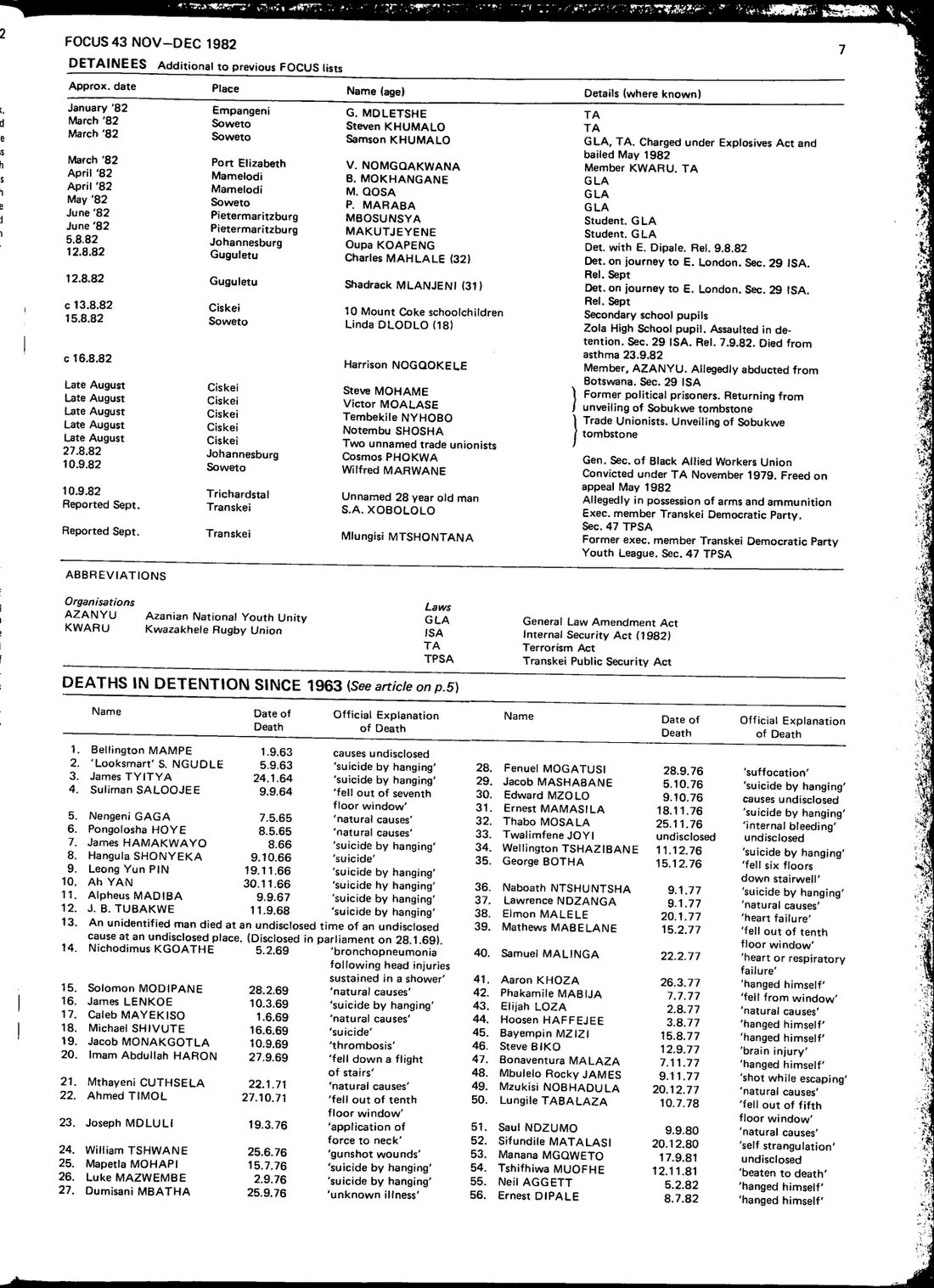
Earlier issues of FOCUS have drawn attention to new restrictions aimed at limiting the reporting of detentions. The current list suggests that these measures are taking effect in that few new detentions were reported in August and September. The list, however, does include a number of people who were detained earlier in 1982 but whose names have only recently become known. It is clear that much security police action goes unreported. Recent trials have featured people who were not known to be in detention. In particular, authorities in the bantustans continued to be reluctant to reveal any details about detentions. The Aggett inquest resumed in September with evidence of torture given by a number of former detainees. This, combined with the death in detention in August of Ernest Dipale, ensured that the conditions suffered by people in detention continued to be publicised.
DEATH OF ERNEST DIPALE
FOCUS 42 p.4, reported the death in detention of Ernest Moabi DIPALE (DEPALE) on 8 August. Dipale was allegedly found hanged in his cell by a piece of blanket. A post mortem at which a pathologist and physician represented the Dipale family, was held on 10 August. Preliminary findings only were reported and by the end of September no date for an inquest had been announced. Dipale was detained on 5 August.
Police alleged that Dipale made a 'confession' to a magistrate on Saturday 7 August and was due to appear in court early the following week, alongside his cousin, Lilian KEAGILE, who had already been charged in July with belonging to a banned organisation (see POLITICAL TRIALS). Dipale's family maintained that he was still in detention at the time of his death, and was not an 'awaiting-trial' prisoner. They pointed out that he was still being held at John Vorster Square along with other detainees and that he had been allowed no access to relatives or lawyers.
The day before his detention, two men shot at Dipale and a friend, Oupa Koapeng, when they stopped at a road junction in Soweto. The incident was reported to the Meadowlands police station, but Dipale's family expressed dissatisfaction that no proper investigation was carried out. Koapeng was detained with Dipale and released on 9 August (RDM 11.8.82, 12.8.82, 14.8.82: S 11.8.82).
FUNERAL
Dipale's funeral was severely restricted in terms of Section 46 (i) of the 1982 Internal Security Act which was invoked for the first time (FOCUS 42, p.12). The authorities imposed a number of restrictions to prevent the funeral being a focus of political protest. All speeches were banned, as were freedom songs, posters, banners, flags and pamphlets. Mourners were forbidden to walk in procession from the house to the graveside either carrying the coffin or transporting it by horse-drawn cart. A route was prescribed which had to be followed by the hearse and by people in mechanical transport only. Dipale's family cancelled the traditional night vigil before the funeral because of police harassment (S 16.8.82, 19.8.82; RDM 14.8.82).
AGGETT INQUEST
The inquest into the death in detention of Neil Aggett resumed in Johannesburg on 20 September. No ruling was announced about the admissability of the last statement allegedly made by Aggett (FOCUS 42 p.4). However, a number of former detainees began to give evidence. This evidence divided into two categories. Firstly there were accounts of Aggett's condition in detention and how he had deteriorated physically and mentally by the week of his death. Secondly, some of those detained gave graphic descriptions of their own ill-treatment, assault or torture.
Keith COLEMAN testified that when he saw Aggett shortly before his death the trade unionist failed to respond to greetings. Another witness Thabo LERUMO, who was described as an 'awaiting-trial' prisoner, described Aggett's condition on the day of his death: 'Tears were running down from his eyes, his hands were handcuffed in front of him and he walked slowly with a stoop. I saw blood on his forehead'. This evidence was corroborated by Ismail MOMONIAT.
The most shocking evidence of torture came from Prema NAIDOO and Sisa NJIKELANA. Naidoo was sentenced to one year's imprisonment in April 1982 for harbouring an escaped political prisoner. He told of seven days of torture following his detention in November 1981 during which he was deprived of sleep, kicked and punched, and forced to do physical exercises. He was kept naked, publicly humiliated and sexually abused. He was beaten on the soles of his feet and kept for long periods with his wrist handcuffed to his ankle. At times a canvas bag was placed over his head to suffocate him.
Sisa NJIKELANA, vice-president of the South African Allied Workers Union, also gave details of torture. He was kept in a squatting position by handcuffs which were clamped on to his leg-irons. With a canvas bag over his head, he was then given electric shocks for a period of 30 minutes. Both Prema Naidoo and Liz FLOYD, testified that security police taunted them with the names of detainees who had died after falling out of the windows at John Vorster Square (RDM 21/22/24/25.9.82; S 22.9.82).
PREVENTIVE DETENTION
At the beginning of September attention was focused on the provision made in security legislation for preventive detention. Two new orders of twelve months each were served on detainees under Section 28 (i) of the 1982 Internal Security Act.
One of the men detained is David NTOMBELA (TOBELA) a Mozambique citizen who was abducted from Matola during the South African Defence Force (SADF) raid in January 1981. His lawyers said that although he could appeal for release to a Board of Review, this body was ineffectual. Ntombela asked to be returned to Mozambique, but even if the Board recommended this, the Minister was under no obligation to take its advice. Furthermore, no legal representation was allowed so that if he was called to give oral evidence to the Board, he would have to do so alone. Ntombela's lawyer said he had not been questioned since April 1981 and had received no visitors throughout his detention (FOCUS 34 p.8, 40 p.2; RDM 11.9.82, 13.9.82).
Modika Mothibi TSATSA was also served with a one year preventive detention order at the beginning of September. He has been held in custody continuously since December 1979, when he was detained whilst in Standard Six. The following year charges were prepared against him, but then dropped. However, he remained in detention as a potential witness in the trial of Khumalo and Dludlu. In March 1981 he refused to give evidence and was sentenced to three years jail, a sentence which was reduced to one year on appeal. On the day he was due for release he was redetained under the preventive detention provision (FOCUS 34 p.6 under TSATSA, 38 p.5 under TATSA; RDM 11.9.82, 13.9.82).
THE CISKEI BANTUSTAN
In late August security police in the CISKEI detained six people who had attended the unveiling of a tombstone for PAC leader Robert Sobukwe who died in 1978. The group were detained near King Williams Town on their way back to Soweto from Graaf Reinet where the ceremony took place. Two of those detained, Steve MOHAME and Victor MOALASE were released from Robben Island in early 1982. The other four, of whom only two were named, are trade unionists (CT 31.8.82; BBC 1.9.82).
WILFRED MARWANE
Legal representatives of Wilfred MARWANE, a former political prisoner, reported that he was detained on 10 September. In November 1978 Marwane was convicted under the Terrorism Act by the Bophutatswana Supreme Court which sentenced him in January 1979 to a 15 year prison term. In May 1982, he successfully appealed to the Bloemfontein Appeal Court which functions as the highest court of appeal for all South African courts, including those in the bantustan areas. The full bench of eleven judges ruled by a majority that the Terrorism Act was in conflict with the Bill of Rights enshrined in the 'constitution' of Bophutatswana and was therefore not applicable in the bantustan. They replaced his conviction and sentence under the Terrorism Act with a three and a half year sentence under the Arms and Ammunition Act (FOCUS 20 p.10, 21 p.9; DD 20.5.82; RDM 21.5.82; 11.9.82).
RELEASES
- Eric MNTONGA, East London branch secretary of the South African Allied Workers Union (SAAWU) was released from detention in August 1982. Mntonga was detained in December 1981 with fellow SAAWU officials, Thozamile GQWETA and Sisa NJIKELANA. During his detention he was twice admitted to hospital - in February and August 1982 (FOCUS 35 p.3, 37 p.5; RDM 7.8.82, 20.8.82).
- It was reported in August that two Durban university students were released from detention. Movendri REDDY and Michael PACE had been detained since 24 November 1981 (FOCUS 39 p.7; SASPU National Aug '82).
- Jabu NGWENYA was released in September 1982 after 10 months in detention. This was his fourth period in detention - he was previously held in 1978, 1979 and 1980. Ngwenya is an organiser for the General and Allied Workers Union who previously worked for the banned Christian Institute. After a period of detention under the Terrorism Act he was held under Section 12(b) of the Internal Security Act (1950) as a potential state witness in the treason trial of Rev. Cedric Mayson. He was subpoenaed to give evidence at this trial, expected to begin in January 1983. Ngwenya submitted an affidavit to the Aggett inquest and gave evidence in September 1982 (FOCUS 38 p.3; S 23.6.82, 23.9.82; RDM 23.9.82; Star 11.9.82).