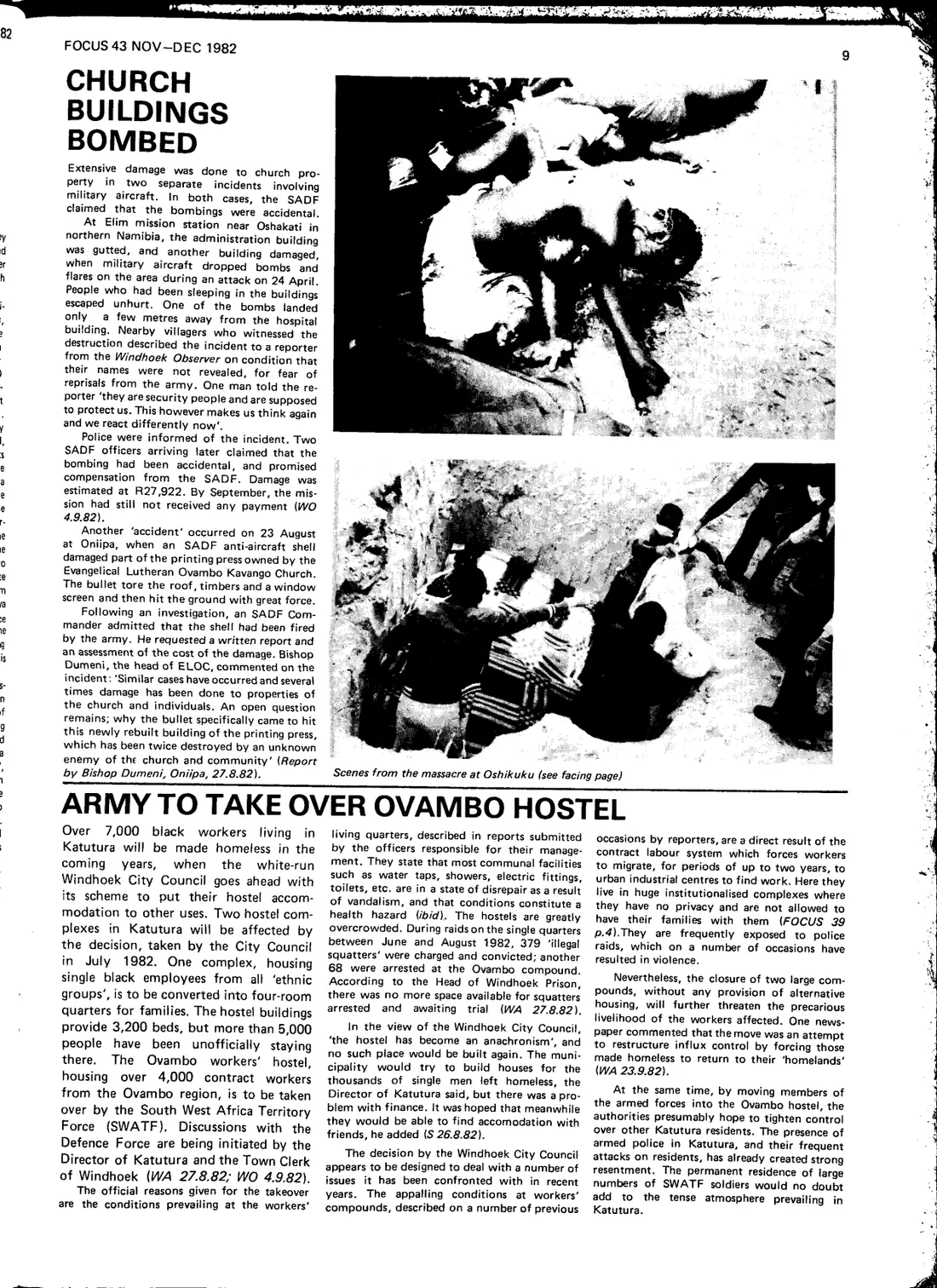
Reports about a massacre in a small village in the north of Namibia have thrown light on the key role of the para-military police unit Koevoet in carrying out atrocities while disguised as SWAPO guerillas. Eyewitness accounts of the massacre, which took place on 10 March 1982 at the village of Oshipanda near Oshikuku in Ovambo, sharply contradict the finding of the inquest held in the Ondangwa Inquest Court in June, which ruled that 'terrorists' were liable for the death of eight people murdered in the incident. Evidence suggests that one of the perpetrators of the killings was also connected with the disappearance of Johannes Kakuva in August 1980 (FOCUS 39 p.2, 42 p.9).
The case has wider implications, showing up the cosmetic nature of the inquests regularly held by courts in Namibia into unnatural deaths, and exposing the strategy of the SADF blaming SWAPO for atrocities against civilians which are in fact committed by the security forces.
There are a number of discrepancies between the various accounts of the massacre, including differences in the names as they are given of those who were killed in the shooting. It would appear that up to 12 people died, including a number of children.
The killings were first reported by South African radio, and picked up by the South African and Namibian press, as having been committed by 'SWAPO terrorists', armed with Russian-made AK-47 rifles. The course of the information was 'a spokesman for the Ovambo administration', who claimed that the guerillas had put a number of civilians against a wall and shot them dead. Two other civilians were reported to have been wounded, and another to have escaped unhurt. The spokesman claimed the guerillas had taken money and portable radios from the civilians, The uninjured man ran to a nearby security force base camp and a patrol was sent out, but the guerillas had already disappeared, the spokesman said (BBC 15.3.82; CT/WA 12.3.82).
In late June, an inquest opened on the case at the Ondangwa Inquest Court, which heard an account from one of the survivors. According to the witness, Jolidye Nauyoma, he and two others were awakened at 2 am by two camouflaged men entering their homestead. Outside were two others, also camouflaged and carrying automatic rifles with crooked magazines - a reference to AK-47 guns. Nauyoma said he and his room-mates were stabbed and taken outside, when nine other inhabitants of the homestead were ordered to line up against a wooden fence. The armed men opened fire, and Nauyoma slumped to the ground pretending to be dead. An hour later, after the men had ran-sacked the huts and left, Nauyoma and two other survivors sought shelter. The following morning, Nauyoma said, he reported the attack. The magistrate presiding at the inquest ruled that 'terrorists were liable for the death of the eight people' (WA 2.7.82).
A different story was told to a reporter from the Windhoek Observer by 'certain sources' in Ovambo, whose identities were not revealed but who were described as those who had taken photos of the massacre before the bodies were buried.
According to this account, twelve men, women and children at the village were woken at 2 a.m. by five black soldiers brandishing automatic rifles with fixed bayonets. The soldiers ordered them to line up outside and demanded money and clothes. One of the twelve, Ms. Penehafo Angula, a shop assistant, collected R3,800 and some other goods from the homestead, and handed them over. She was then made to line up again with the others and the soldiers opened fire after counting them to three. The soldiers then destroyed property, including a vehicle belonging to the owner of the homestead (WO 28.8.82).
This account stated that Penehafo Angula survived despite being shot in both legs. Michael Uupindi, a neighbour, heard the automatic fire. He went to investigate in the morning, covered the corpses and then went to Oshakati to report what had happened (WO ibid).
The Windhoek Observer's sources handed over a written paper, which stated that the survivors had 'unmistakably identified' the soldiers involved. The moon had been full and they had recognised Nakale, whom they described as an infamous and brutal commander at a military camp at Okalongo in north-western Namibia (WO ibid).
The names of those who died in the massacre were recorded by the Ondangwa Inquest Court as: Gisella Nupindi (Uusindi) (aged 61), Johannes Silas (42), Bernadette Tobias (27), Katoole Kawelakana (a girl aged 9), Shivute Kengayi (a male student, 18), Gisella Nepolo (a girl aged 13), Tselina Matheus (13) and Benedictus Nepolo (a male student, 20) — a total of eight people. The survivors were given as Jolidye Nauyoma (a male student aged 20) and Penehafo Angula (see above). A boy aged 8, Erastus Nepolo, was said to have been heavily wounded (and seems to have died later — see below) (WA 2.7.82; WO 28.8.82).
Information made available by the SWAPO office in London stated that the owner of the homestead, Hubertus Mateus Neporo, had been away for the night, and gave the names of those who died as: Bernadette Tobias Kashawa (wife of Hubertus Neporo), Gisela Uupindi, Benedictus Tobias Neporo, Gisela Neporo, Johannes Silas, Aniatar Kengayi Augustinus, Alma Hubertus Neporo, Frans Erasmus, Erastus Neporo and Benedictus the driver — a total of ten. The survivors were named as Penehafo Angula and Iyambo lipinge, cousin of Hubertus Neporo (undated memorandum from SWAPO office, London).
SWAPO's account stated that Michael Uupindi had reported the killings to the Oshakati Police Station, half an hour's drive away. Hubertus Neporo also reported to the police, 'who appeared to have foreknowledge of the incident, and made excuses as to why they would not investigate'. Some villagers and missionaries from the local mission did however go to the scene on the morning of 10 March (SWAPO memorandum ibid).
There is speculation that Nakale, the military commander identified by the survivors previously operated in the Kaoko region in the guise of a guerilla leader and was connected with the Kakuva case. According to the Windhoek Observer, Nakale was described as a SWAPO guerilla commander by a police witness, Lieutenant King, in an affidavit submitted in court during the Kakuva inquiry in November 1981. King claimed that a guerilla commander by the name of Kayala was active in Kaokolang holding political meetings in the settlement and carrying out guerilla activities in the western part of Ovambo and in Kaoko with group of combatants. According to the Windhoek Observer, it is highly likely that Koevoet commander identified by the survivors of the massacre as Nakale is the same man who posed as a guerilla leader under the name of Kayala. Kakuva was, according to Lt. King, persuaded by the police to infiltrate the guerilla group led by Kayala with the aim of reporting their hideout to the police. Kakuva subsequently 'disappeared'; while the police claimed that he had probably joined the guerillas, a fellow detainee reported hearing his screams under torture and witnessing his death (WO 9.1.82; FOCUS 39 p.2).
The use of police or army informers to credit SWAPO combatants among the civilian population seems to be a common practice among the SADF. Its aim is to sow confusion among civilians about SWAPO's objectives and methods. For instance, a witness in the Kakuva case, describing a meeting with the 'guerillas' said Kayala told him they 'had come to South West Africa to kill the whites, to free the country' and that the whites were aliens who had no rights in the country (WO 28.11.81). SWAPO's policy is in fact to create a non-racial society in Namibia, where people of all races can live in peace.
A similar case of members of the security forces posing as SWAPO guerillas and threatening civilians was reported in June 1982. A man wearing a uniform not usually worn by the South African security forces, and carrying an AK-47 rifle commonly ascribed to SWAPO guerillas, repeatedly visited a shop in a village near Rundu in the north, asking the shopkeeper for the whereabouts of a local resident, Mr Mbanzi, and his wife. The shopkeeper became suspicious and, after having a close look at the man, recognised him as someone living nearby. He visited the man's living quarters and found a group of men there, who admitted that they were members of the security forces whose task it was to make night visits to people who were 'enemies of the DTA'. Their leader apparently admitted that the group's work was to terrorise people while masquerading as SWAPO combatants, in an effort to frighten them and to make the threats of 'SWAPO terrorism' spread about by the army become a reality. In this way they would discredit SWAPO and prove to the people that it was SWAPO who killed and terrorised people' (WO 19.6.82).