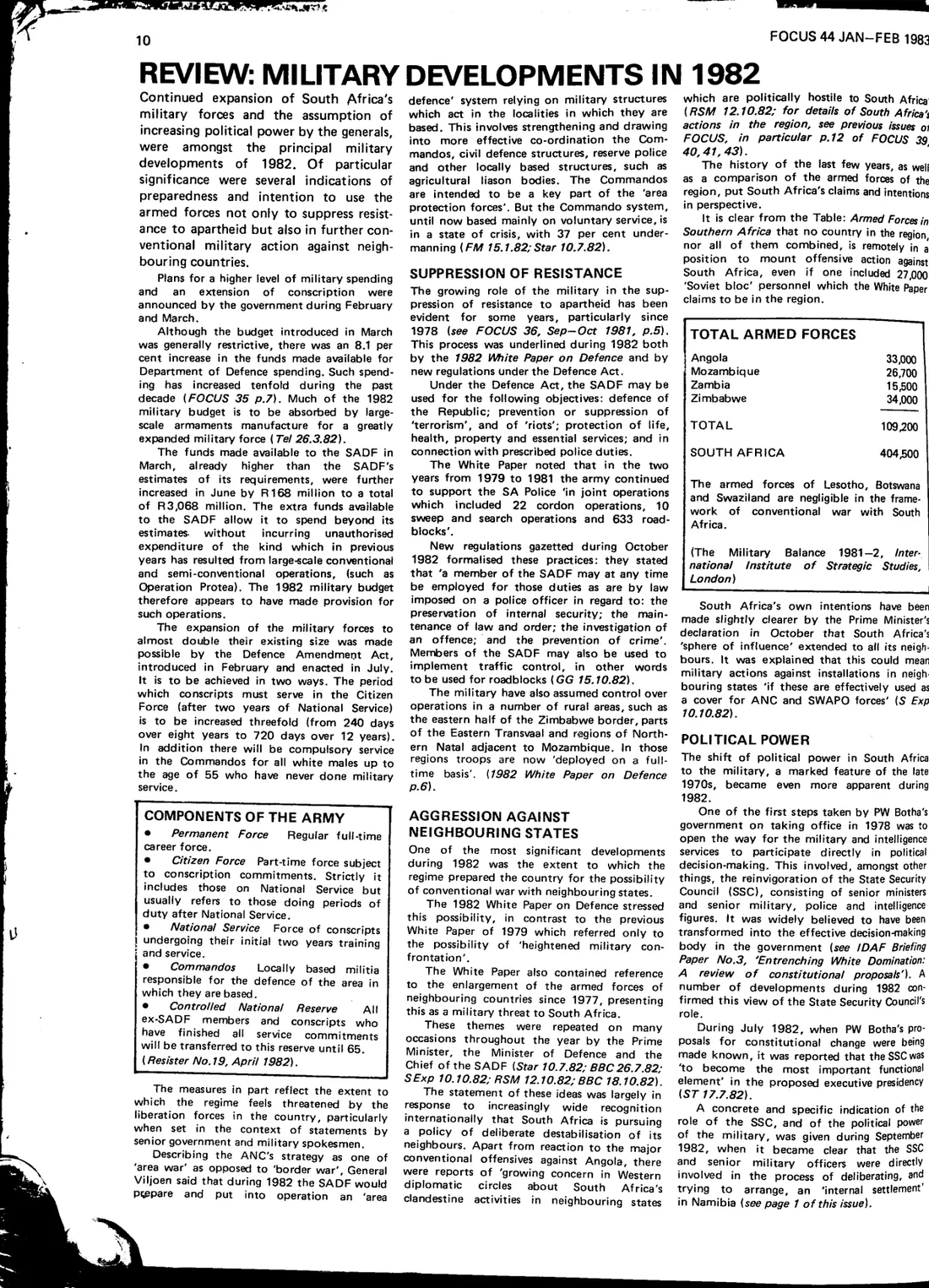
Continued expansion of South Africa's military forces and the assumption of increasing political power by the generals, were amongst the principal military developments of 1982. Of particular significance were several indications of preparedness and intention to use the armed forces not only to suppress resistance to apartheid but also in further conventional military action against neighbouring countries.
Plans for a higher level of military spending and an extension of conscription were announced by the government during February and March.
Although the budget introduced in March was generally restrictive, there was an 8.1 per cent increase in the funds made available for Department of Defence spending. Such spending has increased tenfold during the past decade. Much of the 1982 military budget is to be absorbed by large-scale armaments manufacture for a greatly expanded military force.
The funds made available to the SADF in March, already higher than the SADF's estimates of its requirements, were further increased in June by R168 million to a total of R3,068 million. The extra funds available to the SADF allow it to spend beyond its estimates without incurring unauthorised expenditure of the kind which in previous years has resulted from large-scale conventional and semi-conventional operations, (such as Operation Protea). The 1982 military budget therefore appears to have made provision for such operations.
The expansion of the military forces to almost double their existing size was made possible by the Defence Amendment Act, introduced in February and enacted in July. It is to be achieved in two ways. The period which conscripts must serve in the Citizen Force (after two years of National Service) is to be increased threefold (from 240 days over eight years to 720 days over 12 years). In addition there will be compulsory service in the Commandos for all white males up to the age of 55 who have never done military service.
COMPONENTS OF THE ARMY * Permanent Force Regular full-time career force. * Citizen Force Part-time force subject to conscription commitments. Strictly it includes those on National Service but usually refers to those doing periods of duty after National Service. * National Service Force of conscripts undergoing their initial two years training and service. * Commandos Locally based militia responsible for the defence of the area in which they are based. * Controlled National Reserve All ex-SADF members and conscripts who have finished all service commitments will be transferred to this reserve until 65.
The measures in part reflect the extent to which the regime feels threatened by the liberation forces in the country, particularly when set in the context of statements by senior government and military spokesmen.
Describing the ANC's strategy as one of 'area war' as opposed to 'border war', General Viljoen said that during 1982 the SADF would prepare and put into operation an 'area defence' system relying on military structures which act in the localities in which they are based. This involves strengthening and drawing into more effective co-ordination the Commandos, civil defence structures, reserve police and other locally based structures, such as agricultural liason bodies. The Commandos are intended to be a key part of the 'area protection forces'. But the Commando system, until now based mainly on voluntary service, is in a state of crisis, with 37 per cent undermanning.
SUPPRESSION OF RESISTANCE The growing role of the military in the suppression of resistance to apartheid has been evident for some years, particularly since 1978. This process was underlined during 1982 both by the 1982 White Paper on Defence and by new regulations under the Defence Act.
Under the Defence Act, the SADF may be used for the following objectives: defence of the Republic; prevention or suppression of 'terrorism', and of 'riots'; protection of life, health, property and essential services; and in connection with prescribed police duties.
The White Paper noted that in the two years from 1979 to 1981 the army continued to support the SA Police 'in joint operations which included 22 cordon operations, 10 sweep and search operations and 633 roadblocks'.
New regulations gazetted during October 1982 formalised these practices: they stated that 'a member of the SADF may at any time be employed for those duties as are by law imposed on a police officer in regard to: the preservation of internal security; the maintenance of law and order; the investigation of an offence; and the prevention of crime'. Members of the SADF may also be used to implement traffic control, in other words to be used for roadblocks.
The military have also assumed control over operations in a number of rural areas, such as the eastern half of the Zimbabwe border, parts of the Eastern Transvaal and regions of Northern Natal adjacent to Mozambique. In those regions troops are now 'deployed on a full-time basis'.
AGGRESSION AGAINST NEIGHBOURING STATES One of the most significant developments during 1982 was the extent to which the regime prepared the country for the possibility of conventional war with neighbouring states.
The 1982 White Paper on Defence stressed this possibility, in contrast to the previous White Paper of 1979 which referred only to the possibility of 'heightened military confrontation'.
The White Paper also contained reference to the enlargement of the armed forces of neighbouring countries since 1977, presenting this as a military threat to South Africa.
These themes were repeated on many occasions throughout the year by the Prime Minister, the Minister of Defence and the Chief of the SADF.
The statement of these ideas was largely in response to increasingly wide recognition internationally that South Africa is pursuing a policy of deliberate destabilisation of its neighbours. Apart from reaction to the major conventional offensives against Angola, there were reports of 'growing concern in Western diplomatic circles about South Africa's clandestine activities in neighbouring states which are politically hostile to South Africa.
The history of the last few years, as well as a comparison of the armed forces of the region, put South Africa's claims and intentions in perspective.
It is clear from the Table: Armed Forces in Southern Africa that no country in the region, nor all of them combined, is remotely in a position to mount offensive action against South Africa, even if one included 27,000 'Soviet bloc' personnel which the White Paper claims to be in the region.
South Africa's own intentions have been made slightly clearer by the Prime Minister's declaration in October that South Africa's 'sphere of influence' extended to all its neighbours. It was explained that this could mean military actions against installations in neighbouring states 'if these are effectively used as a cover for ANC and SWAPO forces'.
POLITICAL POWER The shift of political power in South Africa to the military, a marked feature of the late 1970s, became even more apparent during 1982.
One of the first steps taken by PW Botha's government on taking office in 1978 was to open the way for the military and intelligence services to participate directly in political decision-making. This involved, amongst other things, the reinvigoration of the State Security Council (SSC), consisting of senior ministers and senior military, police and intelligence figures. It was widely believed to have been transformed into the effective decision-making body in the government. A number of developments during 1982 confirmed this view of the State Security Council's role.
During July 1982, when PW Botha's proposals for constitutional change were being made known, it was reported that the SSC was 'to become the most important functional element' in the proposed executive presidency.
A concrete and specific indication of the role of the SSC, and of the political power of the military, was given during September 1982, when it became clear that the SSC and senior military officers were directly involved in the process of deliberating, and trying to arrange, an 'internal settlement' in Namibia.