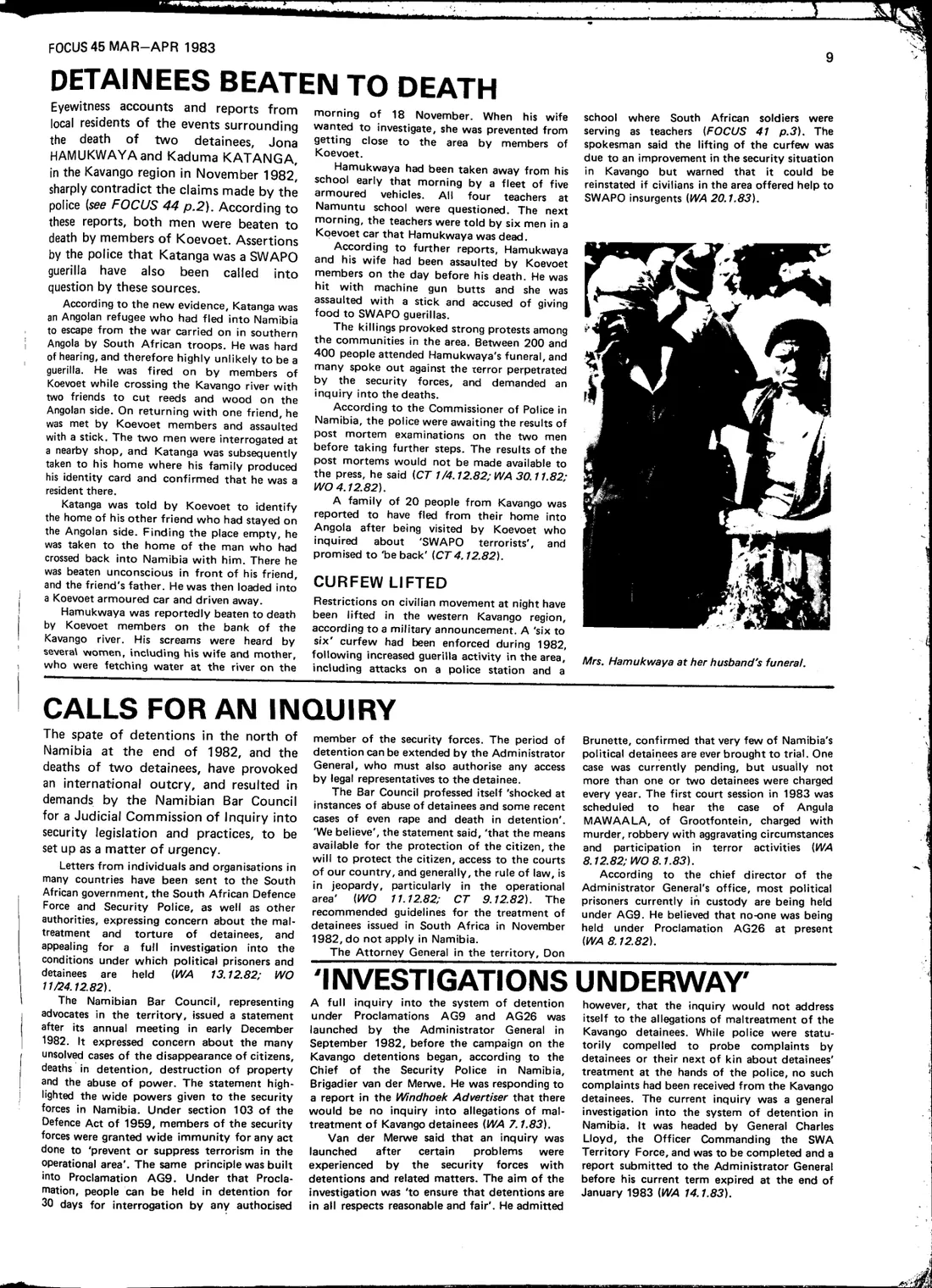
Eyewitness accounts and reports from local residents of the events surrounding the death of two detainees, Jona HAMUKWAYA and Kaduma KATANGA, in the Kavango region in November 1982, sharply contradict the claims made by the police. According to these reports, both men were beaten to death by members of Koevoet. Assertions by the police that Katanga was a SWAPO guerilla have also been called into question by these sources.
According to the new evidence, Katanga was an Angolan refugee who had fled into Namibia to escape from the war carried on in southern Angola by South African troops. He was hard of hearing, and therefore highly unlikely to be a guerilla. He was fired on by members of Koevoet while crossing the Kavango river with two friends to cut reeds and wood on the Angolan side. On returning with one friend, he was met by Koevoet members and assaulted with a stick. The two men were interrogated at a nearby shop, and Katanga was subsequently taken to his home where his family produced his identity card and confirmed that he was a resident there.
Katanga was told by Koevoet to identify the home of his other friend who had stayed on the Angolan side. Finding the place empty, he was taken to the home of the man who had crossed back into Namibia with him. There he was beaten unconscious in front of his friend, and the friend's father. He was then loaded into a Koevoet armoured car and driven away.
Hamukwaya was reportedly beaten to death by Koevoet members on the bank of the Kavango river. His screams were heard by several women, including his wife and mother, who were fetching water at the river on the morning of 18 November. When his wife wanted to investigate, she was prevented from getting close to the area by members of Koevoet.
Hamukwaya had been taken away from his school early that morning by a fleet of five armoured vehicles. All four teachers at Namuntu school were questioned. The next morning, the teachers were told by six men in a Koevoet car that Hamukwaya was dead.
According to further reports, Hamukwaya and his wife had been assaulted by Koevoet members on the day before his death. He was hit with machine gun butts and she was assaulted with a stick and accused of giving food to SWAPO guerillas.
The killings provoked strong protests among the communities in the area. Between 200 and 400 people attended Hamukwaya's funeral, and many spoke out against the terror perpetrated by the security forces, and demanded an inquiry into the deaths.
According to the Commissioner of Police in Namibia, the police were awaiting the results of post mortem examinations on the two men before taking further steps. The results of the post mortems would not be made available to the press, he said.
A family of 20 people from Kavango was reported to have fled from their home into Angola after being visited by Koevoet who inquired about 'SWAPO terrorists', and promised to 'be back'.
CURFEW LIFTED
Restrictions on civilian movement at night have been lifted in the western Kavango region, according to a military announcement. A 'six to six' curfew had been enforced during 1982, following increased guerilla activity in the area, including attacks on a police station and a school where South African soldiers were serving as teachers. The spokesman said the lifting of the curfew was due to an improvement in the security situation in Kavango but warned that it could be reinstated if civilians in the area offered help to SWAPO insurgents.
CALLS FOR AN INQUIRY
The spate of detentions in the north of Namibia at the end of 1982, and the deaths of two detainees, have provoked an international outcry, and resulted in demands by the Namibian Bar Council for a Judicial Commission of Inquiry into security legislation and practices, to be set up as a matter of urgency.
Letters from individuals and organisations in many countries have been sent to the South African government, the South African Defence Force and Security Police, as well as other authorities, expressing concern about the maltreatment and torture of detainees, and appealing for a full investigation into the conditions under which political prisoners and detainees are held.
The Namibian Bar Council, representing advocates in the territory, issued a statement after its annual meeting in early December 1982. It expressed concern about the many unsolved cases of the disappearance of citizens, deaths in detention, destruction of property and the abuse of power. The statement highlighted the wide powers given to the security forces in Namibia. Under section 103 of the Defence Act of 1959, members of the security forces were granted wide immunity for any act done to 'prevent or suppress terrorism in the operational area'. The same principle was built into Proclamation AG9. Under that Proclamation, people can be held in detention for 30 days for interrogation by any authorised member of the security forces. The period of detention can be extended by the Administrator General, who must also authorise any access by legal representatives to the detainee.
The Bar Council professed itself 'shocked at instances of abuse of detainees and some recent cases of even rape and death in detention'. 'We believe', the statement said, 'that the means available for the protection of the citizen, the will to protect the citizen, access to the courts of our country, and generally, the rule of law, is in jeopardy, particularly in the operational area'. The recommended guidelines for the treatment of detainees issued in South Africa in November 1982, do not apply in Namibia.
The Attorney General in the territory, Don Brunette, confirmed that very few of Namibia's political detainees are ever brought to trial. One case was currently pending, but usually not more than one or two detainees were charged every year. The first court session in 1983 was scheduled to hear the case of Angela MAWAALA, of Grootfontein, charged with murder, robbery with aggravating circumstances and participation in terror activities.
According to the chief director of the Administrator General's office, most political prisoners currently in custody are being held under AG9. He believed that no-one was being held under Proclamation AG26 at present.
INVESTIGATIONS UNDERWAY
A full inquiry into the system of detention under Proclamations AG9 and AG26 was launched by the Administrator General in September 1982, before the campaign on the Kavango detentions began, according to the Chief of the Security Police in Namibia, Brigadier van der Merwe. He was responding to a report in the Windhoek Advertiser that there would be no inquiry into allegations of maltreatment of Kavango detainees.
Van der Merwe said that an inquiry was launched after certain problems were experienced by the security forces with detentions and related matters. The aim of the investigation was 'to ensure that detentions are in all respects reasonable and fair'. He admitted however, that the inquiry would not address itself to the allegations of maltreatment of the Kavango detainees. While police were statutorily compelled to probe complaints by detainees or their next of kin about detainees' treatment at the hands of the police, no such complaints had been received from the Kavango detainees. The current inquiry was a general investigation into the system of detention in Namibia. It was headed by General Charles Lloyd, the Officer Commanding the SWA Territory Force, and was to be completed and a report submitted to the Administrator General before his current term expired at the end of January 1983.