Shock and criticism have been expressed by Namibian lawyers and others at the light sentence imposed on a white farmer, Andries Jacobus van Rooyen (23), for beating to death a black parole prisoner handed to him to work on his farm. Van Rooyen was sentenced to six years imprisonment for culpable homicide for killing Kasire Thomas (20), in March 1982. He was granted leave to appeal, and released on bail of R500.
The trial opened in the Windhoek Supreme Court on 16 November 1982, but was postponed to March 1983 to allow van Rooyen time to arrange his defence. Van Rooyen and Lukas Kasuto (26), a fellow convict of Thomas who was also forced to work on the farm and was accused of being involved in the killing, both pleaded not guilty to having murdered Thomas.
According to evidence presented at the trial, Thomas and Kasuto were let out on parole from Grootfontein prison at Rooyen's request to work on his farm. Rooyen collected them from the prison, and on arrival at the farm questioned them about their background. When Thomas told him that he was from Ovambo, van Rooyen reportedly accused him of being a 'terrorist', and chained Thomas to a garage pole. According to evidence given by one of the labourers working on van Rooyen's farm who witnessed the assault, the farmer clubbed Thomas with an empty oil drum on the face and head, and punched him all over the body until Thomas was bleeding profusely. He demanded that Thomas admit that he was a 'terrorist'.
When Thomas refused, van Rooyen slashed pieces off the prisoner's left ear with a pocket knife, telling him that 'wherever you go, people will recognise you as a SWAPO from this earmark'. When Thomas finally 'admitted' that he was a member of SWAPO van Rooyen took a six foot long crowbar and thrust its sharpened edge into Thomas' nostrils.
Thomas, who weighed only 45kg, became unconscious as a result of the continued assault, and was left tied to the garage pole for the night. The other labourers were warned by van Rooyen not to give him any food or water.
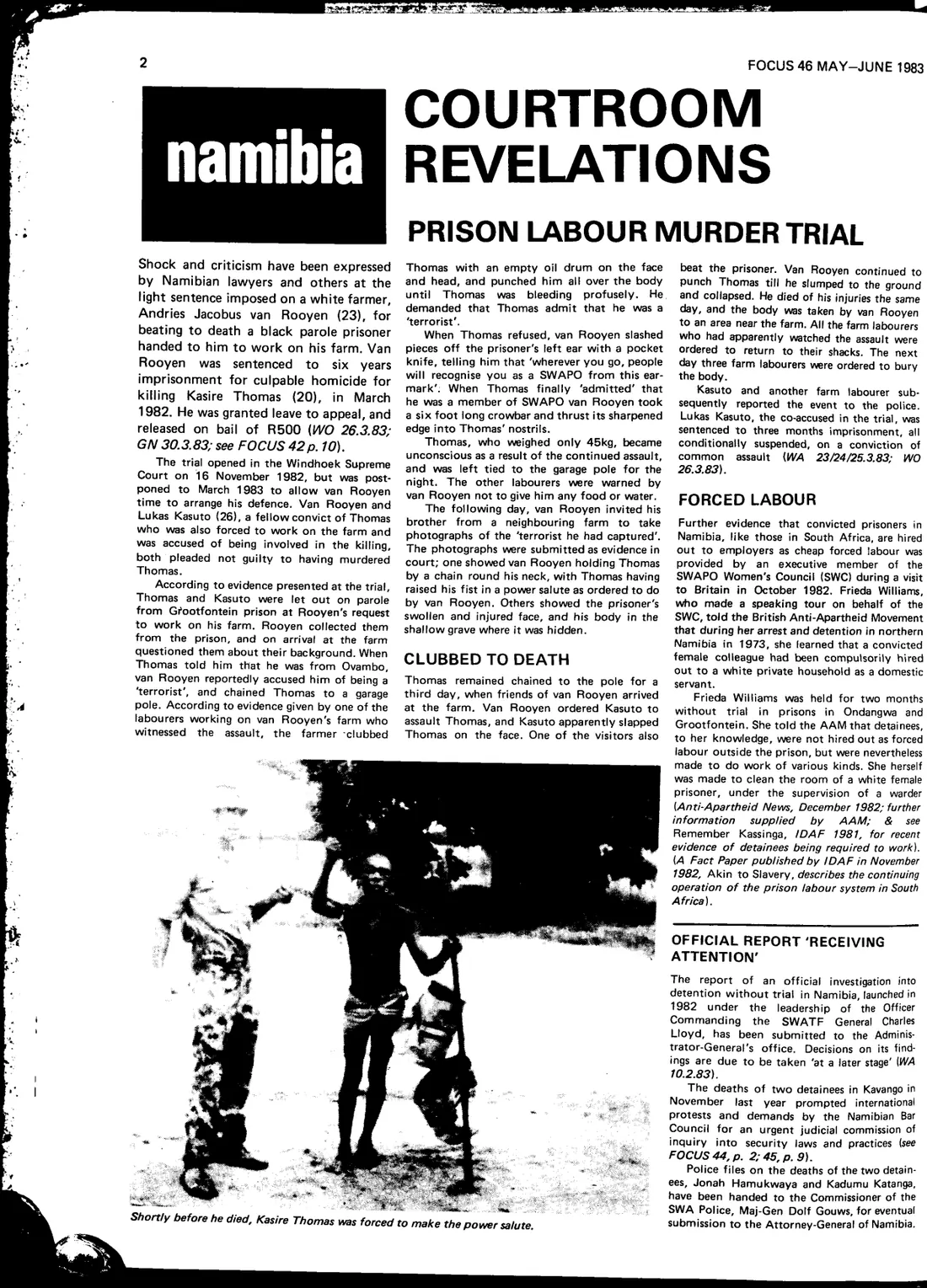
The following day, van Rooyen invited his brother from a neighbouring farm to take photographs of the 'terrorist he had captured'. The photographs were submitted as evidence in court; one showed van Rooyen holding Thomas by a chain round his neck, with Thomas having raised his fist in a power salute as ordered to do by van Rooyen. Others showed the prisoner's swollen and injured face, and his body in the shallow grave where it was hidden.
Thomas remained chained to the pole for a third day, when friends of van Rooyen arrived at the farm. Van Rooyen ordered Kasuto to assault Thomas, and Kasuto apparently slapped Thomas on the face. One of the visitors also beat the prisoner. Van Rooyen continued to punch Thomas till he slumped to the ground and collapsed. He died of his injuries the same day, and the body was taken by van Rooyen to an area near the farm. All the farm labourers who had apparently watched the assault were ordered to return to their shacks. The next day three farm labourers were ordered to bury the body.
Kasuto and another farm labourer subsequently reported the event to the police. Lukas Kasuto, the co-accused in the trial, was sentenced to three months imprisonment, all conditionally suspended, on a conviction of common assault.
Further evidence that convicted prisoners in Namibia, like those in South Africa, are hired out to employers as cheap forced labour was provided by an executive member of the SWAPO Women's Council (SWC) during a visit to Britain in October 1982. Frieda Williams, who made a speaking tour on behalf of the SWC, told the British Anti-Apartheid Movement that during her arrest and detention in northern Namibia in 1973, she learned that a convicted female colleague had been compulsorily hired out to a white private household as a domestic servant.
Frieda Williams was held for two months without trial in prisons in Ondangwa and Grootfontein. She told the AAM that detainees, to her knowledge, were not hired out as forced labour outside the prison, but were nevertheless made to do work of various kinds. She herself was made to clean the room of a white female prisoner, under the supervision of a warder.