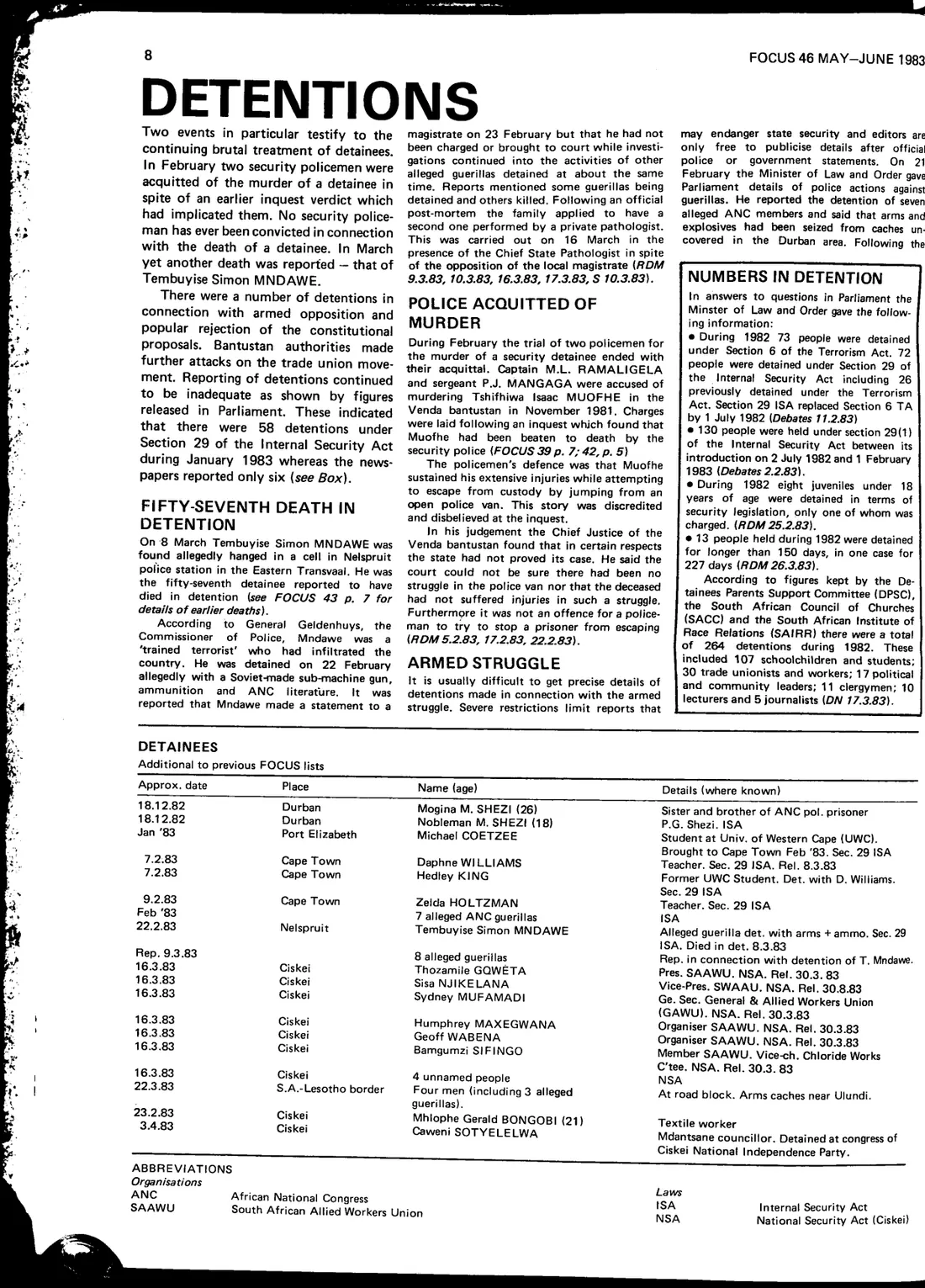
Two events in particular testify to the continuing brutal treatment of detainees. In February two security policemen were acquitted of the murder of a detainee in spite of an earlier inquest verdict which had implicated them. No security policeman has ever been convicted in connection with the death of a detainee. In March yet another death was reported - that of Tembuyise Simon MNDAWE.
There were a number of detentions in connection with armed opposition and popular rejection of the constitutional proposals. Bantustan authorities made further attacks on the trade union movement. Reporting of detentions continued to be inadequate as shown by figures released in Parliament. These indicated that there were 58 detentions under Section 29 of the Internal Security Act during January 1983 whereas the newspapers reported only six.
FIFTY-SEVENTH DEATH IN DETENTION
On 8 March Tembuyise Simon MNDAWE was found allegedly hanged in a cell in Nelspruit police station in the Eastern Transvaal. He was the fifty-seventh detainee reported to have died in detention.
According to General Geldenhuys, the Commissioner of Police, Mndawe was a 'trained terrorist' who had infiltrated the country. He was detained on 22 February allegedly with a Soviet-made sub-machine gun, ammunition and ANC literature. It was reported that Mndawe made a statement to a magistrate on 23 February but that he had not been charged or brought to court while investigations continued into the activities of other alleged guerillas detained at about the same time. Reports mentioned some guerillas being detained and others killed. Following an official post-mortem the family applied to have a second one performed by a private pathologist. This was carried out on 16 March in the presence of the Chief State Pathologist in spite of the opposition of the local magistrate.
POLICE ACQUITTED OF MURDER
During February the trial of two policemen for the murder of a security detainee ended with their acquittal. Captain M.L. RAMALIGELA and sergeant P.J. MANGAGA were accused of murdering Tshifhiwa Isaac MUOFHE in the Venda bantustan in November 1981. Charges were laid following an inquest which found that Muofhe had been beaten to death by the security police.
The policemen's defence was that Muofhe sustained his extensive injuries while attempting to escape from custody by jumping from an open police van. This story was discredited and disbelieved at the inquest.
In his judgement the Chief Justice of the Venda bantustan found that in certain respects the state had not proved its case. He said the court could not be sure there had been no struggle in the police van nor that the deceased had not suffered injuries in such a struggle. Furthermore it was not an offence for a policeman to try to stop a prisoner from escaping.
ARMED STRUGGLE
It is usually difficult to get precise details of detentions made in connection with the armed struggle. Severe restrictions limit reports that may endanger state security and editors are only free to publicise details after official police or government statements. On 21 February the Minister of Law and Order gave Parliament details of police actions against guerillas. He reported the detention of several alleged ANC members and said that arms and explosives had been seized from caches uncovered in the Durban area.
NUMBERS IN DETENTION
In answers to questions in Parliament the Minster of Law and Order gave the following information: * During 1982 73 people were detained under Section 6 of the Terrorism Act. 72 people were detained under Section 29 of the Internal Security Act including 26 previously detained under the Terrorism Act. Section 29 ISA replaced Section 6 TA by 1 July 1982. * 130 people were held under section 29(1) of the Internal Security Act between its introduction on 2 July 1982 and 1 February 1983. * During 1982 eight juveniles under 18 years of age were detained in terms of security legislation, only one of whom was charged. * 13 people held during 1982 were detained for longer than 150 days, in one case for 227 days.
According to figures kept by the Detainees Parents Support Committee (DPSC), the South African Council of Churches (SACC) and the South African Institute of Race Relations (SAIRR) there were a total of 264 detentions during 1982. These included 107 schoolchildren and students; 30 trade unionists and workers; 17 political and community leaders; 11 clergymen; 10 lecturers and 5 journalists.