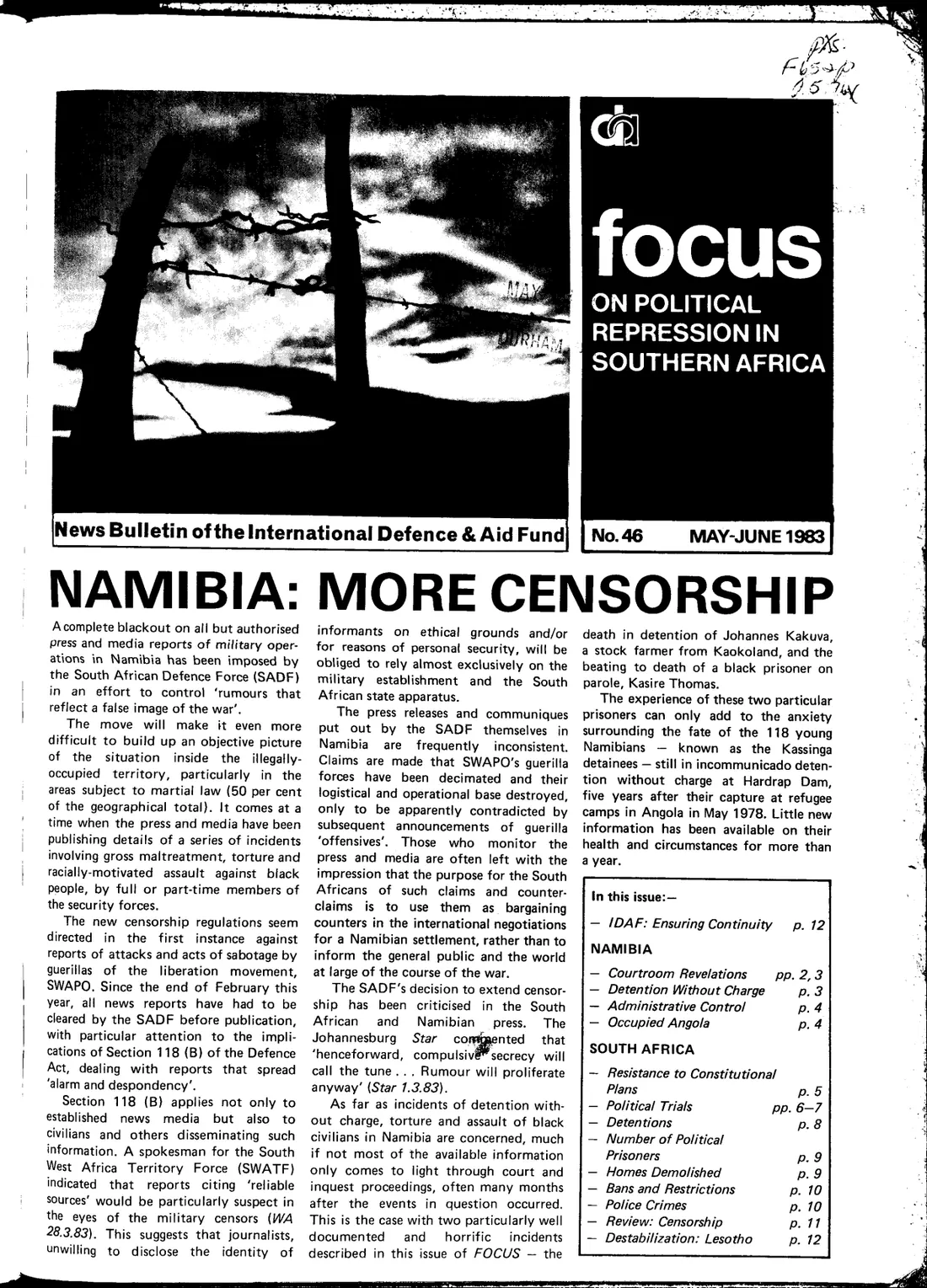
A complete blackout on all but authorised press and media reports of military operations in Namibia has been imposed by the South African Defence Force (SADF) in an effort to control 'rumours that reflect a false image of the war'.
The move will make it even more difficult to build up an objective picture of the situation inside the illegally-occupied territory, particularly in the areas subject to martial law (50 per cent of the geographical total). It comes at a time when the press and media have been publishing details of a series of incidents involving gross maltreatment, torture and racially-motivated assault against black people, by full or part-time members of the security forces.
The new censorship regulations seem directed in the first instance against reports of attacks and acts of sabotage by guerillas of the liberation movement, SWAPO. Since the end of February this year, all news reports have had to be cleared by the SADF before publication, with particular attention to the implications of Section 118 (B) of the Defence Act, dealing with reports that spread 'alarm and despondency'.
Section 118 (B) applies not only to established news media but also to civilians and others disseminating such information. A spokesman for the South West Africa Territory Force (SWATF) indicated that reports citing 'reliable sources' would be particularly suspect in the eyes of the military censors. This suggests that journalists, unwilling to disclose the identity of informants on ethical grounds and/or for reasons of personal security, will be obliged to rely almost exclusively on the military establishment and the South African state apparatus.
The press releases and communiques put out by the SADF themselves in Namibia are frequently inconsistent. Claims are made that SWAPO's guerilla forces have been decimated and their logistical and operational base destroyed, only to be apparently contradicted by subsequent announcements of guerilla 'offensives'. Those who monitor the press and media are often left with the impression that the purpose for the South Africans of such claims and counter-claims is to use them as bargaining counters in the international negotiations for a Namibian settlement, rather than to inform the general public and the world at large of the course of the war.
The SADF's decision to extend censorship has been criticised in the South African and Namibian press. The Johannesburg Star commented that 'henceforward, compulsive secrecy will call the tune . . . Rumour will proliferate anyway'.
As far as incidents of detention without charge, torture and assault of black civilians in Namibia are concerned, much if not most of the available information only comes to light through court and inquest proceedings, often many months after the events in question occurred. This is the case with two particularly well documented and horrific incidents described in this issue of FOCUS — the death in detention of Johannes Kakuva, a stock farmer from Kaokoland, and the beating to death of a black prisoner on parole, Kasire Thomas.
The experience of these two particular prisoners can only add to the anxiety surrounding the fate of the 118 young Namibians — known as the Kassinga detainees — still in incommunicado detention without charge at Hardrap Dam, five years after their capture at refugee camps in Angola in May 1978. Little new information has been available on their health and circumstances for more than a year.