The South African government claims that there are no political prisoners in South Africa, only what it calls 'security prisoners'. A 'security prisoner' is defined by the government as 'an ordinary criminal who has been sentenced by the courts for serious crimes against public safety and the security of the state.'
Nevertheless the authorities have always treated their 'security prisoners' as a group apart and have ensured that there is no contact between them and other 'ordinary criminals'.
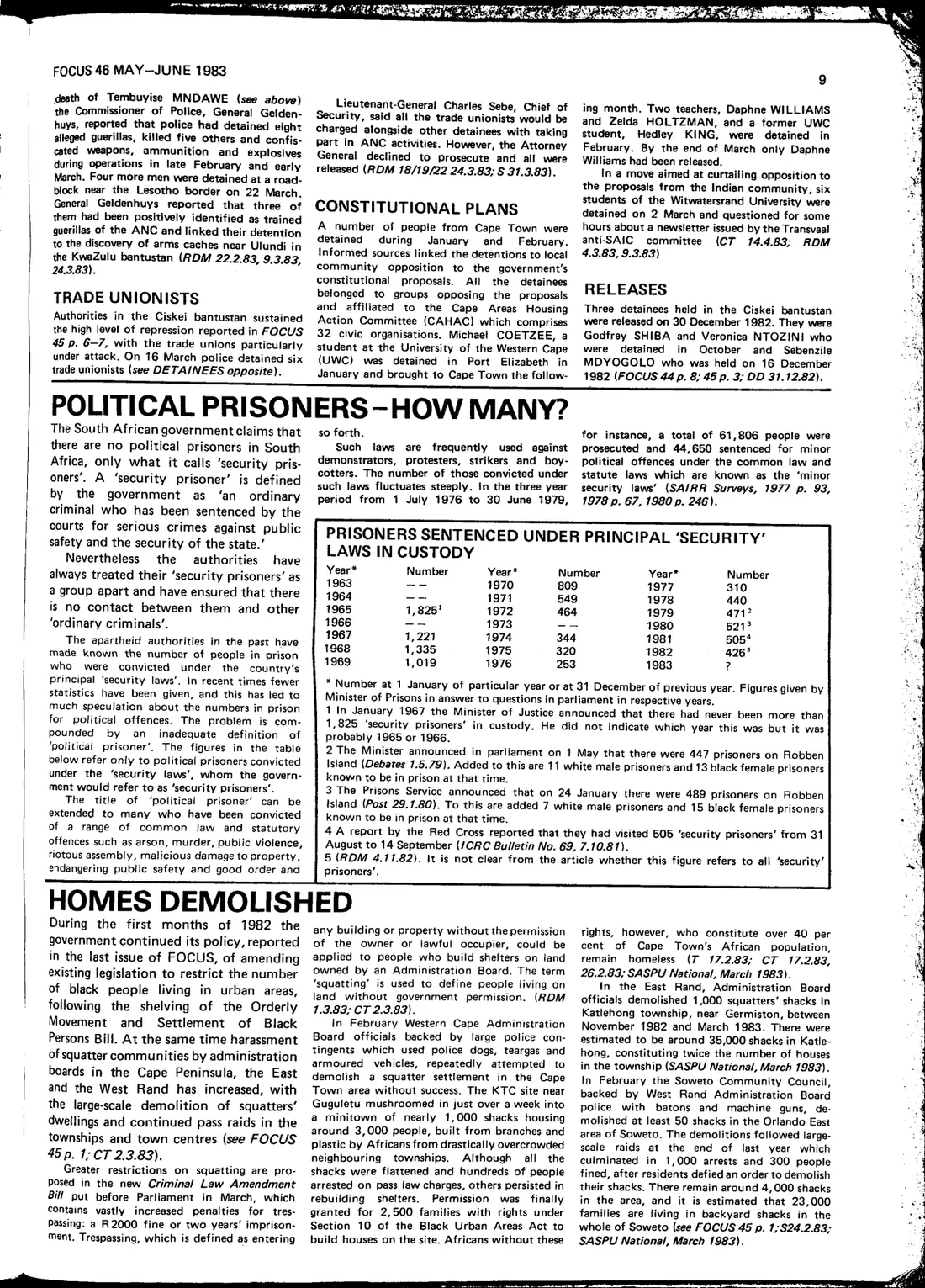
The apartheid authorities in the past have made known the number of people in prison who were convicted under the country's principal 'security laws'. In recent times fewer statistics have been given, and this has led to much speculation about the numbers in prison for political offences. The problem is compounded by an inadequate definition of 'political prisoner'. The figures in the table below refer only to political prisoners convicted under the 'security laws', whom the government would refer to as 'security prisoners'.
The title of 'political prisoner' can be extended to many who have been convicted of a range of common law and statutory offences such as arson, murder, public violence, riotous assembly, malicious damage to property, endangering public safety and good order and so forth.
Such laws are frequently used against demonstrators, protesters, strikers and boycotters. The number of those convicted under such laws fluctuates steeply. In the three year period from 1 July 1976 to 30 June 1979, for instance, a total of 61,806 people were prosecuted and 44,650 sentenced for minor political offences under the common law and statute laws which are known as the 'minor security laws'.