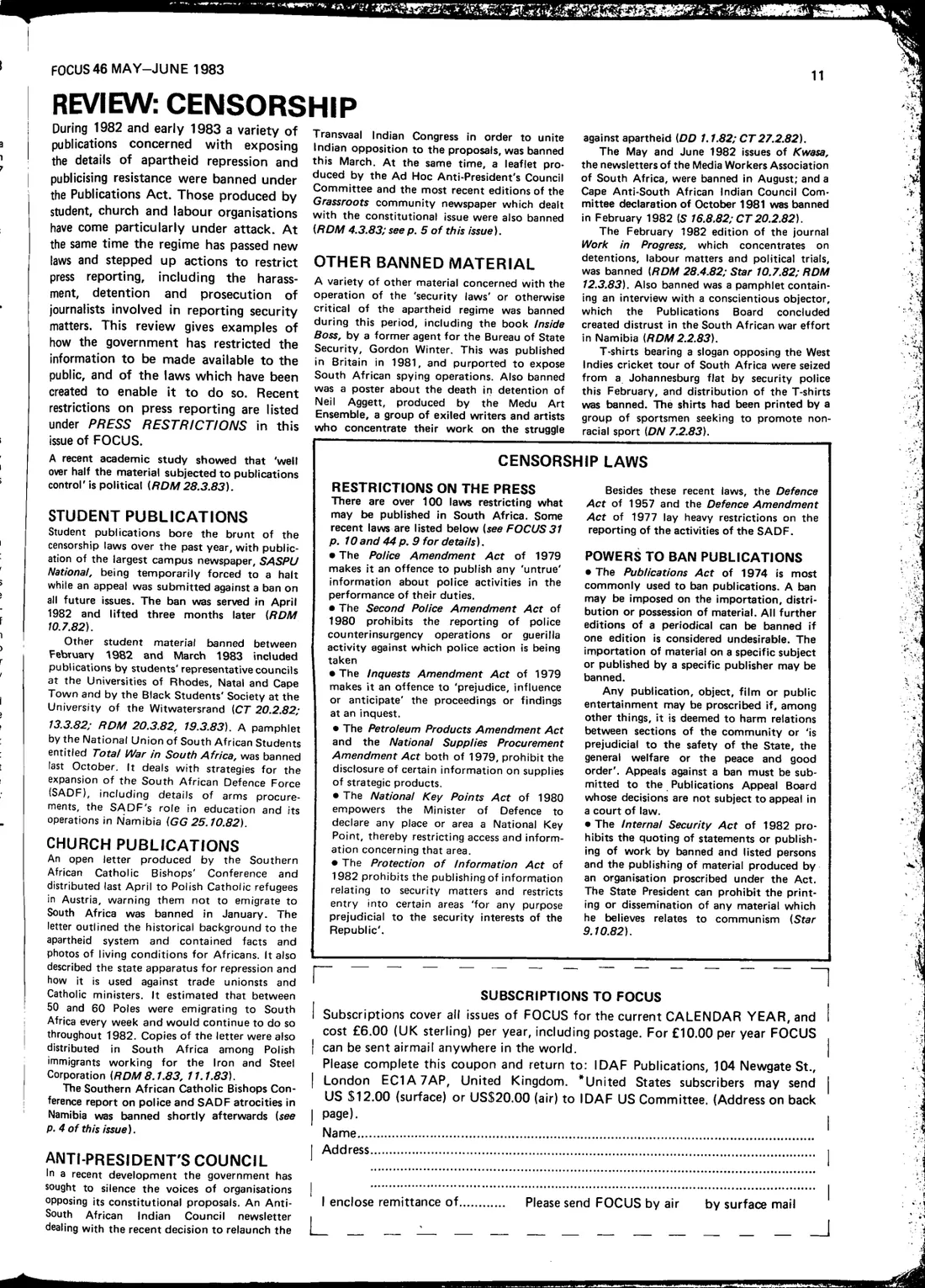
During 1982 and early 1983 a variety of publications concerned with exposing the details of apartheid repression and publicising resistance were banned under the Publications Act. Those produced by student, church and labour organisations have come particularly under attack. At the same time the regime has passed new laws and stepped up actions to restrict press reporting, including the harassment, detention and prosecution of journalists involved in reporting security matters. This review gives examples of how the government has restricted the information to be made available to the public, and of the laws which have been created to enable it to do so.
A recent academic study showed that 'well over half the material subjected to publications control' is political.
STUDENT PUBLICATIONS
Student publications bore the brunt of the censorship laws over the past year, with publication of the largest campus newspaper, SASPU National, being temporarily forced to a halt while an appeal was submitted against a ban on all future issues. The ban was served in April 1982 and lifted three months later.
Other student material banned between February 1982 and March 1983 included publications by students' representative councils at the Universities of Rhodes, Natal and Cape Town and by the Black Students' Society at the University of the Witwatersrand. A pamphlet by the National Union of South African Students entitled Total War in South Africa, was banned last October. It deals with strategies for the expansion of the South African Defence Force (SADF), including details of arms procurements, the SADF's role in education and its operations in Namibia.
CHURCH PUBLICATIONS
An open letter produced by the Southern African Catholic Bishops' Conference and distributed last April to Polish Catholic refugees in Austria, warning them not to emigrate to South Africa was banned in January. The letter outlined the historical background to the apartheid system and contained facts and photos of living conditions for Africans. It also described the state apparatus for repression and how it is used against trade unionists and Catholic ministers. It estimated that between 50 and 60 Poles were emigrating to South Africa every week and would continue to do so throughout 1982. Copies of the letter were also distributed in South Africa among Polish immigrants working for the Iron and Steel Corporation.
The Southern African Catholic Bishops Conference report on police and SADF atrocities in Namibia was banned shortly afterwards.
ANTI-PRESIDENT'S COUNCIL
In a recent development the government has sought to silence the voices of organisations opposing its constitutional proposals. An Anti-South African Indian Council newsletter dealing with the recent decision to relaunch the Transvaal Indian Congress in order to unite Indian opposition to the proposals, was banned this March. At the same time, a leaflet produced by the Ad Hoc Anti-President's Council Committee and the most recent editions of the Grassroots community newspaper which dealt with the constitutional issue were also banned.
OTHER BANNED MATERIAL
A variety of other material concerned with the operation of the 'security laws' or otherwise critical of the apartheid regime was banned during this period, including the book Inside Boss, by a former agent for the Bureau of State Security, Gordon Winter. This was published in Britain in 1981, and purported to expose South African spying operations. Also banned was a poster about the death in detention of Neil Aggett, produced by the Medu Art Ensemble, a group of exiled writers and artists who concentrate their work on the struggle against apartheid.
The May and June 1982 issues of Kwasa, the newsletters of the Media Workers Association of South Africa, were banned in August; and a Cape Anti-South African Indian Council Committee declaration of October 1981 was banned in February 1982.
The February 1982 edition of the journal Work in Progress, which concentrates on detentions, labour matters and political trials, was banned. Also banned was a pamphlet containing an interview with a conscientious objector, which the Publications Board concluded created distrust in the South African war effort in Namibia.
T-shirts bearing a slogan opposing the West Indies cricket tour of South Africa were seized from a Johannesburg flat by security police this February, and distribution of the T-shirts was banned. The shirts had been printed by a group of sportsmen seeking to promote non-racial sport.