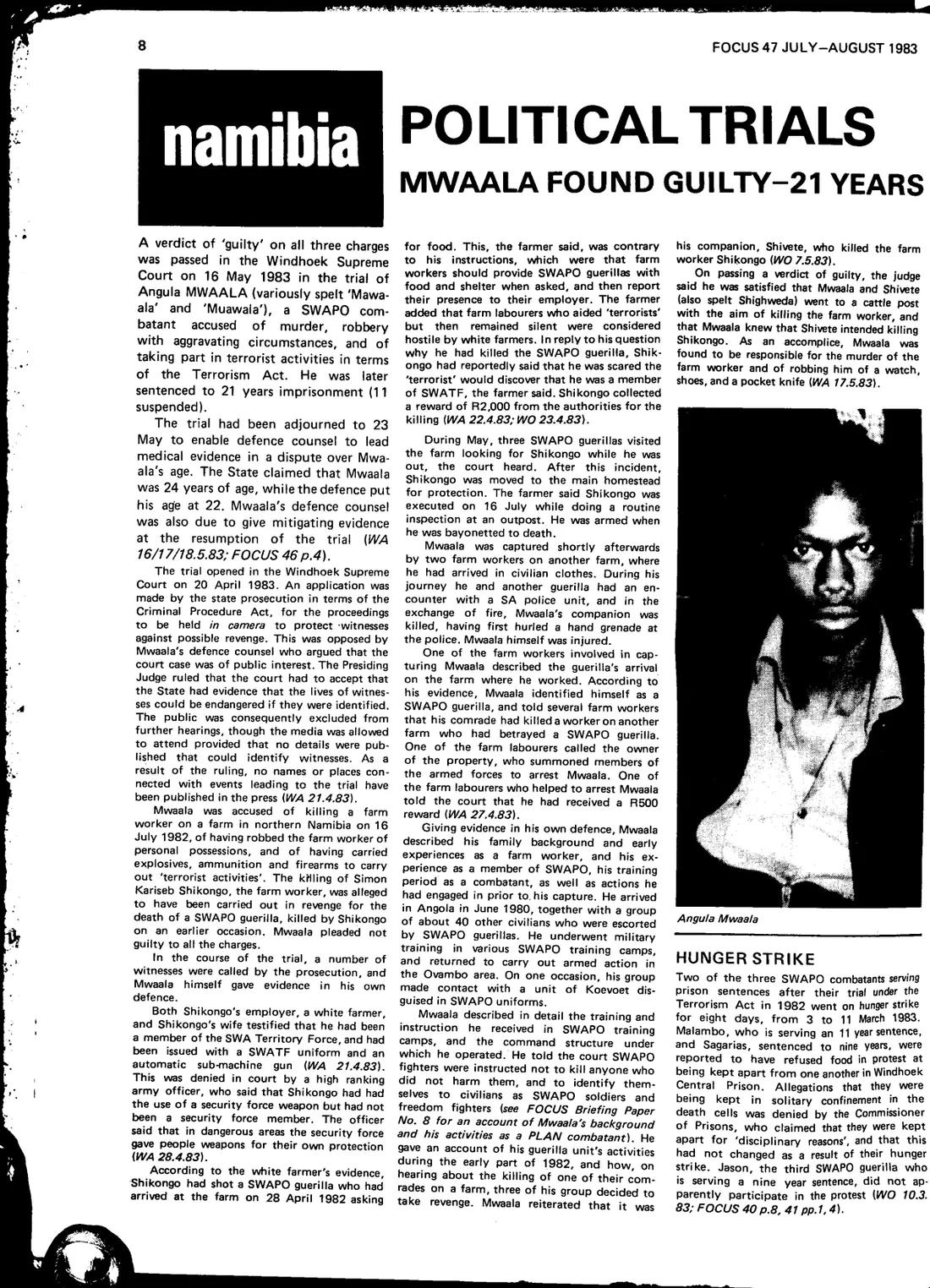
A verdict of 'guilty' on all three charges was passed in the Windhoek Supreme Court on 16 May 1983 in the trial of Angela MWAALA (variously spelt 'Mawala' and 'Muawala'), a SWAPO combatant accused of murder, robbery with aggravating circumstances, and of taking part in terrorist activities in terms of the Terrorism Act. He was later sentenced to 21 years imprisonment (11 suspended).
The trial had been adjourned to 23 May to enable defence counsel to lead medical evidence in a dispute over Mwala's age. The State claimed that Mwaala was 24 years of age, while the defence put his age at 22. Mwaala's defence counsel was also due to give mitigating evidence at the resumption of the trial (WA 16/17/18.5.83; FOCUS 46 p.4).
The trial opened in the Windhoek Supreme Court on 20 April 1983. An application was made by the state prosecution in terms of the Criminal Procedure Act, for the proceedings to be held in camera to protect witnesses against possible revenge. This was opposed by Mwaala's defence counsel who argued that the court case was of public interest. The Presiding Judge ruled that the court had to accept that the State had evidence that the lives of witnesses could be endangered if they were identified. The public was consequently excluded from further hearings, though the media was allowed to attend provided that no details were published that could identify witnesses. As a result of the ruling, no names or places connected with events leading to the trial have been published in the press (WA 21.4.83).
Mwaala was accused of killing a farm worker on a farm in northern Namibia on 16 July 1982, of having robbed the farm worker of personal possessions, and of having carried explosives, ammunition and firearms to carry out 'terrorist activities'. The killing of Simon Kariseb Shikongo, the farm worker, was alleged to have been carried out in revenge for the death of a SWAPO guerilla, killed by Shikongo on an earlier occasion. Mwaala pleaded not guilty to all the charges.
In the course of the trial, a number of witnesses were called by the prosecution, and Mwaala himself gave evidence in his own defence.
Both Shikongo's employer, a white farmer, and Shikongo's wife testified that he had been a member of the SWAPO Territorial Force, and had been issued with a SWATF uniform and an automatic sub-machine gun (WA 21.4.83). This was denied in court by a high ranking army officer, who said that Shikongo had had the use of a security force weapon but had not been a security force member. The officer said that in dangerous areas the security force gave people weapons for their own protection (WA 28.4.83).
According to the white farmer's evidence, Shikongo had shot a SWAPO guerilla who had arrived at the farm on 28 April 1982 asking for food. This, the farmer said, was contrary to his instructions, which were that farm workers should provide SWAPO guerillas with food and shelter when asked, and then report their presence to their employer. The farmer added that farm labourers who aided 'terrorists' but then remained silent were considered hostile by white farmers. In reply to his question why he had killed the SWAPO guerilla, Shikongo had reportedly said that he was scared the 'terrorist' would discover that he was a member of SWATF, the farmer said. Shikongo collected a reward of R2,000 from the authorities for the killing (WA 22.4.83; WA 23.4.83).
During May, three SWAPO guerillas visited the farm looking for Shikongo while he was out, the court heard. After this incident, Shikongo was moved to the main homestead for protection. The farmer said Shikongo was executed on 16 July while doing a routine inspection at an outpost. He was armed when he was bayonnetted to death.
Mwaala was captured shortly afterwards by two farm workers on another farm, where he had arrived in civilian clothes. During his journey he and another guerilla had an encounter with a SA police unit, and in the exchange of fire, Mwaala's companion was killed, having first hurled a hand grenade at the police. Mwaala himself was injured.
One of the farm workers involved in capturing Mwaala described the guerilla's arrival on the farm where he worked. According to his evidence, Mwaala identified himself as a SWAPO guerilla, and told several farm workers that his comrade had killed a worker on another farm who had betrayed a SWAPO guerilla. One of the farm labourers called the owner of the property, who summoned members of the armed forces to arrest Mwaala. One of the farm labourers who helped to arrest Mwaala told the court that he had received a R500 reward (WA 27.4.83).
Giving evidence in his own defence, Mwaala described his family background and early experiences as a farm worker, and his experience as a member of SWAPO, his training period as a combatant, as well as actions he had engaged in prior to his capture. He arrived in Angola in June 1980, together with a group of about 40 other civilians who were escorted by SWAPO guerillas. He underwent military training in various SWAPO training camps, and returned to carry out armed action in the Ovambo area. On one occasion, his group made contact with a unit of Koevoet disguised in SWAPO uniforms.
Mwaala described in detail the training and instruction he received in SWAPO training camps, and the command structure under which he operated. He told the court SWAPO fighters were instructed not to kill anyone who did not harm them, and to identify themselves to civilians as SWAPO soldiers and freedom fighters (see FOCUS Briefing Paper No. 8 for an account of Mwaala's background and his activities as a PLAN combatant). He gave an account of his guerilla unit's activities during the early part of 1982, and how, on hearing about the killing of one of their comrades on a farm, three of his group decided to take revenge. Mwaala reiterated that it was his companion, Shivete, who killed the farm worker Shikongo (WO 7.5.83).
On passing a verdict of guilty, the judge said he was satisfied that Mwaala and Shivete (also spelt Shighweda) went to a cattle post with the aim of killing the farm worker, and that Mwaala knew that Shivete intended killing Shikongo. As an accomplice, Mwaala was found to be responsible for the murder of the farm worker and of robbing him of a watch, shoes, and a pocket knife (WA 17.5.83).