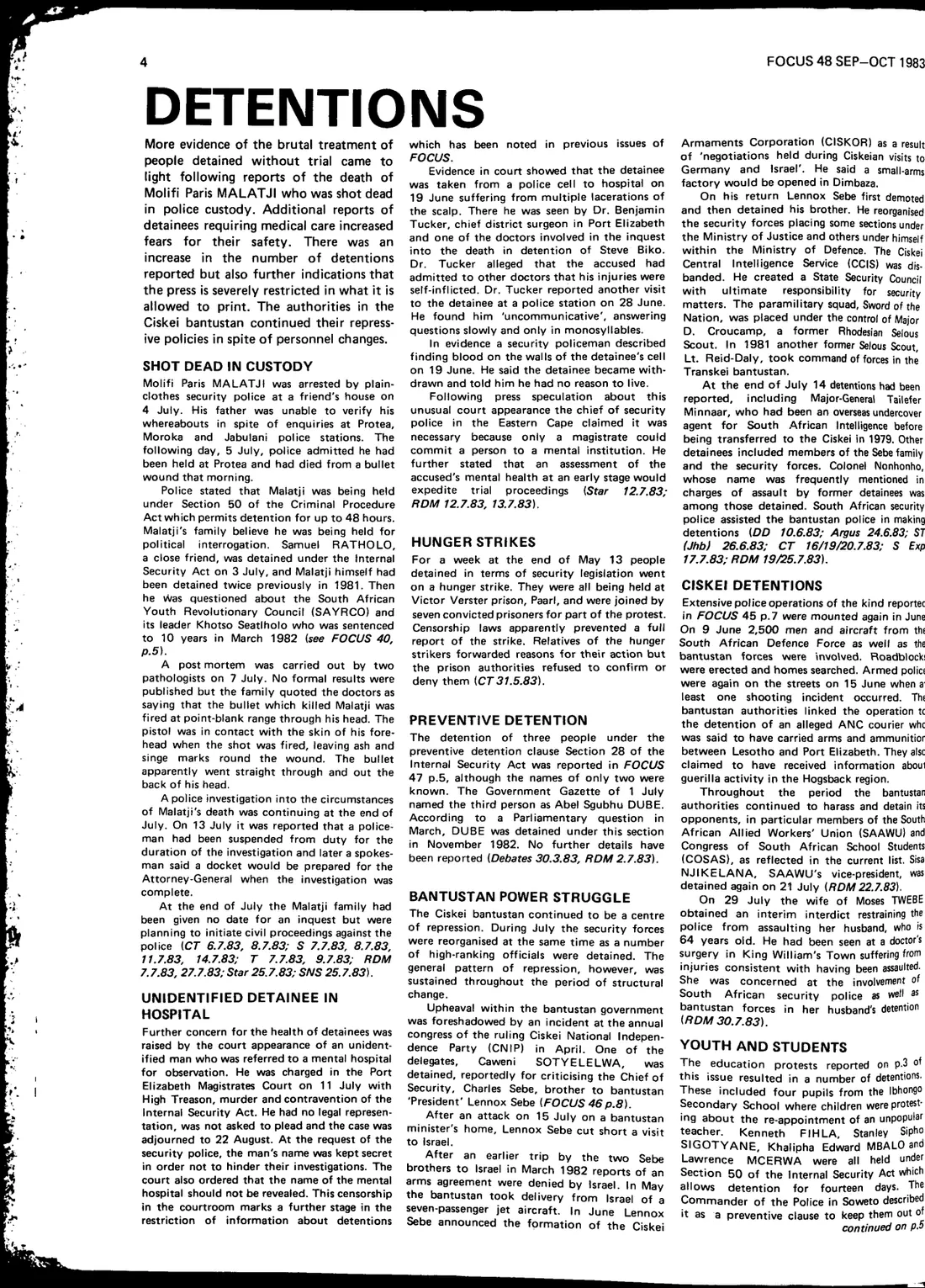
DETENTIONS
More evidence of the brutal treatment of people detained without trial came to light following reports of the death of Molifi Paris MALATJI who was shot dead in police custody. Additional reports of detainees requiring medical care increased fears for their safety. There was an increase in the number of detentions reported but also further indications that the press is severely restricted in what it is allowed to print. The authorities in the Ciskei bantustan continued their repressive policies in spite of personnel changes.
SHOT DEAD IN CUSTODY
Molifi Paris MALATJI was arrested by plain-clothes security police at a friend's house on 4 July. His father was unable to verify his whereabouts in spite of enquiries at Protea, Moroka and Jabulani police stations. The following day, 5 July, police admitted he had been held at Protea and had died from a bullet wound that morning.
Police stated that Malatji was being held under Section 50 of the Criminal Procedure Act which permits detention for up to 48 hours. Malatji's family believe he was being held for political interrogation. Samuel RATHOLO, a close friend, was detained under the Internal Security Act on 3 July, and Malatji himself had been detained twice previously in 1981. Then he was questioned about the South African Youth Revolutionary Council (SAYRCO) and its leader Khotso Seatlholo who was sentenced to 10 years in March 1982.
A post mortem was carried out by two pathologists on 7 July. No formal results were published but the family quoted the doctors as saying that the bullet which killed Malatji was fired at point-blank range through his head. The pistol was in contact with the skin of his forehead when the shot was fired, leaving ash and singe marks round the wound. The bullet apparently went straight through and out the back of his head.
A police investigation into the circumstances of Malatji's death was continuing at the end of July. On 13 July it was reported that a policeman had been suspended from duty for the duration of the investigation and later a spokesman said a docket would be prepared for the Attorney-General when the investigation was complete.
At the end of July the Malatji family had been given no date for an inquest but were planning to initiate civil proceedings against the police.
UNIDENTIFIED DETAINEE IN HOSPITAL
Further concern for the health of detainees was raised by the court appearance of an unidentified man who was referred to a mental hospital for observation. He was charged in the Port Elizabeth Magistrates Court on 11 July with High Treason, murder and contravention of the Internal Security Act. He had no legal representation, was not asked to plead and the case was adjourned to 22 August. At the request of the security police, the man's name was kept secret in order not to hinder their investigations. The court also ordered that the name of the mental hospital should not be revealed. This censorship in the courtroom marks a further stage in the restriction of information about detentions which has been noted in previous issues of FOCUS.
Evidence in court showed that the detainee was taken from a police cell to hospital on 19 June suffering from multiple lacerations of the scalp. There he was seen by Dr. Benjamin Tucker, chief district surgeon in Port Elizabeth and one of the doctors involved in the inquest into the death in detention of Steve Biko. Dr. Tucker alleged that the accused had admitted to other doctors that his injuries were self-inflicted. Dr. Tucker reported another visit to the detainee at a police station on 28 June. He found him 'uncommunicative', answering questions slowly and only in monosyllables.
In evidence a security policeman described finding blood on the walls of the detainee's cell on 19 June. He said the detainee became withdrawn and told him he had no reason to live.
Following press speculation about this unusual court appearance the chief of security police in the Eastern Cape claimed it was necessary because only a magistrate could commit a person to a mental institution. He further stated that an assessment of the accused's mental health at an early stage would expedite trial proceedings.
HUNGER STRIKES
For a week at the end of May 13 people detained in terms of security legislation went on a hunger strike. They were all being held at Victor Verster prison, Paarl, and were joined by seven convicted prisoners for part of the protest. Censorship laws apparently prevented a full report of the strike. Relatives of the hunger strikers forwarded reasons for their action but the prison authorities refused to confirm or deny them.
PREVENTIVE DETENTION
The detention of three people under the preventive detention clause Section 28 of the Internal Security Act was reported in FOCUS 47 p.5, although the names of only two were known. The Government Gazette of 1 July named the third person as Abel Sgubhu DUBE. According to a Parliamentary question in March, DUBE was detained under this section in November 1982. No further details have been reported.
BANTUSTAN POWER STRUGGLE
The Ciskei bantustan continued to be a centre of repression. During July the security forces were reorganised at the same time as a number of high-ranking officials were detained. The general pattern of repression, however, was sustained throughout the period of structural change.
Upheaval within the bantustan government was foreshadowed by an incident at the annual congress of the ruling Ciskei National Independence Party (CNIP) in April. One of the delegates, Caweni SOTYELELWA, was detained, reportedly for criticising the Chief of Security, Charles Sebe, brother to bantustan 'President' Lennox Sebe.
After an attack on 15 July on a bantustan minister's home, Lennox Sebe cut short a visit to Israel.
After an earlier trip by the two Sebe brothers to Israel in March 1982 reports of an arms agreement were denied by Israel. In May the bantustan took delivery from Israel of a seven-passenger jet aircraft. In June Lennox Sebe announced the formation of the Ciskei Armaments Corporation (CISKOR) as a result of 'negotiations held during Ciskean visits to Germany and Israel'. He said a small-arms factory would be opened in Dimbaza.
On his return Lennox Sebe first demoted and then detained his brother. He reorganised the security forces placing some sections under the Ministry of Justice and others under himself within the Ministry of Defence. The Ciskei Central Intelligence Service (CCIS) was disbanded. He created a State Security Council with ultimate responsibility for security matters. The paramilitary squad, Sword of the Nation, was placed under the control of Major D. Croucamp, a former Rhodesian Selous Scout. In 1981 another former Selous Scout, Lt. Reid-Daly, took command of forces in the Transkei bantustan.
At the end of July 14 detentions had been reported, including Major-General Tailfer Minnaar, who had been an overseas undercover agent for South African Intelligence before being transferred to the Ciskei in 1979. Other detainees included members of the Sebe family and the security forces. Colonel Nonhonho, whose name was frequently mentioned in charges of assault by former detainees was among those detained. South African security police assisted the bantustan police in making detentions.
CISKEI DETENTIONS
Extensive police operations of the kind reported in FOCUS 45 p.7 were mounted again in June. On 9 June 2,500 men and aircraft from the South African Defence Force as well as the bantustan forces were involved. Roadblock were erected and homes searched. Armed police were again on the streets on 15 June when at least one shooting incident occurred. The bantustan authorities linked the operation to the detention of an alleged ANC courier who was said to have carried arms and ammunition between Lesotho and Port Elizabeth. They also claimed to have received information about guerilla activity in the Hogsback region.
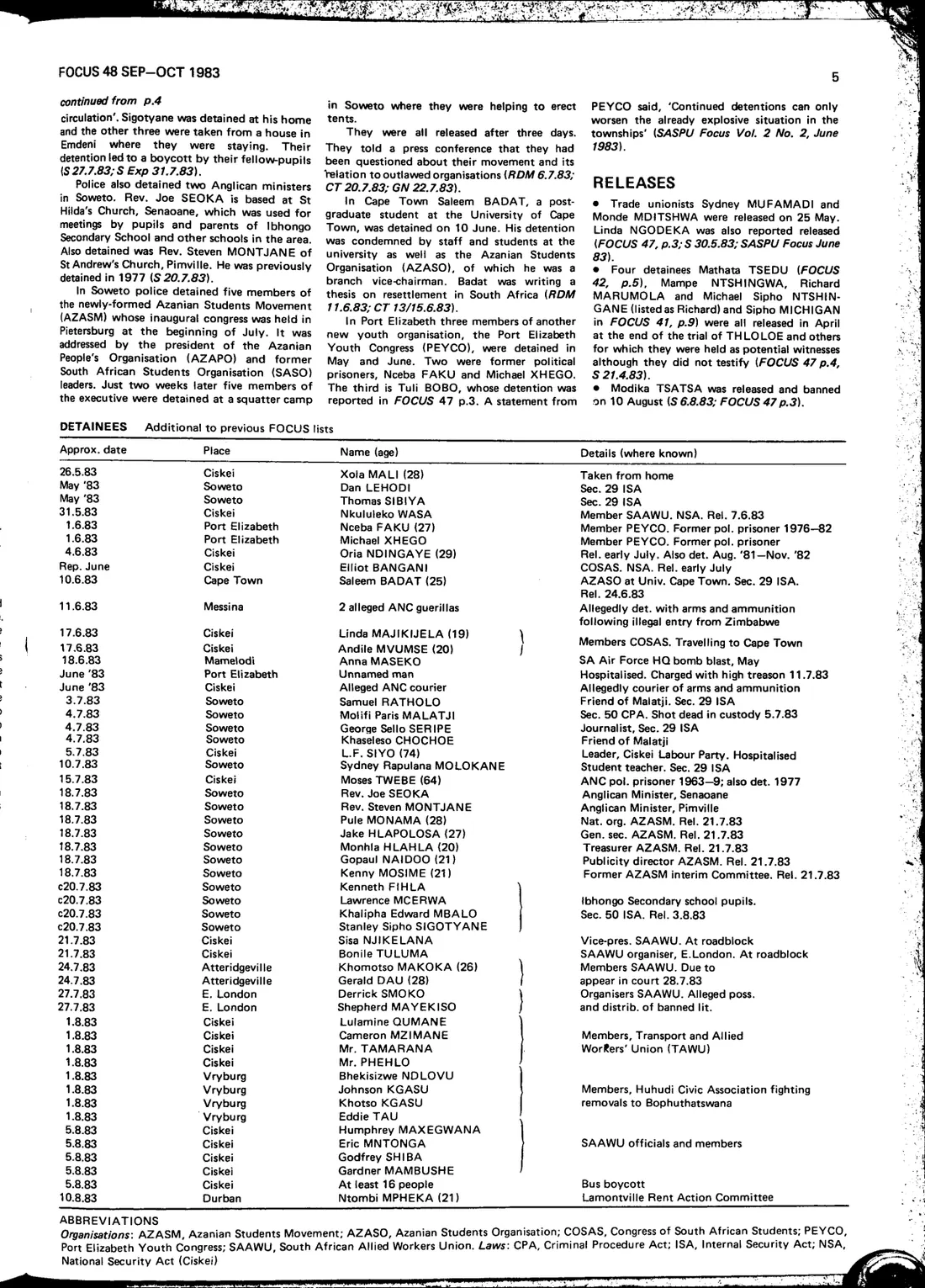
Throughout the period the bantustan authorities continued to harass and detain its opponents, in particular members of the South African Allied Workers' Union (SAAWU) and Congress of South African School Students (COSAS), as reflected in the current list. Sisa NJIKELANA, SAAWU's vice-president, was detained again on 21 July.
On 29 July the wife of Moses TWEBE obtained an interim interdict restraining the police from assaulting her husband, who is 64 years old. He had been seen at a doctor's surgery in King William's Town suffering from injuries consistent with having been assaulted. She was concerned at the involvement of South African security police as well as bantustan forces in her husband's detention.
YOUTH AND STUDENTS
The education protests reported on p.3 of this issue resulted in a number of detentions. These included four pupils from the Ibhongo Secondary School where children were protesting about the re-appointment of an unpopular teacher. Kenneth FIHLA, Stanley Sipho SIGOTYANE, Khalipha Edward MBALO and Lawrence MCERWA were all held under Section 50 of the Internal Security Act which allows detention for fourteen days. The Commander of the Police in Soweto described it as a preventive clause to keep them out of circulation.