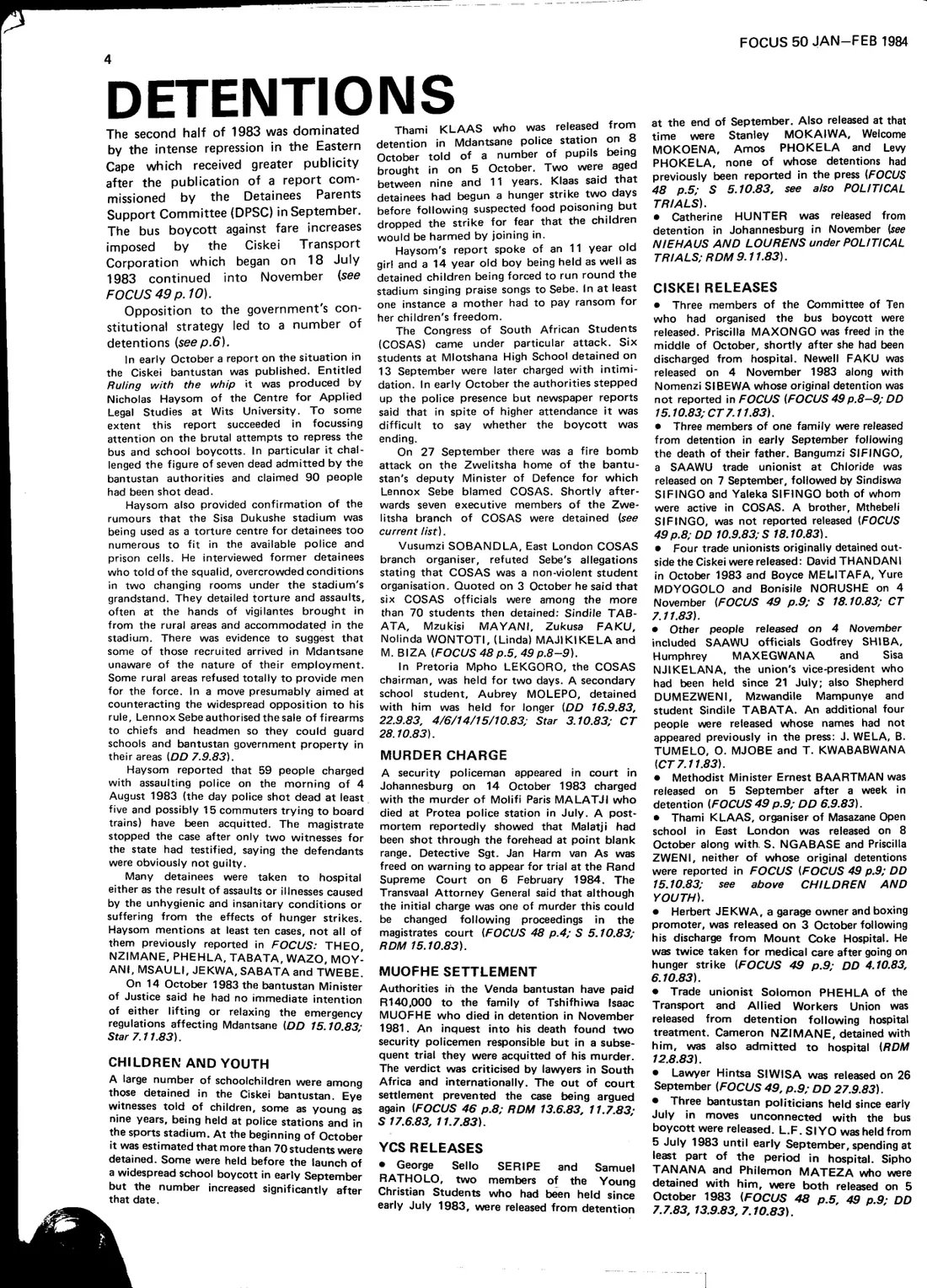
The second half of 1983 was dominated by the intense repression in the Eastern Cape which received greater publicity after the publication of a report commissioned by the Detainees Parents Support Committee (DPSC) in September. The bus boycott against fare increases imposed by the Ciskei Transport Corporation which began on 18 July 1983 continued into November.
Opposition to the government's constitutional strategy led to a number of detentions.
In early October a report on the situation in the Ciskei bantustan was published. Entitled Ruling with the whip it was produced by Nicholas Haysom of the Centre for Applied Legal Studies at Wits University. To some extent this report succeeded in focussing attention on the brutal attempts to repress the bus and school boycotts. In particular it challenged the figure of seven dead admitted by the bantustan authorities and claimed 90 people had been shot dead.
Haysom also provided confirmation of the rumours that the Sisa Dukushe stadium was being used as a torture centre for detainees too numerous to fit in the available police and prison cells. He interviewed former detainees who told of the squalid, overcrowded conditions in two changing rooms under the stadium's grandstand. They detailed torture and assaults, often at the hands of vigilantes brought in from the rural areas and accommodated in the stadium. There was evidence to suggest that some of those recruited arrived in Mdantsane unaware of the nature of their employment. Some rural areas refused totally to provide men for the force. In a move presumably aimed at counteracting the widespread opposition to his rule, Lennox Sebe authorised the sale of firearms to chiefs and headmen so they could guard schools and bantustan government property in their areas.
Haysom reported that 59 people charged with assaulting police on the morning of 4 August 1983 (the day police shot dead at least five and possibly 15 commuters trying to board trains) have been acquitted. The magistrate stopped the case after only two witnesses for the state had testified, saying the defendants were obviously not guilty.
Many detainees were taken to hospital either as the result of assaults or illnesses caused by the unhygienic and insanitary conditions or suffering from the effects of hunger strikes. Haysom mentions at least ten cases, not all of them previously reported in FOCUS: THEO, NZIMANE, PHEHLA, TABATA, WAZO, MOYANI, MSAULI, JEKWA, SABATA and TWEBE.
On 14 October 1983 the bantustan Minister of Justice said he had no immediate intention of either lifting or relaxing the emergency regulations affecting Mdantsane.
CHILDREN AND YOUTH
A large number of schoolchildren were among those detained in the Ciskei bantustan. Eye witnesses told of children, some as young as nine years, being held at police stations and in the sports stadium. At the beginning of October it was estimated that more than 70 students were detained. Some were held before the launch of a widespread school boycott in early September but the number increased significantly after that date.
Thami KLAAS who was released from detention in Mdantsane police station on 8 October told of a number of pupils being brought in on 5 October. Two were aged between nine and 11 years. Klaas said that detainees had begun a hunger strike two days before following suspected food poisoning but dropped the strike for fear that the children would be harmed by joining in.
Haysom's report spoke of an 11 year old girl and a 14 year old boy being held as well as detained children being forced to run round the stadium singing praise songs to Sebe. In at least one instance a mother had to pay ransom for her children's freedom.
The Congress of South African Students (COSAS) came under particular attack. Six students at Mlotshana High School detained on 13 September were later charged with intimidation. In early October the authorities stepped up the police presence but newspaper reports said that in spite of higher attendance it was difficult to say whether the boycott was ending.
On 27 September there was a fire bomb attack on the Zwelitsha home of the bantustan's deputy Minister of Defence for which Lennox Sebe blamed COSAS. Shortly afterwards seven executive members of the Zwelitsha branch of COSAS were detained.
Vusumzi SOBANDLA, East London COSAS branch organiser, refuted Sebe's allegations stating that COSAS was a non-violent student organisation. Quoted on 3 October he said that six COSAS officials were among the more than 70 students then detained: Sindile TABATA, Mzukisi MAYANI, Zukusa FAKU, Nolinda WONTOTI, (Linda) MAJIKIKELA and M. BIZA.
In Pretoria Mpho LEKGORO, the COSAS chairman, was held for two days. A secondary school student, Aubrey MOLEPO, detained with him was held for longer.
MURDER CHARGE
A security policeman appeared in court in Johannesburg on 14 October 1983 charged with the murder of Molifi Paris MALATJI who died at Protea police station in July. A post-mortem reportedly showed that Malatji had been shot through the forehead at point blank range. Detective Sgt. Jan Harm van As was freed on warning to appear for trial at the Rand Supreme Court on 6 February 1984. The Transvaal Attorney General said that although the initial charge was one of murder this could be changed following proceedings in the magistrates court.
MUOFHE SETTLEMENT
Authorities in the Venda bantustan have paid R140,000 to the family of Tshifhiwa Isaac MUOFHE who died in detention in November 1981. An inquest into his death found two security policemen responsible but in a subsequent trial they were acquitted of his murder. The verdict was criticised by lawyers in South Africa and internationally. The out of court settlement prevented the case being argued again.
YCS RELEASES
- George Sello SERIPE and Samuel RATHOLO, two members of the Young Christian Students who had been held since early July 1983, were released from detention at the end of September. Also released at that time were Stanley MOKAIWA, Welcome MOKOENA, Amos PHOKELA and Levy PHOKELA, none of whose detentions had previously been reported in the press.
- Catherine HUNTER was released from detention in Johannesburg in November.
CISKEI RELEASES
- Three members of the Committee of Ten who had organised the bus boycott were released. Priscilla MAXONGO was freed in the middle of October, shortly after she had been discharged from hospital. Newell FAKU was released on 4 November 1983 along with Nomenzi SIBEWA whose original detention was not reported in FOCUS.
- Three members of one family were released from detention in early September following the death of their father. Bangumzi SIFINGO, a SAAWU trade unionist at Chloride was released on 7 September, followed by Sindiswa SIFINGO and Yaleka SIFINGO both of whom were active in COSAS. A brother, Mthebeli SIFINGO, was not reported released.
- Four trade unionists originally detained outside the Ciskei were released: David THANDANI in October 1983 and Boyce MELITAFA, Yure MDYOGOLO and Bonisile NORUSHE on 4 November.
- Other people released on 4 November included SAAWU officials Godfrey SHIBA, Humphrey MAXEGWANA and Sisa NJIKELANA, the union's vice-president who had been held since 21 July; also Shepherd DUMEZWENI, Mzwandile Mampunye and student Sindile TABATA. An additional four people were released whose names had not appeared previously in the press: J. WELA, B. TUMELO, O. MJOBE and T. KWABABWANA.
- Methodist Minister Ernest BAARTMAN was released on 5 September after a week in detention.
- Thami KLAAS, organiser of Masazane Open school in East London was released on 8 October along with S. NGABASE and Priscilla ZWENI, neither of whose original detentions were reported in FOCUS.
- Herbert JEKWA, a garage owner and boxing promoter, was released on 3 October following his discharge from Mount Coke Hospital. He was twice taken for medical care after going on hunger strike.
- Trade unionist Solomon PHEHLA of the Transport and Allied Workers Union was released from detention following hospital treatment. Cameron NZIMANE, detained with him, was also admitted to hospital.
- Lawyer Hintsa SIWISA was released on 26 September.
- Three bantustan politicians held since early July in moves unconnected with the bus boycott were released. L.F. SIYO was held from 5 July 1983 until early September, spending at least part of the period in hospital. Sipho TANANA and Philemon MATEZA who were detained with him, were both released on 5 October 1983.