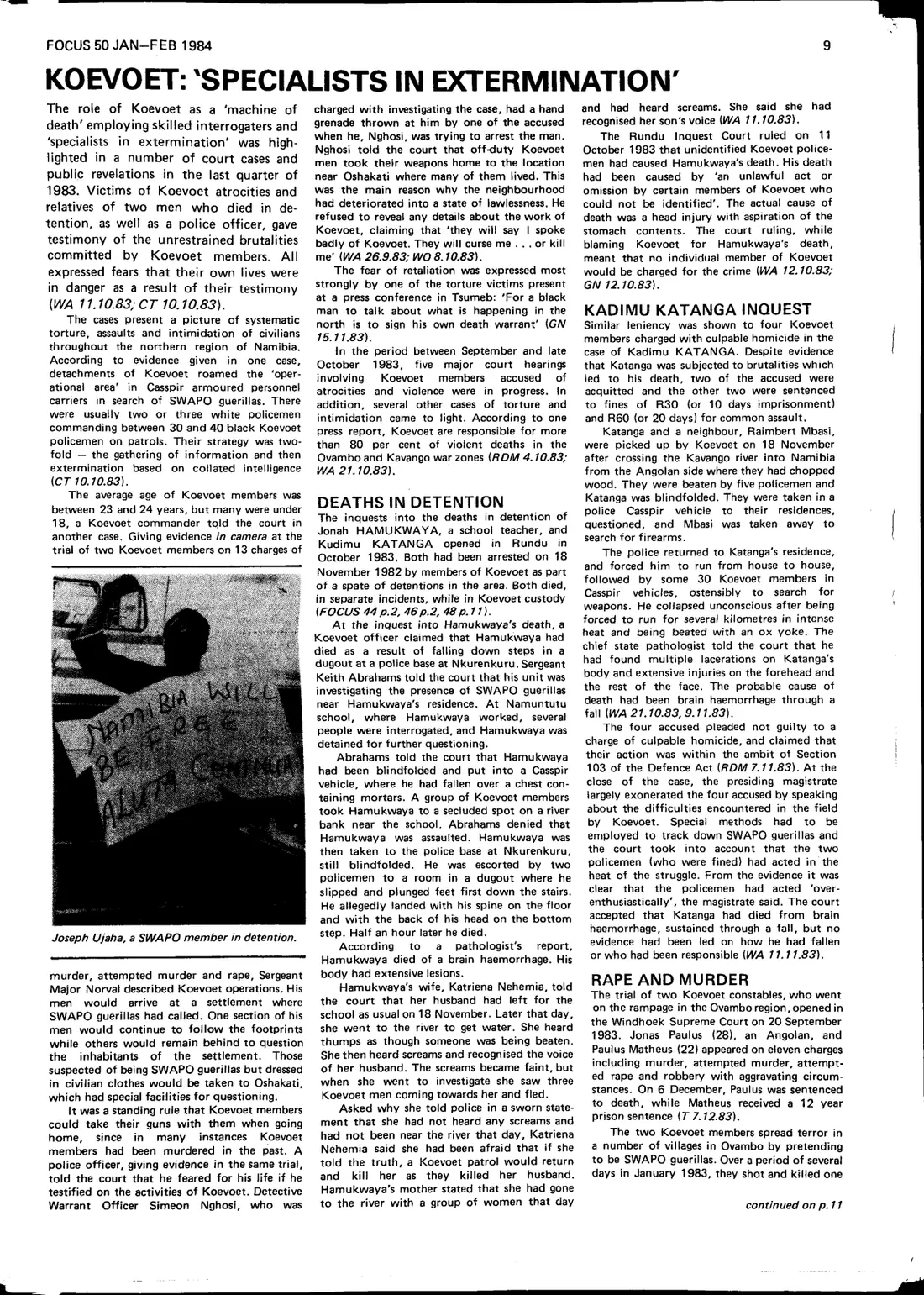
The role of Koevoet as a 'machine of death' employing skilled interrogaters and 'specialists in extermination' was highlighted in a number of court cases and public revelations in the last quarter of 1983. Victims of Koevoet atrocities and relatives of two men who died in detention, as well as a police officer, gave testimony of the unrestrained brutalities committed by Koevoet members. All expressed fears that their own lives were in danger as a result of their testimony.
The cases present a picture of systematic torture, assaults and intimidation of civilians throughout the northern region of Namibia. According to evidence given in one case, detachments of Koevoet roamed the 'operational area' in Casspir armoured personnel carriers in search of SWAPO guerillas. There were usually two or three white policemen commanding between 30 and 40 black Koevoet policemen on patrols. Their strategy was two-fold – the gathering of information and then extermination based on collated intelligence.
The average age of Koevoet members was between 23 and 24 years, but many were under 18, a Koevoet commander told the court in another case. Giving evidence in camera at the trial of two Koevoet members on 13 charges of murder, attempted murder and rape, Sergeant Major Norval described Koevoet operations. His men would arrive at a settlement where SWAPO guerillas had called. One section of his men would continue to follow the footprints while others would remain behind to question the inhabitants of the settlement. Those suspected of being SWAPO guerillas but dressed in civilian clothes would be taken to Oshakati, which had special facilities for questioning.
It was a standing rule that Koevoet members could take their guns with them when going home, since in many instances Koevoet members had been murdered in the past. A police officer, giving evidence in the same trial, told the court that he feared for his life if he testified on the activities of Koevoet. Detective Warrant Officer Simeon Nghosi, who was charged with investigating the case, had a hand grenade thrown at him by one of the accused when he, Nghosi, was trying to arrest the man. Nghosi told the court that off-duty Koevoet men took their weapons home to the location near Oshakati where many of them lived. This was the main reason why the neighbourhood had deteriorated into a state of lawlessness. He refused to reveal any details about the work of Koevoet, claiming that 'they will say I spoke badly of Koevoet. They will curse me ... or kill me'.
The fear of retaliation was expressed most strongly by one of the torture victims present at a press conference in Tsumeb: 'For a black man to talk about what is happening in the north is to sign his own death warrant'.
In the period between September and late October 1983, five major court hearings involving Koevoet members accused of atrocities and violence were in progress. In addition, several other cases of torture and intimidation came to light. According to one press report, Koevoet are responsible for more than 80 per cent of violent deaths in the Ovambo and Kavango war zones.
DEATHS IN DETENTION
The inquests into the deaths in detention of Jonah HAMUKWAYA, a school teacher, and Kudimu KATANGA opened in Rundu in October 1983. Both had been arrested on 18 November 1982 by members of Koevoet as part of a spate of detentions in the area. Both died, in separate incidents, while in Koevoet custody.
At the inquest into Hamukwaya's death, a Koevoet officer claimed that Hamukwaya had died as a result of falling down steps in a dugout at a police base at Nkurenkuru. Sergeant Keith Abrahams told the court that his unit was investigating the presence of SWAPO guerillas near Hamukwaya's residence. At Namuntutu school, where Hamukwaya worked, several people were interrogated, and Hamukwaya was detained for further questioning.
Abrahams told the court that Hamukwaya had been blindfolded and put into a Casspir vehicle, where he had fallen over a chest containing mortars. A group of Koevoet members took Hamukwaya to a secluded spot on a river bank near the school. Abrahams denied that Hamukwaya was assaulted. Hamukwaya was then taken to the police base at Nkurenkuru, still blindfolded. He was escorted by two policemen to a room in a dugout where he slipped and plunged feet first down the stairs. He allegedly landed with his spine on the floor and with the back of his head on the bottom step. Half an hour later he died.
According to a pathologist's report, Hamukwaya died of a brain haemorrhage. His body had extensive lesions.
Hamukwaya's wife, Katriena Nehemia, told the court that her husband had left for the school as usual on 18 November. Later that day, she went to the river to get water. She heard thumps as though someone was being beaten. She then heard screams and recognised the voice of her husband. The screams became faint, but when she went to investigate she saw three Koevoet men coming towards her and fled.
Asked why she told police in a sworn statement that she had not heard any screams and had not been near the river that day, Katriena Nehemia said she had been afraid that if she told the truth, a Koevoet patrol would return and kill her as they killed her husband. Hamukwaya's mother stated that she had gone to the river with a group of women that day and had heard screams. She said she had recognised her son's voice.
The Rundu Inquest Court ruled on 11 October 1983 that unidentified Koevoet policemen had caused Hamukwaya's death. His death had been caused by 'an unlawful act or omission by certain members of Koevoet who could not be identified'. The actual cause of death was a head injury with aspiration of the stomach contents. The court ruling, while blaming Koevoet for Hamukwaya's death, meant that no individual member of Koevoet would be charged for the crime.
KADIMU KATANGA INQUEST
Similar leniency was shown to four Koevoet members charged with culpable homicide in the case of Kadimu KATANGA. Despite evidence that Katanga was subjected to brutalities which led to his death, two of the accused were acquitted and the other two were sentenced to fines of R30 (or 10 days imprisonment) and R60 (or 20 days) for common assault.
Katanga and a neighbour, Raimbert Mbasi, were picked up by Koevoet on 18 November after crossing the Kavango river into Namibia from the Angolan side where they had chopped wood. They were beaten by five policemen and Katanga was blindfolded. They were taken in a police Casspir vehicle to their residences, questioned, and Mbasi was taken away to search for firearms.
The police returned to Katanga's residence, and forced him to run from house to house, followed by some 30 Koevoet members in Casspir vehicles, ostensibly to search for weapons. He collapsed unconscious after being forced to run for several kilometres in intense heat and being beaten with an ox yoke. The chief state pathologist told the court that he had found multiple lacerations on Katanga's body and extensive injuries on the forehead and the rest of the face. The probable cause of death had been brain haemorrhage through a fall.
The four accused pleaded not guilty to a charge of culpable homicide, and claimed that their action was within the ambit of Section 103 of the Defence Act. At the close of the case, the presiding magistrate largely exonerated the four accused by speaking about the difficulties encountered in the field by Koevoet. Special methods had to be employed to track down SWAPO guerillas and the court took into account that the two policemen (who were fined) had acted in the heat of the struggle. From the evidence it was clear that the policemen had acted 'overenthusiastically', the magistrate said. The court accepted that Katanga had died from brain haemorrhage, sustained through a fall, but no evidence had been led on how he had fallen or who had been responsible.
RAPE AND MURDER
The trial of two Koevoet constables, who went on the rampage in the Ovambo region, opened in the Windhoek Supreme Court on 20 September 1983. Jonas Paulus (28), an Angolan, and Paulus Matheus (22) appeared on eleven charges including murder, attempted murder, attempted rape and robbery with aggravating circumstances. On 6 December, Paulus was sentenced to death, while Matheus received a 12 year prison sentence.
The two Koevoet members spread terror in a number of villages in Ovambo by pretending to be SWAPO guerillas. Over a period of several days in January 1983, they shot and killed one