Parts of Angola's southern Kunene province remain occupied by South African forces despite considerable press and media coverage of a 'withdrawal' of troops by Pretoria during the first half of January.
The major South African military offensive which was launched inside Angola on 14 December 1983 and continued over a period of more than four weeks into the New Year illustrates the 'carrot and stick' technique which has become a familiar part of South Africa's policy of destabilisation in the region as a whole. While on one side of the sub-continent Pretoria was engaged in intense aggression, on the other it was preparing for a series of diplomatic meetings and negotiations with Mozambique.
In the context of the Namibian settlement negotiations, South Africa's military offensives have tended in the past to be related to periods of activity on the political and diplomatic front and, specifically, with efforts by Pretoria to create the impression either that it is prepared to make concessions on the Namibian independence issue or that the liberation movement SWAPO is not. This pattern was repeated during the December offensive, in the form of a proposal put to the United Nations by Pretoria on 15 December for a 'mutual force disengagement' on the Namibia/Angola border. The proposed ceasefire would begin on 31 January 1984 and last for 30 days or longer.
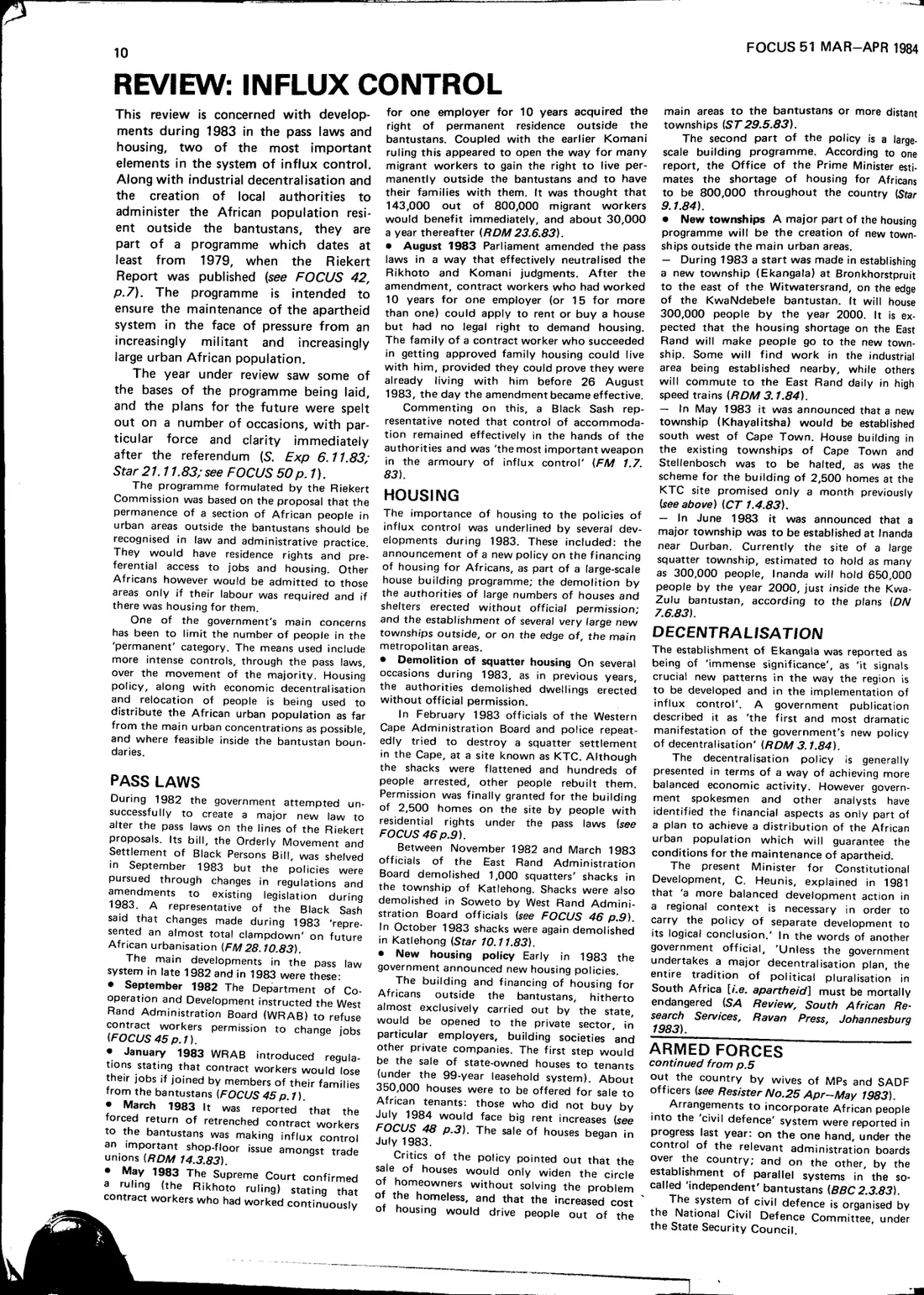
Simultaneously, South African regular air and ground forces inside Angola were pushing northwards in a three-pronged advance from occupied Kunene, to attack the towns of Cahama, Mulondo and Cuvelai in Kunene province, Kassinga in Huila province, south-central Angola, and Caiundo in Kuando Kubango, south-eastern Angola. Air bombardments were launched on all those centres and also in the vicinity of Lubango, Namibe province. The South Africans, by their own admission, penetrated 300 km into Angola.
In a statement issued on 3 January, the acting chairman of the UN Special Committee against Apartheid described the South African offensive as taking place behind 'a smokescreen of propaganda about its desire for a reduction of conflict'.
The South African intention, from a military point of view, seems to have been to enlarge the area of southern Angola already occupied by its forces and to destroy Angolan lines of defence, as part of its long-term policy of destabilisation of the MPLA government. These objectives were not, however, achieved, due to determined resistance on the part of the Angolan armed forces among other factors. The offensive may also have reflected a decision to give increased military and logistical support to South Africa's UNITA surrogate forces in response to Angolan army operations against the latter.
The South African government and armed forces themselves characterised the offensive, codenamed 'Operation Askari', as a pre-emptive strike against SWAPO guerrillas allegedly based inside Angola, prior to the start of the expected rainy season offensive by the liberation movement. The Angolan government, however, stated that the SADF's targets were exclusively Angolan civilian and military installations, while SWAPO confirmed that none of its combatants had been involved in the month-long offensive and that none had been among the 400 soldiers allegedly killed.
The troops and equipment deployed by Pretoria in the offensive made it the biggest South African operation in Angola since Operation Protea, launched on 23 August 1981 and involving 11,000 troops. The latter led to the occupation of southern Angola which has continued to the present day. In addition to its troops already deployed in Kunene province as part of its occupying force (estimated by the Angolan government in 1982 as 5,500 men and subsequently reinforced), the South Africans sent in a further force of up to 9-10,000 men. Despite this show of military strength, the SADF appears to have met much more effective and determined resistance than it had anticipated and to have suffered damaging losses of troops and equipment.
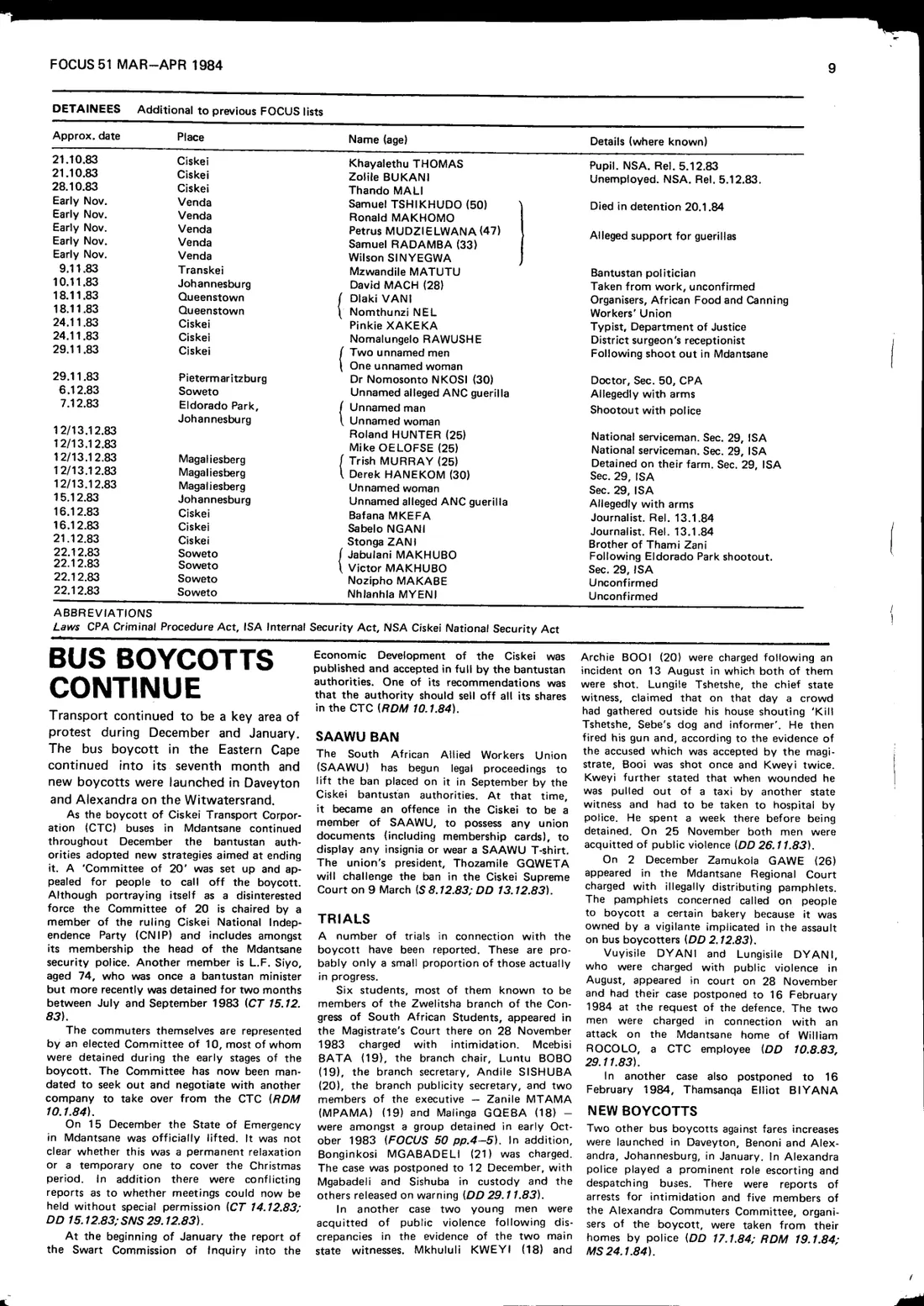
In a letter to the UN Secretary General dated 31 December 1983, the Angolan President itemised the South African invading force as: Three motorised infantry brigades; Four 140 mm and 155 mm artillery units; Two battalions of paratroopers; 100 planes and helicopters; AML-90s, AML-60s and MX tanks and armoured vehicles.
The Angolan Vice-Minister for External Relations told a press conference in Luanda on 24 December that the South Africans had used 100 fighter bombers and six helicopters in the offensive. Up to that date there had been 30 bombing raids by formations of four to 18 planes.
On 13 January, the Officer Commanding the South West Africa Territory Force (SWATF), Maj. Gen. George Meiring, stated that 'about 2,000' South African soldiers had taken part in 'Operation Askari'. The South Africans denied that tanks had been deployed but warned that they 'would be compelled to consider their use' if resistance continued.
On 28 December it was reported that 'embattled' South African troops might be forced to make a 'strategic withdrawal' from southern Angola in response to 'stiff opposition' from Angolan and Cuban units. General Constand Viljoen, head of the SADF, stated after his return from a four day visit to the operational area over Christmas that 'SWAPO is misusing the situation and it is a bit worrying'. He later admitted that, at Cuvelai, the SADF had been 'surprised by the aggressive manner' in which the Angolan armed forces had 'intervened' into the operation against SWAPO.
The offensive was launched on 14 December 1983 when four South African army columns, comprising a reinforced brigade, advanced from Xangongo in the occupied zone of Kunene province towards Angolan military units in Mulondo. The SADF was also reported to have concentrated two parachute battalions and two artillery regiments along the Namibian-Angolan border.
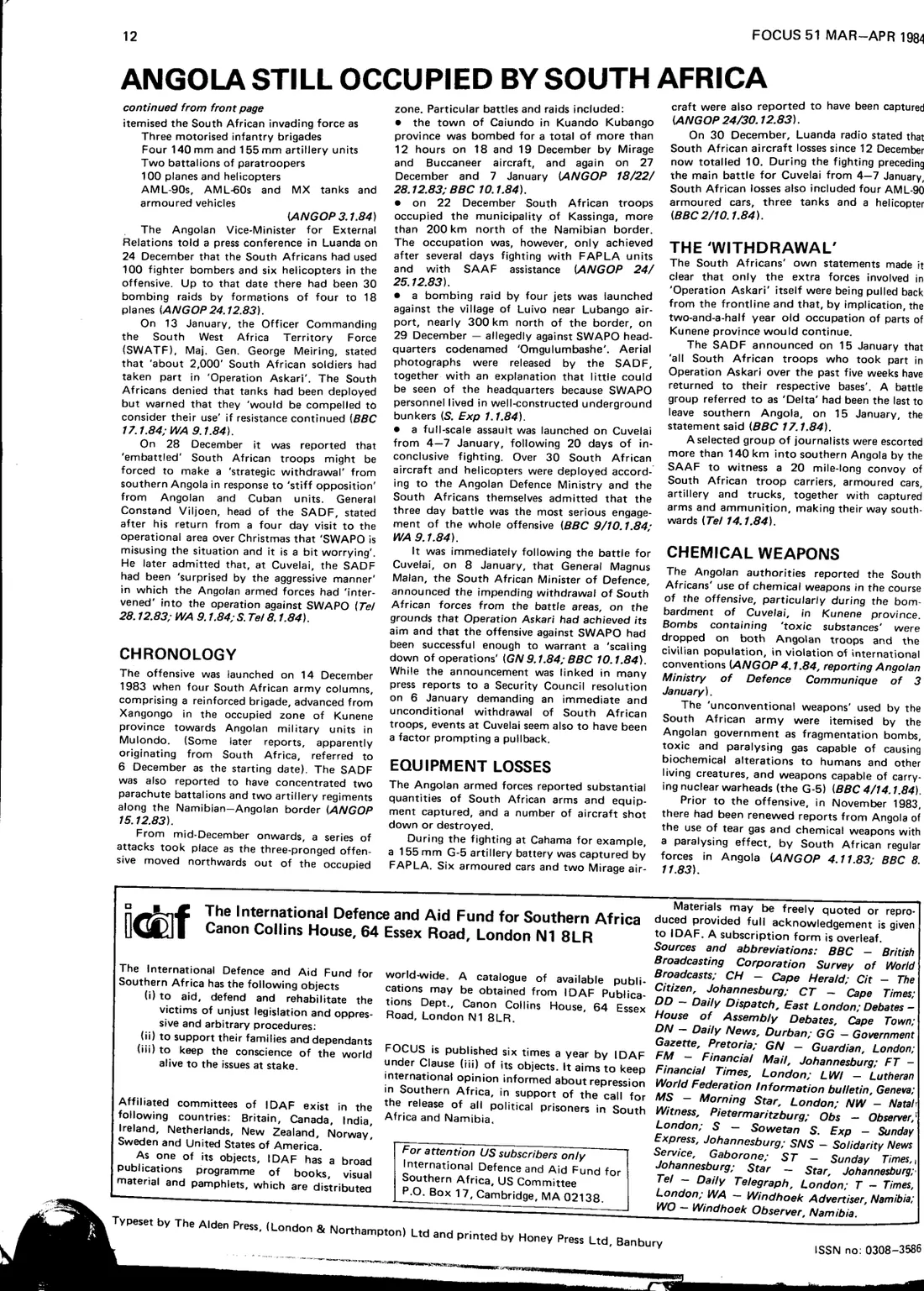
From mid-December onwards, a series of attacks took place as the three-pronged offensive moved northwards out of the occupied zone. Particular battles and raids included: the town of Caiundo in Kuando Kubango province was bombed for a total of more than 12 hours on 18 and 19 December by Mirage and Buccaneer aircraft, and again on 27 December and 7 January; on 22 December South African troops occupied the municipality of Kassinga, more than 200 km north of the Namibian border. The occupation was, however, only achieved after several days fighting with FAPLA units and with SAAF assistance; a bombing raid by four jets was launched against the village of Luivo near Lubango airport, nearly 300 km north of the border, on 29 December — allegedly against SWAPO headquarters codenamed 'Omgulumbashe'; a full-scale assault was launched on Cuvelai from 4-7 January, following 20 days of inconclusive fighting. Over 30 South African aircraft and helicopters were deployed according to the Angolan Defence Ministry and the South Africans themselves admitted that the three day battle was the most serious engagement of the whole offensive.
It was immediately following the battle for Cuvelai, on 8 January, that General Magnus Malan, the South African Minister of Defence, announced the impending withdrawal of South African forces from the battle areas, on the grounds that Operation Askari had achieved its aim and that the offensive against SWAPO had been successful enough to warrant a 'scaling down of operations'.
The Angolan armed forces reported substantial quantities of South African arms and equipment captured, and a number of aircraft shot down or destroyed. During the fighting at Cahama for example, a 155 mm G-5 artillery battery was captured by FAPLA. Six armoured cars and two Mirage aircraft were also reported to have been captured.
On 30 December, Luanda radio stated that South African aircraft losses since 12 December now totalled 10. During the fighting preceding the main battle for Cuvelai from 4-7 January, South African losses also included four AML-90 armoured cars, three tanks and a helicopter.
The South Africans' own statements made it clear that only the extra forces involved in 'Operation Askari' itself were being pulled back from the frontline and that, by implication, the two-and-a-half year old occupation of parts of Kunene province would continue. The SADF announced on 15 January that 'all South African troops who took part in Operation Askari over the past five weeks have returned to their respective bases'. A battle group referred to as 'Delta' had been the last to leave southern Angola, on 15 January, the statement said.
A selected group of journalists were escorted more than 140 km into southern Angola by the SAAF to witness a 20 mile-long convoy of South African troop carriers, armoured cars, artillery and trucks, together with captured arms and ammunition, making their way southwards.
The Angolan authorities reported the South Africans' use of chemical weapons in the course of the offensive, particularly during the bombardment of Cuvelai, in Kunene province. Bombs containing 'toxic substances' were dropped on both Angolan troops and the civilian population, in violation of international conventions. The 'unconventional weapons' used by the South African army were itemised by the Angolan government as fragmentation bombs, toxic and paralysing gas capable of causing biochemical alterations to humans and other living creatures, and weapons capable of carrying nuclear warheads (the G-5). Prior to the offensive, in November 1983, there had been renewed reports from Angola of the use of tear gas and chemical weapons with a paralysing effect, by South African regular forces in Angola.