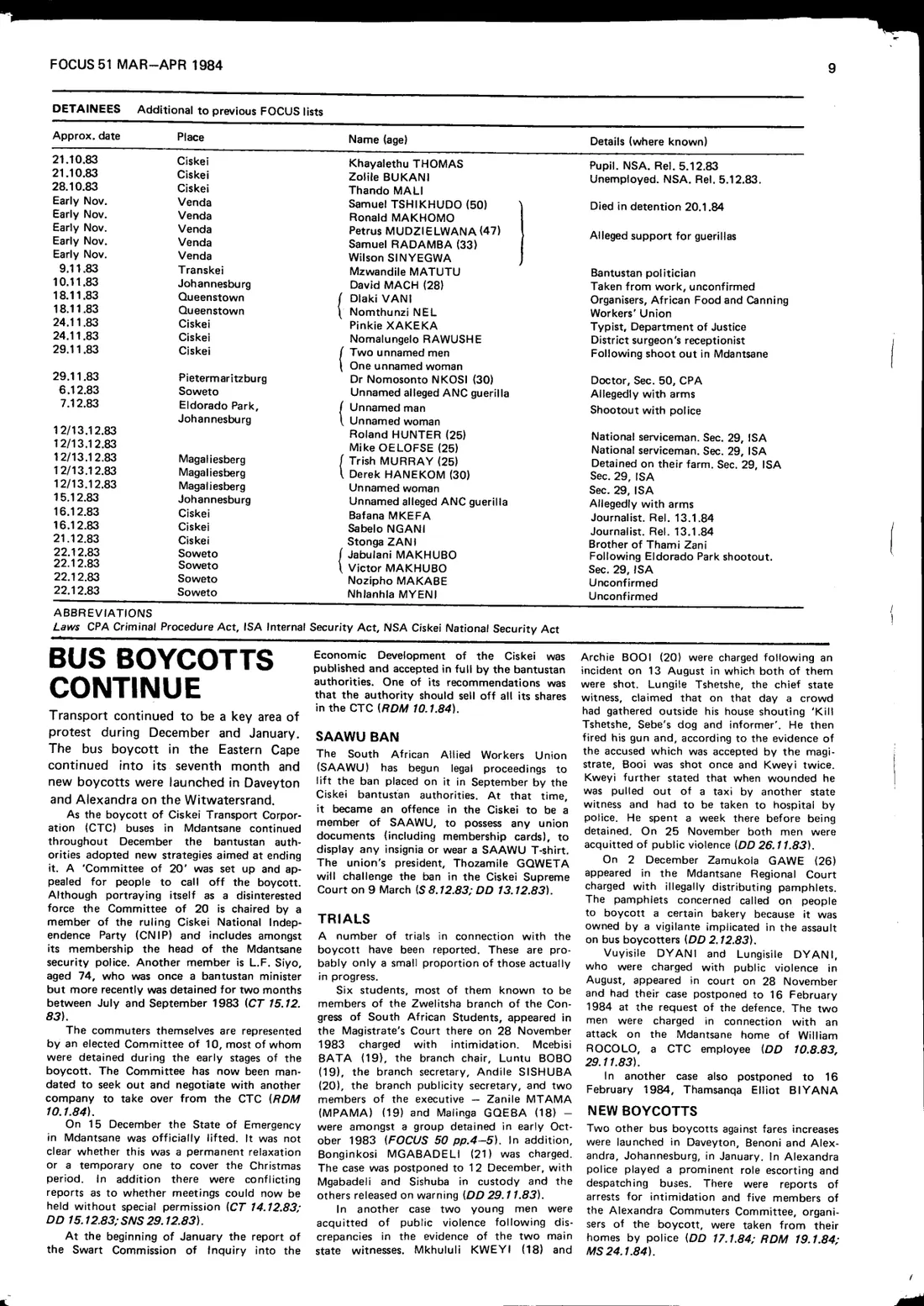
Transport continued to be a key area of protest during December and January. The bus boycott in the Eastern Cape continued into its seventh month and new boycotts were launched in Daveyton and Alexandra on the Witwatersrand.
As the boycott of Ciskei Transport Corporation (CTC) buses in Mdantsane continued throughout December the bantustan authorities adopted new strategies aimed at ending it. A 'Committee of 20' was set up and appealed for people to call off the boycott. Although portraying itself as a disinterested force the Committee of 20 is chaired by a member of the ruling Ciskei National Independence Party (CNIP) and includes amongst its membership the head of the Mdantsane security police. Another member is L.F. Siyo, aged 74, who was once a bantustan minister but more recently was detained for two months between July and September 1983.
The commuters themselves are represented by an elected Committee of 10, most of whom were detained during the early stages of the boycott. The Committee has now been mandated to seek out and negotiate with another company to take over from the CTC.
On 15 December the State of Emergency in Mdantsane was officially lifted. It was not clear whether this was a permanent relaxation or a temporary one to cover the Christmas period. In addition there were conflicting reports as to whether meetings could now be held without special permission.
At the beginning of January the report of the Swart Commission of Inquiry into the Economic Development of the Ciskei was published and accepted in full by the bantustan authorities. One of its recommendations was that the authority should sell off all its shares in the CTC.
The South African Allied Workers Union (SAAWU) has begun legal proceedings to lift the ban placed on it in September by the Ciskei bantustan authorities. At that time, it became an offence in the Ciskei to be a member of SAAWU, to possess any union documents (including membership cards), to display any insignia or wear a SAAWU T-shirt. The union's president, Thozamile GQWETA will challenge the ban in the Ciskei Supreme Court on 9 March.
A number of trials in connection with the boycott have been reported. These are probably only a small proportion of those actually in progress. Six students, most of them known to be members of the Zwelitshita branch of the Congress of South African Students, appeared in the Magistrate's Court there on 28 November 1983 charged with intimidation. Mcebisi BATA (19), the branch chair, Luntu BOBO (19), the branch secretary, Andile SISHUBA (20), the branch publicity secretary, and two members of the executive - Zanile MTAMA (MPAMA) (19) and Malinga GQEBA (18) - were amongst a group detained in early October 1983. In addition, Bonginkosi MGABADELI (21) was charged. The case was postponed to 12 December, with Mgabadeli and Sishuba in custody and the others released on warning.
In another case two young men were acquitted of public violence following discrepancies in the evidence of the two main state witnesses. Mkhululi KWEYI (18) and Archie BOOI (20) were charged following an incident on 13 August in which both of them were shot. Lungile Tshetshe, the chief state witness, claimed that on that day a crowd had gathered outside his house shouting 'Kill Tshetshe, Sebe's dog and informer'. He then fired his gun and, according to the evidence of the accused which was accepted by the magistrate, Booi was shot once and Kweyi twice. Kweyi further stated that when wounded he was pulled out of a taxi by another state witness and had to be taken to hospital by police. He spent a week there before being detained. On 25 November both men were acquitted of public violence.
On 2 December Zamukola GAWE (26) appeared in the Mdantsane Regional Court charged with illegally distributing pamphlets. The pamphlets concerned called on people to boycott a certain bakery because it was owned by a vigilante implicated in the assault on bus boycotters.
Vuyisile DYANI and Lungisile DYANI, who were charged with public violence in August, appeared in court on 28 November and had their case postponed to 16 February 1984 at the request of the defence. The two men were charged in connection with an attack on the Mdantsane home of William ROCOLO, a CTC employee. In another case also postponed to 16 February 1984, Thamsanqa Elliot BIYANA.
Two other bus boycotts against fares increases were launched in Daveyton, Benoni and Alexandra, Johannesburg, in January. In Alexandra police played a prominent role escorting and despatching buses. There were reports of arrests for intimidation and five members of the Alexandra Comuters Committee, organisers of the boycott, were taken from their homes by police.