Detentions and arbitrary arrests have become part of the terror campaign by the South African military forces in Namibia, according to Bishop Kleopas Dumeni of the Evangelical Lutheran Ovambokavango Church. He told a meeting of the All Africa Lutheran Consultation in Harare that a large number of Namibians were being held incomunicado, without privileges or the opportunity of a fair trial. The frequency of abductions had also increased during 1983. In many cases, the whereabouts of political detainees were not known, making it difficult to determine whether they were alive or dead, he said.
Security police appear unable or unwilling to divulge the number and names of those in detention. In mid-November 1983, Colonel Strydom, chief of the South African security police in Namibia, told reporters that 'about 30' people were still detained in the Kavango area, but added that he could not give the exact figure as some had been released and some fresh people had been detained. A SWATF spokesman confirmed that 132 Namibians and 12 Angolans were currently held at the detention camp at Mariental. He was evidently referring to the Kassinga detainees. In December 1983, Colonel Coffee, another spokesman for the security police told journalists that he could not divulge the total number of detainees in the country, but thought that a few had been released. Lack of information from official sources about the fate of people who may have disappeared undoubtedly adds to the anguish of relatives. For those who are known to be in detention, fear for their physical safety is exacerbated by the mounting evidence that torture and assault are apparently used in a systematic way. This was confirmed in 18 affidavits submitted by former detainees in November 1983 about their torture in detention.
An urgent application was lodged with the Windhoek Supreme Court in November 1983 to restrain the security police from assaulting three Kavango detainees and to allow registered private doctors immediate access to and subsequent inspection of the detainees at intervals of not more than 72 hours. Lawyers acting for the relatives of Pastor Heikki AUSIKU (HAUSIKU), Gideon NESTOR and Severinus SITEKETA submitted evidence from a doctor who had examined the detainees. The submission stated that they were kept in solitary confinement, or alternatively in crowded cells, were underfed and kept in unhygienic conditions. Siteketa had lacerations on his left foot and his blood pressure had increased. He alleged that he had been assaulted by the police. Pastor Ausiku had chronic diarrhoea and possibly malarial parasites, showed signs of having been assaulted and suffered reactive depression. Nestor had a cardiac problem, was depressed and slow in responding to questions. Siteketa had previously been held in detention for 78 days until 5 October, and had been re-detained with Pastor Ausiku on 2 November.
Sabine Nestor, wife of Gideon Nestor, said in her sworn affidavit that she had not yet been informed by the police where her husband was being held, why, or even that he had been taken into custody. During a previous period of detention in May 1983 he had been kept in a corrugated iron kennel. Martha Ausiku, wife of Heikki Ausiku, expressed the fear that the police would assault her husband and said she believed his life was in danger. Theresia Hauwina, Siteketa's wife, said that after a previous detention her husband had returned 'much thinner and talked as if his head wasn't working'. She felt that if he was further assaulted he would become 'totally abnormal'.
The lawyer acting on behalf of the relatives told the court that 15 supporting affidavits submitted by former detainees established that residents of all parts of Namibia, but particularly in Kavango, had been seized by members of the security police since July 1983. They had been blindfolded, taken to unknown detention camps, housed in what appeared to be kennels — small corrugated iron cells — kept in solitary confinement and had been singly removed at intervals and beaten with planks across the buttocks. The majority had also been tortured with electric shocks and made to sign statements. He concluded that in view of the evidence submitted, the current applicants were 'at grave risk'. Members of the security police strongly denied all allegations, claiming that there was a two-year-long campaign to discredit the security police. Despite the urgency of the application, no ruling had been made by the presiding judge three weeks after the hearing, when the three were reported to have been released.
Fifteen former detainees submitted affidavits to the Windhoek Supreme Court in November 1983, detailing their experiences of torture and maltreatment in detention. Kavango residents arrested during 1983, and residents from other parts of the country held in detention during 1981, all described a similar pattern of treatment. After their arrest they were blindfolded, driven to a detention camp in a rural area, and kept in small kennels apparently of identical construction. They were held in solitary confinement, blindfolded during interrogations to prevent them from identifying their interrogators, systematically beaten and subjected to electric shock. They were warned not to tell anyone that they had been assaulted. The following three statements are selected from the 15 affidavits published by the Windhoek Advertiser, which all recount similar experiences: Adam KABONO: A teacher from Tondoro, Kavango, aged 39. Arrested 20 July 1983, released 5 October 1983. 'At Nkurenkuru police station a policeman hit me and my nose began to bleed. I was accused of pointing Koevoet members out to SWAPO. Water was poured over me and four men took turns in beating me on the buttocks. I was alternatively shocked, questioned and beaten, also on the soles of my feet. In mid-August I received medical attention for the first time. I was told when a representative of the AG's office asks if I have been assaulted I should say 'no'. They said if I should say I was treated badly they would hold me till my hair turned grey. On October 5 I signed a statement, lifting the hood over my head slightly so I could see'. Simon NDAPUKA: From Katutura, age 33, married with four children. Arrested 26 August 1983 on the way home. Driven to an unknown place about 45 minutes outside Windhoek. 'They wanted information relating to Peter Nanyemba and Frans Naholo. I was beaten on my naked buttocks on several occasions. One day I was again ordered to remove my pants. Someone then parted my buttocks and poured a fluid which smelt of spirits into my anus. It was very painful. No questions were directed at me. At the beginning of December I was asked to sign a document. I was chained by my ankle to the floor for a week. When I was released outside Katutura Police Station my interrogator put his fingers to his lips as a sign that I should keep quiet. During my detention I heard numerous other persons screaming in the offices where I had been beaten'. Milka NAUYOMA: Housewife, aged 41, from Tsumeb. Married with eight children. Arrested 11 September 1981. 'Two Afrikaans-speaking white men questioned me about my involvement in SWAPO's political activities. I was beaten on my buttocks and upper legs. The blows were then concentrated on the toes. A chain was put around my neck and I was lifted and then dropped onto the ground. This hoisting and dropping was repeated on three or four occasions. I am a heavily-built woman and thought they would break my neck. Some weeks later I signed a statement. I suffer from high blood pressure. I never received medical treatment. I thought I should take my life but I could think of no way how'. Other former detainees who submitted similar affidavits are: Magnus Hausiku MPASI, Johannes HAINGURU, Amos SIRONGO, Abisai HAMUPOLO, Charles KADHIKWA, Andries THEMBA, Theopoltine NSHIDENGO, Thomas UJUSHONA, Justine KHEIMSES.
Ida JIMMY, a SWAPO activist who was sentenced to seven years imprisonment in 1980 under the Terrorism Act, had her sentence reduced by two years on appeal. Jimmy, who recently lost the child to whom she had given birth in prison, and was refused permission to attend the funeral, lodged an appeal against her sentence on 21 November 1983. The appeal was heard by the appellate division of the Windhoek Supreme Court. Efforts to secure Jimmy's release on parole in August 1983 had failed because no employment could be secured for her. Counsel for Jimmy argued that Jimmy's conviction should be set aside or alternatively that her sentence should be reduced to three years. He said that Jimmy, who was sentenced for addressing a rally in Lüderitz supporting SWAPO's freedom fighters, had 'at no stage (equated) the freedom fighters with terrorists'. At issue was the principle of freedom of speech. SWAPO in Namibia had not been proscribed and its activities were legal. The regional court had erred in equating all the activities of SWAPO with the activities of a section of its supporters who sought to achieve their aims through violence, he said. The regional court had misdirected itself in believing that a minimum sentence of five years was required in terms of the Terrorism Act. Counsel for the state conceded that Jimmy's sentence had been too harsh, but claimed that Jimmy's speech had incited ordinary SWAPO supporters to aid the overthrow of the government. Jimmy's sentence was reduced from seven to five years. However, the court ruled that there was no question of reviewing the conviction itself.
Food parcels sent to seven SWAPO political prisoners at Christmas were stopped by the Windhoek prison authorities. The food had been sent to Ida JIMMY, Marcus GARISEB, Angela MWAALA, Josef SAGARIAS, Theofilus JASON, Lucius Nangala MALAMBO and Marcus KATEKA. The Commissioner of Windhoek Prison said it was against prison regulations to allow food from outside for convicted prisoners. If something like that had happened, then it was clearly a mistake, he said.
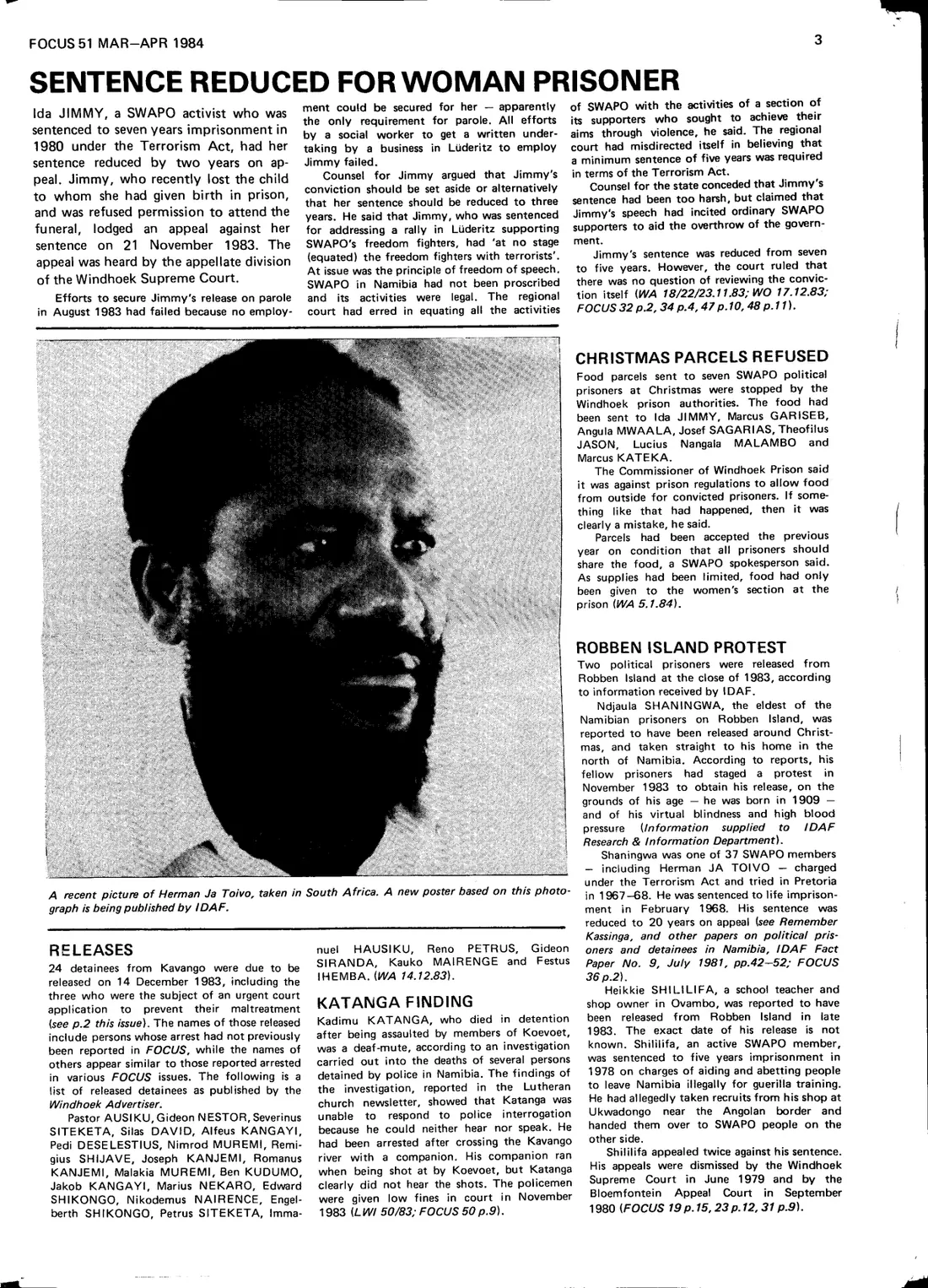
Two political prisoners were released from Robben Island at the close of 1983, according to information received by IDAF. Ndjaula SHANINGWA, the eldest of the Namibian prisoners on Robben Island, was reported to have been released around Christmas, and taken straight to his home in the north of Namibia. According to reports, his fellow prisoners had staged a protest in November 1983 to obtain his release, on the grounds of his age – he was born in 1909 – and of his virtual blindness and high blood pressure. Shaningwa was one of 37 SWAPO members – including Herman JA TOIVO – charged under the Terrorism Act and tried in Pretoria in 1967–68. He was sentenced to life imprisonment in February 1968. His sentence was reduced to 20 years on appeal. Heikki SHILILIFA, a school teacher and shop owner in Ovambo, was reported to have been released from Robben Island in late 1983. The exact date of his release is not known. Shililifa, an active SWAPO member, was sentenced to five years imprisonment in 1978 on charges of aiding and abetting people to leave Namibia illegally for guerilla training. He had allegedly taken recruits from his shop at Ukwadongo near the Angolan border and handed them over to SWAPO people on the other side. Shililifa appealed twice against his sentence. His appeals were dismissed by the Windhoek Supreme Court in June 1979 and by the Bloemfontein Appeal Court in September 1980.
24 detainees from Kavango were due to be released on 14 December 1983, including the three who were the subject of an urgent court application to prevent their maltreatment. The names of those released include: Pastor AUSIKU, Gideon NESTOR, Severinus SITEKETA, Silas DAVID, Alfeus KANGAYI, Pedi DESELESTIUS, Nimrod MUREMI, Remigius SHIJAVE, Joseph KANJEMI, Romanus KANJEMI, Malakia MUREMI, Ben KUDUMO, Jakob KANGAYI, Marius NEKARO, Edward SHIKONGO, Nikodemus NAIRENCE, Engelberth SHIKONGO, Petrus SITEKETA, Immanuel HAUSIKU, Reno PETRUS, Gideon SIRANDA, Kauko MAIRENGE and Festus IHEMBA.
Kadimu KATANGA, who died in detention after being assaulted by members of Koevoet, was a deaf-mute, according to an investigation carried out into the deaths of several persons detained by police in Namibia. The findings of the investigation, reported in the Lutheran church newsletter, showed that Katanga was unable to respond to police interrogation because he could neither hear nor speak. He had been arrested after crossing the Kavango river with a companion. His companion ran when being shot at by Koevoet, but Katanga clearly did not hear the shots. The policemen were given low fines in court in November 1983.
The Windhoek chairman of SWAPO, Marco HAUSIKU, was detained at his home in Katutura on 18 November 1983. Three armed policemen were reported to have been raided his house at 5 a.m. He is being held under Proclamation AG9. Friends and neighbours of Hausiku claimed that he had been manhandled and 'roughed up' by the police arresting him.
The security police confirmed, in November 1983, the continued detention of Gregor MAKGONE, Rahimisa KAHIMISA, and Joseph UJALA. Cosmos Kalat MAKANGA, a member of the Namibia Christian Democratic Party and opposition member of the Kavango legislative assembly, was rearrested in Windhoek on 28 November 1983. Makanga spent several periods in detention in 1980 and 1982. He was again arrested in early 1983 and held for 87 days by Koevoet. In November 1983, while he was attending a multi-party conference in Windhoek as an NCDP delegate, Makanga expressed his fears about returning to Kavango where he runs a business. His wife had been visited twice by members of Koevoet who had inquired about the whereabouts of her husband, he told reporters. They had asked that he should report to the Koevoet camp. He was seriously considering selling his business and moving his family from Kavango to another part of Namibia. He did not intend to return to Kavango in the near future, since he was too scared of the consequences. His arrest in Windhoek came only a few days after he had expressed his fears.
A group of Kavango detainees have been moved to Bethanie Police Station where they are being held, according to a report received by the Windhoek Advertiser. Those still in detention are believed to include Paulus SILINDO, Gosberth SIKERETHE, Petrus SHAANIKA, Patrick KATANGA, Winfred MANGUNDU, Engelmund HAMTENYA and Pius KATURA. With the exception of Gosberth SIKERETHE, none of these detainees had previously been mentioned in press reports. A Windhoek security police spokesman denied that the men were being held in Bethanie.
Two soldiers were fined R50 each after being found guilty in a court martial of assaulting Ndama KAPITANGO in the Kavango region in July 1983. Kapitango was held over a fire and later tossed into the coals by the soldiers. The case was reported to be still under review.