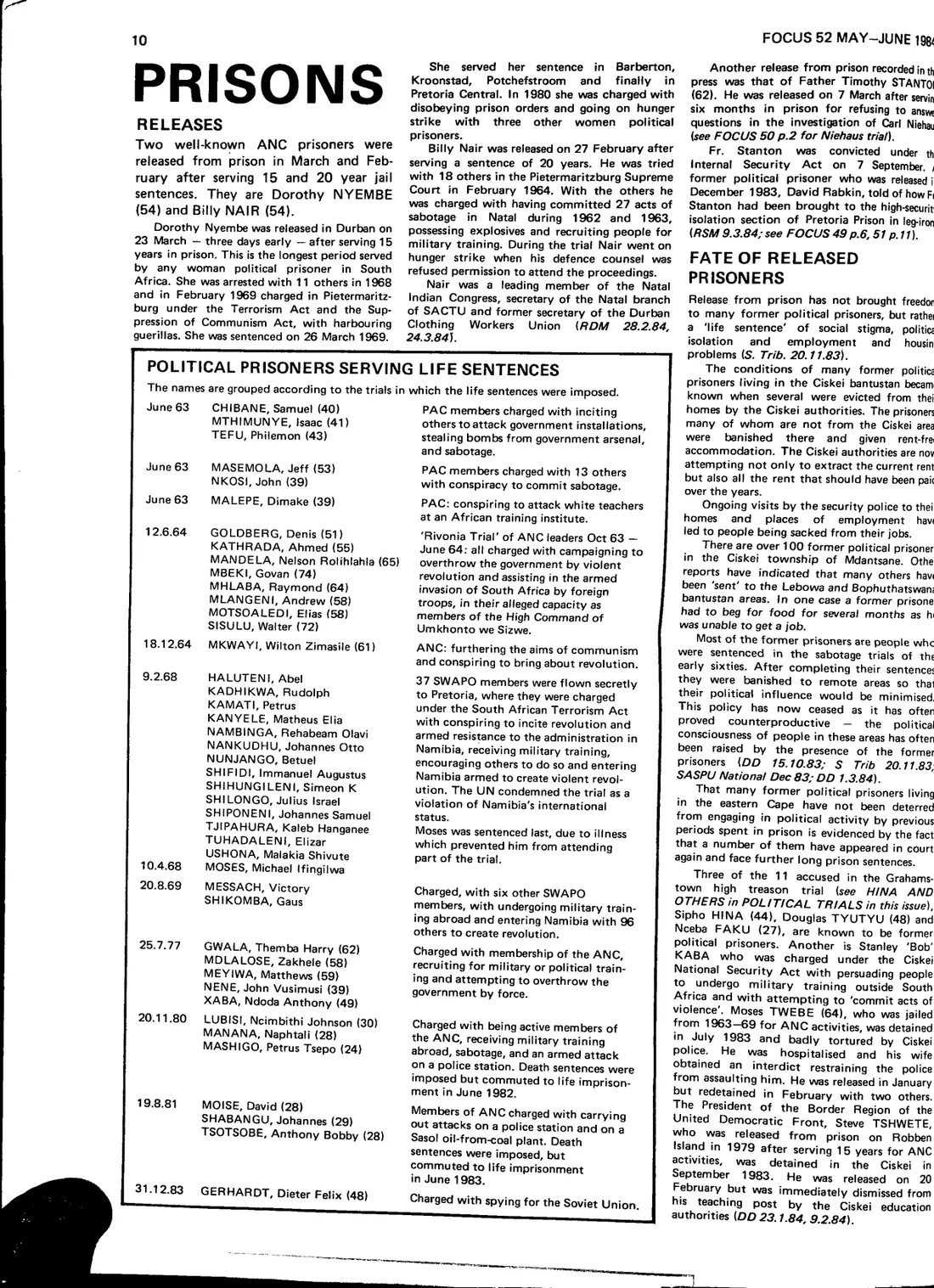
Two well-known ANC prisoners were released from prison in March and February after serving 15 and 20 year jail sentences. They are Dorothy NYEMBE (54) and Billy NAIR (54).
Dorothy Nyembe was released in Durban on 23 March – three days early – after serving 15 years in prison. This is the longest period served by any woman political prisoner in South Africa. She was arrested with 11 others in 1968 and in February 1969 charged in Pietermaritzburg under the Terrorism Act and the Suppression of Communism Act, with harbouring guerillas. She was sentenced on 26 March 1969. She served her sentence in Barberton, Kroonstad, Potchefstroom and finally in Pretoria Central. In 1980 she was charged with disobeying prison orders and going on hunger strike with three other women political prisoners.
Billy Nair was released on 27 February after serving a sentence of 20 years. He was tried with 18 others in the Pietermaritzburg Supreme Court in February 1964. With the others he was charged with having committed 27 acts of sabotage in Natal during 1962 and 1963, possessing explosives and recruiting people for military training. During the trial Nair went on hunger strike when his defence counsel was refused permission to attend the proceedings. Nair was a leading member of the Natal Indian Congress, secretary of the Natal branch of SACTU and former secretary of the Durban Clothing Workers Union.
Another release from prison recorded in the press was that of Father Timothy STANTON (62). He was released on 7 March after serving six months in prison for refusing to answer questions in the investigation of Carl Niehaus. Fr. Stanton was convicted under the Internal Security Act on 7 September, a former political prisoner who was released in December 1983, David Rabkin, told of how Fr. Stanton had been brought to the high-security isolation section of Pretoria Prison in leg-iron.
Release from prison has not brought freedom to many former political prisoners, but rather a 'life sentence' of social stigma, political isolation and employment and housing problems. The conditions of many former political prisoners living in the Ciskei bantustan became known when several were evicted from their homes by the Ciskei authorities. The prisoners many of whom are not from the Ciskei area were banished there and given rent-free accommodation. The Ciskei authorities are now attempting not only to extract the current rent but also all the rent that should have been paid over the years. Ongoing visits by the security police to their homes and places of employment have led to people being sacked from their jobs. There are over 100 former political prisoners in the Ciskei township of Mdantsane. Other reports have indicated that many others have been 'sent' to the Lebowa and Bophuthatswana bantustan areas. In one case a former prisoner had to beg for food for several months as he was unable to get a job. Most of the former prisoners are people who were sentenced in the sabotage trials of the early sixties. After completing their sentences they were banished to remote areas so that their political influence would be minimised. This policy has now ceased as it has often proved counterproductive – the political consciousness of people in these areas has often been raised by the presence of the former prisoners.