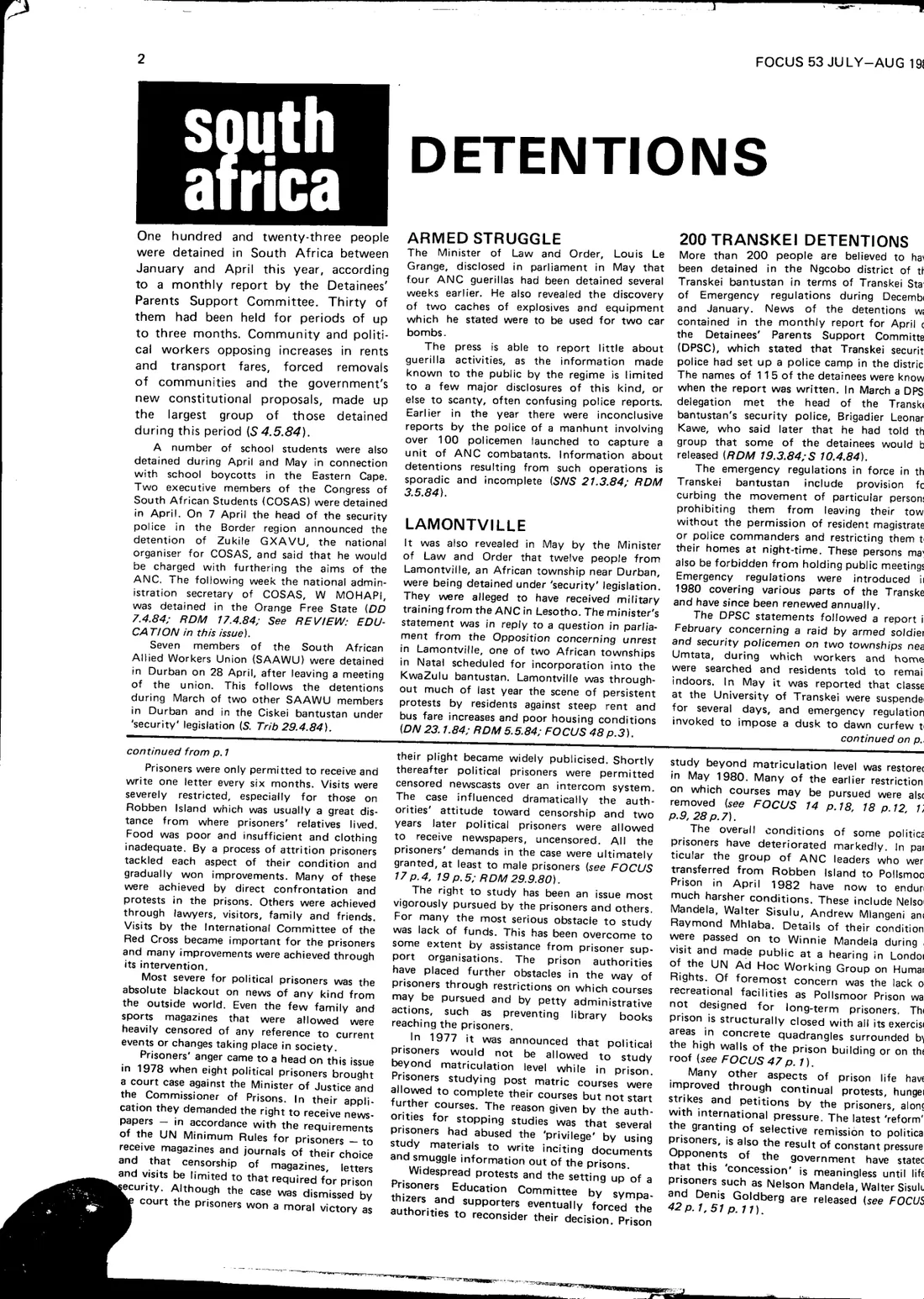
One hundred and twenty-three people were detained in South Africa between January and April this year, according to a monthly report by the Detainees' Parents Support Committee. Thirty of them had been held for periods of up to three months. Community and political workers opposing increases in rents and transport fares, forced removals of communities and the government's new constitutional proposals, made up the largest group of those detained during this period.
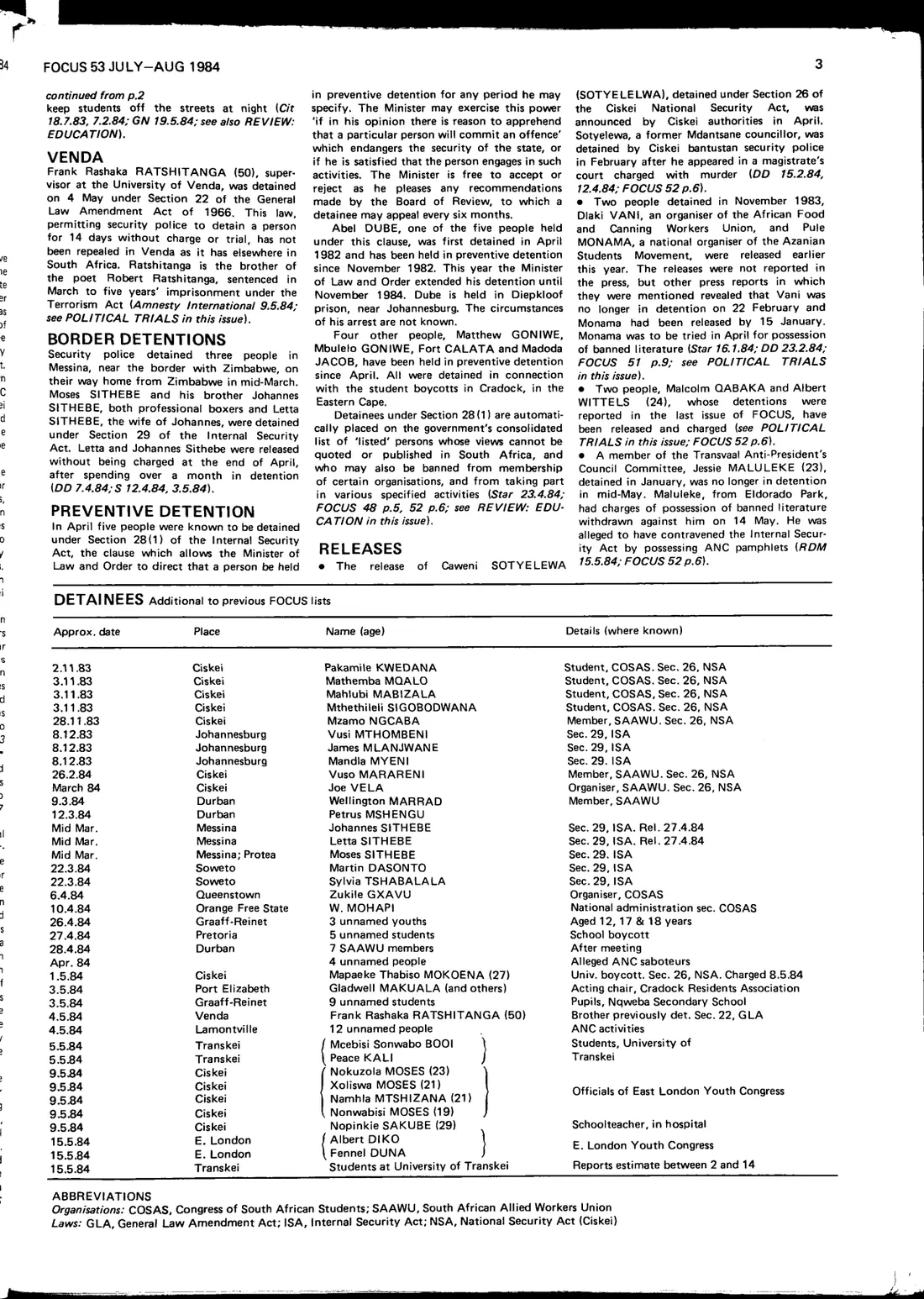
A number of school students were also detained during April and May in connection with school boycotts in the Eastern Cape. Two executive members of the Congress of South African Students (COSAS) were detained in April. On 7 April the head of the security police in the Border region announced the detention of Zukile GXAVU, the national organiser for COSAS, and said that he would be charged with furthering the aims of the ANC. The following week the national administration secretary of COSAS, W MOHAPI, was detained in the Orange Free State.
Seven members of the South African Allied Workers Union (SAAWU) were detained in Durban on 28 April, after leaving a meeting of the union. This follows the detentions during March of two other SAAWU members in Durban and in the Ciskei bantustan under 'security' legislation.
The Minister of Law and Order, Louis Le Grange, disclosed in parliament in May that four ANC guerillas had been detained several weeks earlier. He also revealed the discovery of two caches of explosives and equipment which he stated were to be used for two car bombs.
The press is able to report little about guerilla activities, as the information made known to the public by the regime is limited to a few major disclosures of this kind, or else to scanty, often confusing police reports. Earlier in the year there were inconclusive reports by the police of a manhunt involving over 100 policemen launched to capture a unit of ANC combatants. Information about detentions resulting from such operations is sporadic and incomplete.
It was also revealed in May by the Minister of Law and Order that twelve people from Lamontville, an African township near Durban, were being detained under 'security' legislation. They were alleged to have received military training from the ANC in Lesotho. The minister's statement was in reply to a question in parliament from the Opposition concerning unrest in Lamontville, one of two African townships in Natal scheduled for incorporation into the KwaZulu bantustan. Lamontville was throughout much of last year the scene of persistent protests by residents against steep rent and bus fare increases and poor housing conditions.
More than 200 people are believed to have been detained in the Ngcobo district of the Transkei bantustan in terms of Transkei State of Emergency regulations during December and January. News of the detentions was contained in the monthly report for April of the Detainees' Parents Support Committee (DPSC), which stated that Transkei security police had set up a police camp in the district. The names of 115 of the detainees were known when the report was written. In March a DPS delegation met the head of the Transkei bantustan's security police, Brigadier Leonar Kawe, who said later that he had told the group that some of the detainees would be released.
The emergency regulations in force in the Transkei bantustan include provision for curbing the movement of particular persons prohibiting them from leaving their town without the permission of resident magistrates or police commanders and restricting them to their homes at night-time. These persons may also be forbidden from holding public meetings. Emergency regulations were introduced in 1980 covering various parts of the Transkei and have since been renewed annually.
The DPSC statements followed a report in February concerning a raid by armed soldiers and security policemen on two townships near Umtata, during which workers and home owners were searched and residents told to remain indoors. In May it was reported that classes at the University of Transkei were suspended for several days, and emergency regulations invoked to impose a dusk to dawn curfew on keep students off the streets at night.
Frank Rashaka RATSHITANGA (50), supervisor at the University of Venda, was detained on 4 May under Section 22 of the General Law Amendment Act of 1966. This law, permitting security police to detain a person for 14 days without charge or trial, has not been repealed in Venda as it has elsewhere in South Africa. Ratshitanga is the brother of the poet Robert Ratshitanga, sentenced in March to five years' imprisonment under the Terrorism Act.
Security police detained three people in Messina, near the border with Zimbabwe, on their way home from Zimbabwe in mid-March. Moses SITHEBE and his brother Johannes SITHEBE, both professional boxers and Letta SITHEBE, the wife of Johannes, were detained under Section 29 of the Internal Security Act. Letta and Johannes Sithebe were released without being charged at the end of April, after spending over a month in detention.
In April five people were known to be detained under Section 28(1) of the Internal Security Act, the clause which allows the Minister of Law and Order to direct that a person be held in preventive detention for any period he may specify. The Minister may exercise this power 'if in his opinion there is reason to apprehend that a particular person will commit an offence' which endangers the security of the state, or if he is satisfied that the person engages in such activities. The Minister is free to accept or reject as he pleases any recommendations made by the Board of Review, to which a detainee may appeal every six months.
Abel DUBE, one of the five people held under this clause, was first detained in April 1982 and has been held in preventive detention since November 1982. This year the Minister of Law and Order extended his detention until November 1984. Dube is held in Dieploof prison, near Johannesburg. The circumstances of his arrest are not known.
Four other people, Matthew GONIWE, Mbulelo GONIWE, Fort CALATA and Madoda JACOB, have been held in preventive detention since April. All were detained in connection with the student boycotts in Cradock, in the Eastern Cape.
Detainees under Section 28(1) are automatically placed on the government's consolidated list of 'listed' persons whose views cannot be quoted or published in South Africa, and who may also be banned from membership of certain organisations, and from taking part in various specified activities.
The release of Caweni SOTYELEWA (SOTYELELWA), detained under Section 26 of the Ciskei National Security Act, was announced by Ciskei authorities in April. Sotyelewa, a former Mdantsane councillor, was detained by Ciskei bantustan security police in February after he appeared in a magistrate's court charged with murder.
Two people detained in November 1983, Dlaki VANI, an organiser of the African Food and Canning Workers Union, and Pule MONAMA, a national organiser of the Azanian Students Movement, were released earlier this year. The releases were not reported in the press, but other press reports in which they were mentioned revealed that Vani was no longer in detention on 22 February and Monama had been released by 15 January. Monama was to be tried in April for possession of banned literature.
Two people, Malcolm QABAKA and Albert WITTELS (24), whose detentions were reported in the last issue of FOCUS, have been released and charged.
A member of the Transvaal Anti-President's Council Committee, Jessie MALULEKE (23), detained in January, was no longer in detention in mid-May. Maluleke, from Eldorado Park, had charges of possession of banned literature withdrawn against him on 14 May. He was alleged to have contravened the Internal Security Act by possessing ANC pamphlets.