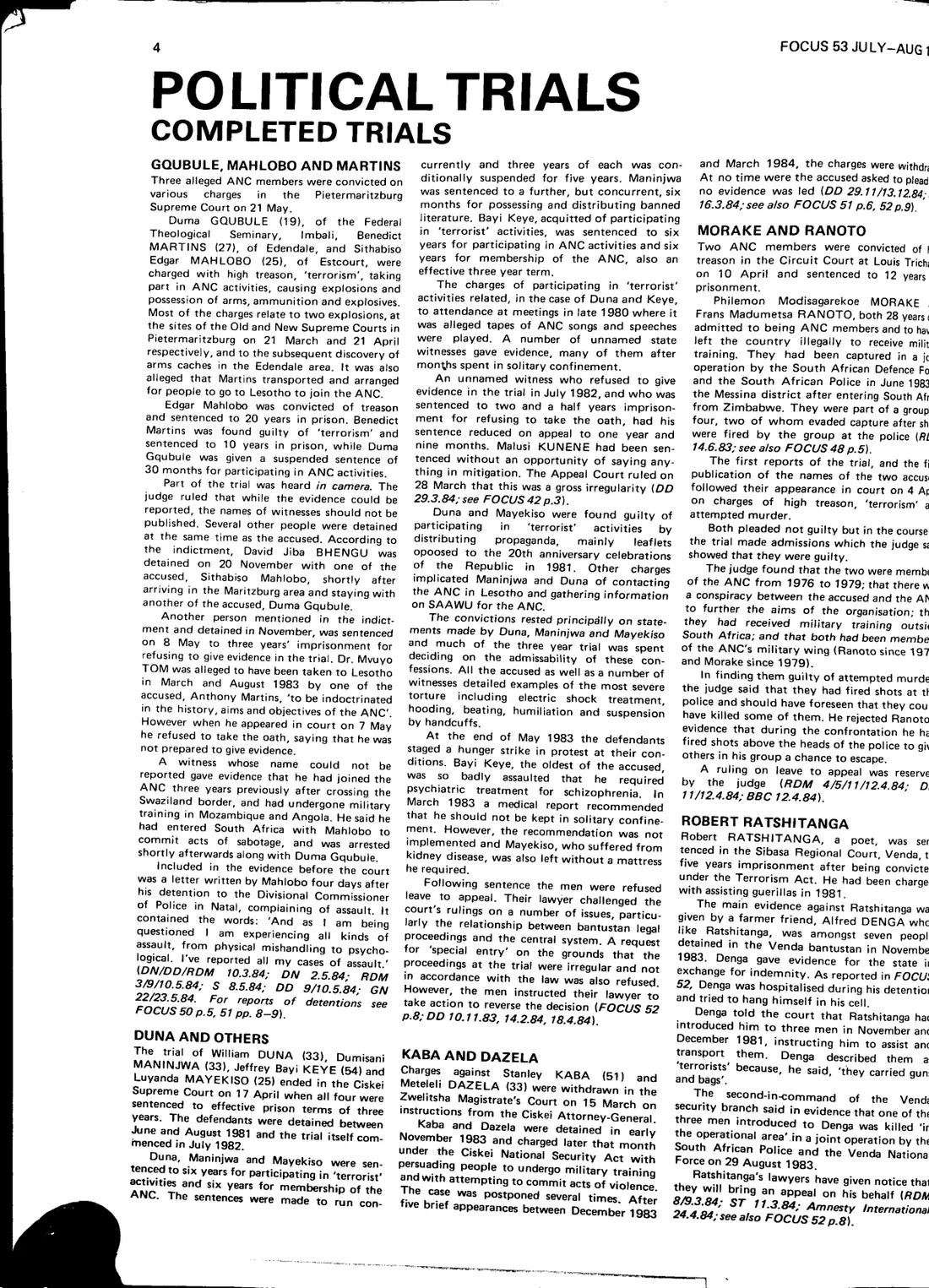
Three alleged ANC members were convicted on various charges in the Pietermaritzburg Supreme Court on 21 May.
Duma GQUBULE (19), of the Federal Theological Seminary, Imbali, Benedict MARTINS (27), of Edendale, and Sithabiso Edgar MAHLOBO (25), of Estcourt, were charged with high treason, 'terrorism', taking part in ANC activities, causing explosions and possession of arms, ammunition and explosives. Most of the charges relate to two explosions, at the sites of the Old and New Supreme Courts in Pietermaritzburg on 21 March and 21 April respectively, and to the subsequent discovery of arms caches in the Edendale area. It was also alleged that Martins transported and arranged for people to go to Lesotho to join the ANC.
Edgar Mahlobo was convicted of treason and sentenced to 20 years in prison. Benedict Martins was found guilty of 'terrorism' and sentenced to 10 years in prison, while Duma Gqubule was given a suspended sentence of 30 months for participating in ANC activities.
Part of the trial was heard in camera. The judge ruled that while the evidence could be reported, the names of witnesses should not be published. Several other people were detained at the same time as the accused. According to the indictment, David Jiba BHENGU was detained on 20 November with one of the accused, Sithabiso Mahlobo, shortly after arriving in the Maritzburg area and staying with another of the accused, Duma Gqubule.
Another person mentioned in the indictment and detained in November, was sentenced on 8 May to three years' imprisonment for refusing to give evidence in the trial. Dr. Mvuyo TOM was alleged to have been taken to Lesotho in March and August 1983 by one of the accused, Anthony Martins, 'to be indoctrinated in the history, aims and objectives of the ANC'. However when he appeared in court on 7 May he refused to take the oath, saying that he was not prepared to give evidence.
A witness whose name could not be reported gave evidence that he had joined the ANC three years previously after crossing the Swaziland border, and had undergone military training in Mozambique and Angola. He said he had entered South Africa with Mahlobo to commit acts of sabotage, and was arrested shortly afterwards along with Duma Gqubule.
Included in the evidence before the court was a letter written by Mahlobo four days after his detention to the Divisional Commissioner of Police in Natal, complaining of assault. It contained the words: 'And as I am being questioned I am experiencing all kinds of assault, from physical mishandling to psychological. I've reported all my cases of assault.'
The trial of William DUNA (33), Dumsani MANINJWA (33), Jeffrey Bayi KEYE (54) and Luyanda MAYEKISO (25) ended in the Ciskei Supreme Court on 17 April when all four were sentenced to effective prison terms of three years. The defendants were detained between June and August 1981 and the trial itself commenced in July 1982.
Duna, Maninjwa and Mayekiso were sentenced to six years for participating in 'terrorist' activities and six years for membership of the ANC. The sentences were made to run concurrently and three years of each was conditionally suspended for five years. Maninjwa was sentenced to a further, but concurrent, six months for possessing and distributing banned literature. Bayi Keye, acquitted of participating in 'terrorist' activities, was sentenced to six years for participating in ANC activities and six years for membership of the ANC, also an effective three year term.
The charges of participating in 'terrorist' activities related, in the case of Duna and Keye, to attendance at meetings in late 1980 where it was alleged tapes of ANC songs and speeches were played. A number of unnamed state witnesses gave evidence, many of them after months spent in solitary confinement.
An unnamed witness who refused to give evidence in the trial in July 1982, and who was sentenced to two and a half years imprisonment for refusing to take the oath, had his sentence reduced on appeal to one year and nine months. Malusi KUNENE had been sentenced without an opportunity of saying anything in mitigation. The Appeal Court ruled on 28 March that this was a gross irregularity.
Duna and Mayekiso were found guilty of participating in 'terrorist' activities by distributing propaganda, mainly leaflets opposed to the 20th anniversary celebrations of the Republic in 1981. Other charges implicated Maninjwa and Duna of contacting the ANC in Lesotho and gathering information on SAAWU for the ANC.
The convictions rested principally on statements made by Duna, Maninjwa and Mayekiso and much of the three year trial was spent deciding on the admissability of these confessions. All the accused as well as a number of witnesses detailed examples of the most severe torture including electric shock treatment, hooding, beating, humiliation and suspension by handcuffs.
At the end of May 1983 the defendants staged a hunger strike in protest at their conditions. Bayi Keye, the oldest of the accused, was so badly assaulted that he required psychiatric treatment for schizophrenia. In March 1983 a medical report recommended that he should not be kept in solitary confinement. However, the recommendation was not implemented and Mayekiso, who suffered from kidney disease, was also left without a mattress he required.
Following sentence the men were refused leave to appeal. Their lawyer challenged the court's rulings on a number of issues, particularly the relationship between bantustan legal proceedings and the central system. A request for 'special entry' on the grounds that the proceedings at the trial were irregular and not in accordance with the law was also refused. However, the men instructed their lawyer to take action to reverse the decision.
Charges against Stanley KABA (51) and Meteleli DAZELA (33) were withdrawn in the Zwelitsha Magistrate's Court on 15 March on instructions from the Ciskei Attorney-General.
Kaba and Dazela were detained in early November 1983 and charged later that month under the Ciskei National Security Act with persuading people to undergo military training and with attempting to commit acts of violence. The case was postponed several times. After five brief appearances between December 1983 and March 1984, the charges were withdrawn. At no time were the accused asked to plead no evidence was led.
Two ANC members were convicted of treason in the Circuit Court at Louis Trichie on 10 April and sentenced to 12 years imprisonment.
Philemon Modisagarekoe MORAKE Frans Madumetsa RANOTO, both 28 years old, admitted to being ANC members and to having left the country illegally to receive military training. They had been captured in a joint operation by the South African Defence Force and the South African Police in June 1983 from Zimbabwe. They were part of a group of four, two of whom evaded capture after she were fired by the group at the police.
The first reports of the trial, and the final publication of the names of the two accused followed their appearance in court on 4 April on charges of high treason, 'terrorism' and attempted murder.
Both pleaded not guilty but in the course of the trial made admissions which the judge said showed that they were guilty.
The judge found that the two were members of the ANC from 1976 to 1979; that there was a conspiracy between the accused and the ANC to further the aims of the organisation; that they had received military training outside South Africa; and that both had been members of the ANC's military wing (Ranoto since 1976 and Morake since 1979).
In finding them guilty of attempted murder the judge said that they had fired shots at the police and should have foreseen that they could have killed some of them. He rejected Ranoto's evidence that during the confrontation he had fired shots above the heads of the police to give others in his group a chance to escape.
A ruling on leave to appeal was reserved by the judge.
Robert RATSHITANGA, a poet, was sentenced in the Sibasa Regional Court, Venda, to five years imprisonment after being convicted under the Terrorism Act. He had been charged with assisting guerillas in 1981.
The main evidence against Ratshitanga was given by a farmer friend, Alfred DENGA who like Ratshitanga, was amongst seven people detained in the Venda bantustan in November 1983. Denga gave evidence for the state in exchange for indemnity. As reported in FOCUS 52, Denga was hospitalised during his detention and tried to hang himself in his cell.
Denga told the court that Ratshitanga had introduced him to three men in November and December 1981, instructing him to assist and transport them. Denga described them as 'terrorists' because, he said, 'they carried guns and bags'.
The second-in-command of the Venda security branch said in evidence that one of the three men introduced to Denga was killed 'in the operational area' in a joint operation by the South African Police and the Venda National Force on 29 August 1983.
Ratshitanga's lawyers have given notice that they will bring an appeal on his behalf.
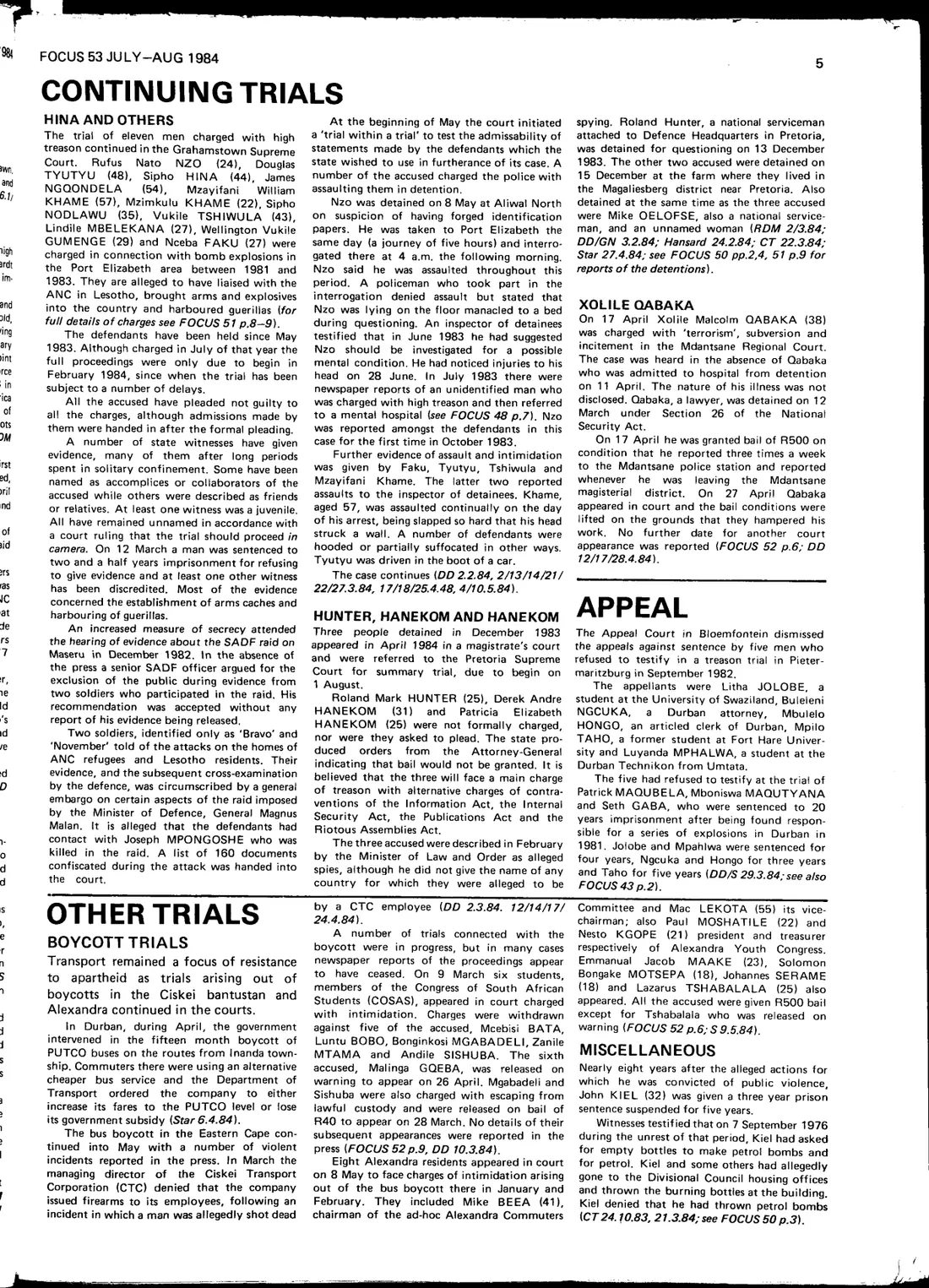
The trial of eleven men charged with high treason continued in the Grahamstown Supreme Court. Rufus Nato NZO (24), Douglas TYUTYU (48), Sipho HINA (44), James NGQONDELA (54), Mzayifani William KHAME (57), Mzimkulu KHAME (22), Sipho NODLAWU (35), Vukile TSHIWULA (43), Lindile MBELEKANA (27), Wellington Vukile GUMENGE (29) and Nceba FAKU (27) were charged in connection with bomb explosions in the Port Elizabeth area between 1981 and 1983. They are alleged to have liaised with the ANC in Lesotho, brought arms and explosives into the country and harboured guerillas.
The defendants have been held since May 1983. Although charged in July of that year the full proceedings were only due to begin in February 1984, since when the trial has been subject to a number of delays.
All the accused have pleaded not guilty to all the charges, although admissions made by them were handed in after the formal pleading.
A number of state witnesses have given evidence, many of them after long periods spent in solitary confinement. Some have been named as accomplices or collaborators of the accused while others were described as friends or relatives. At least one witness was a juvenile. All have remained unnamed in accordance with a court ruling that the trial should proceed in camera. On 12 March a man was sentenced to two and a half years imprisonment for refusing to give evidence and at least one other witness has been discredited. Most of the evidence concerned the establishment of arms caches and harbouring of guerillas.
An increased measure of secrecy attended the hearing of evidence about the SADF raid on Maseru in December 1982. In the absence of the press a senior SADF officer argued for the exclusion of the public during evidence from two soldiers who participated in the raid. His recommendation was accepted without any report of his evidence being released.
Two soldiers, identified only as 'Bravo' and 'November' told of the attacks on the homes of ANC refugees and Lesotho residents. Their evidence, and the subsequent cross-examination by the defence, was circumscribed by a general embargo on certain aspects of the raid imposed by the Minister of Defence, General Magnus Malan. It is alleged that the defendants had contact with Joseph MPONGOSHE who was killed in the raid. A list of 160 documents confiscated during the attack was handed into the court.
At the beginning of May the court initiated a 'trial within a trial' to test the admissability of statements made by the defendants which the state wished to use in furtherance of its case. A number of the accused charged the police with assaulting them in detention.
Nzo was detained on 8 May at Aliwal North on suspicion of having forged identification papers. He was taken to Port Elizabeth the same day (a journey of five hours) and interrogated there at 4 a.m. the following morning. Nzo said he was assaulted throughout this period. A policeman who took part in the interrogation denied assault but stated that Nzo was lying on the floor manacled to a bed during questioning. An inspector of detainees testified that in June 1983 he had suggested Nzo should be investigated for a possible mental condition. He had noticed injuries to his head on 28 June. In July 1983 there were newspaper reports of an unidentified man who was charged with high treason and then referred to a mental hospital. Nzo was reported amongst the defendants in this case for the first time in October 1983.
Further evidence of assault and intimidation was given by Faku, Tyutyu, Tshiwula and Mzayifani Khame. The latter two reported assaults to the inspector of detainees. Khame, aged 57, was assaulted continually on the day of his arrest, being slapped so hard that his head struck a wall. A number of defendants were hooded or partially suffocated in other ways. Tyutyu was driven in the boot of a car.
Three people detained in December 1983 appeared in April 1984 in a magistrate's court and were referred to the Pretoria Supreme Court for summary trial, due to begin on 1 August.
Roland Mark HUNTER (25), Derek Andre HANEKOM (31) and Patricia Elizabeth HANEKOM (25) were not formally charged, nor were they asked to plead. The state produced orders from the Attorney-General indicating that bail would not be granted. It is believed that the three will face a main charge of treason with alternative charges of contraventions of the Information Act, the Internal Security Act, the Publications Act and the Riotous Assemblies Act.
The three accused were described in February by the Minister of Law and Order as alleged spies, although he did not give the name of any country for which they were alleged to be spying. Roland Hunter, a national serviceman attached to Defence Headquarters in Pretoria, was detained for questioning on 13 December 1983. The other two accused were detained on 15 December at the farm where they lived in the Magaliesberg district near Pretoria. Also detained at the same time as the three accused were Mike OELOFSE, also a national serviceman, and an unnamed woman.
On 17 April Xolile Malcolm QABAKA (38) was charged with 'terrorism', subversion and incitement in the Mdantsane Regional Court. The case was heard in the absence of Qabaka who was admitted to hospital from detention on 11 April. The nature of his illness was not disclosed. Qabaka, a lawyer, was detained on 12 March under Section 26 of the National Security Act.
On 17 April he was granted bail of R500 on condition that he reported three times a week to the Mdantsane police station and reported whenever he was leaving the Mdantsane magisterial district. On 27 April Qabaka appeared in court and the bail conditions were lifted on the grounds that they hampered his work. No further date for another court appearance was reported.
The Appeal Court in Bloemfontein dismissed the appeals against sentence by five men who refused to testify in a treason trial in Pietermaritzburg in September 1982.
The appellants were Litha JOLOBE, a student at the University of Swaziland, Buleleni NGCUKA, a Durban attorney, Mbulelo HONGO, an articled clerk of Durban, Mpilo TAHO, a former student at Fort Hare University and Luyanda MPHALWA, a student at the Durban Technikon from Umtata.
The five had refused to testify at the trial of Patrick MAQUBELA, Mboniswa MAQUTYANA and Seth GABA, who were sentenced to 20 years imprisonment after being found responsible for a series of explosions in Durban in 1981. Jolobe and Mpahlwa were sentenced for four years, Ngcuka and Hongo for three years and Taho for five years.
Transport remained a focus of resistance to apartheid as trials arising out of boycotts in the Ciskei bantustan and Alexandra continued in the courts.
In Durban, during April, the government intervened in the fifteen month boycott of PUTCO buses on the routes from Inanda township. Commuters there were using an alternative cheaper bus service and the Department of Transport ordered the company to either increase its fares to the PUTCO level or lose its government subsidy.
The bus boycott in the Eastern Cape continued into May with a number of violent incidents reported in the press. In March the managing director of the Ciskei Transport Corporation (CTC) denied that the company issued firearms to its employees, following an incident in which a man was allegedly shot dead by a CTC employee.
A number of trials connected with the boycott were in progress, but in many cases newspaper reports of the proceedings appear to have ceased. On 9 March six students, members of the Congress of South African Students (COSAS), appeared in court charged with intimidation. Charges were withdrawn against five of the accused, Mcebisi BATA, Luntu BOBO, Bonginkosi MGABADELI, Zanile MTAMA and Andile SISHUBA. The sixth accused, Malinga GQEBA, was released on warning to appear on 26 April. Mgabadeli and Sishuba were also charged with escaping from lawful custody and were released on bail of R40 to appear on 28 March. No details of their subsequent appearances were reported in the press.
Eight Alexandra residents appeared in court on 8 May to face charges of intimidation arising out of the bus boycott there in January and February. They included Mike BEEA (41), chairman of the ad-hoc Alexandra Commuters Committee and Mac LEKOTA (55) its vice-chairman; also Paul MOSHATILE (22) and Nesto KGOPE (21) president and treasurer respectively of Alexandra Youth Congress. Emmanuel Jacob MAAKE (23), Solomon Bongake MOTSEPA (18), Johannes SERAME (18) and Lazarus TSHABALALA (25) also appeared. All the accused were given R500 bail except for Tshabalala who was released on warning.
Nearly eight years after the alleged actions for which he was convicted of public violence, John KIEL (32) was given a three year prison sentence suspended for five years.
Witnesses testified that on 7 September 1976 during the unrest of that period, Kiel had asked for empty bottles to make petrol bombs and for petrol. Kiel and some others had allegedly gone to the Divisional Council housing offices and thrown the burning bottles at the building. Kiel denied that he had thrown petrol bombs.