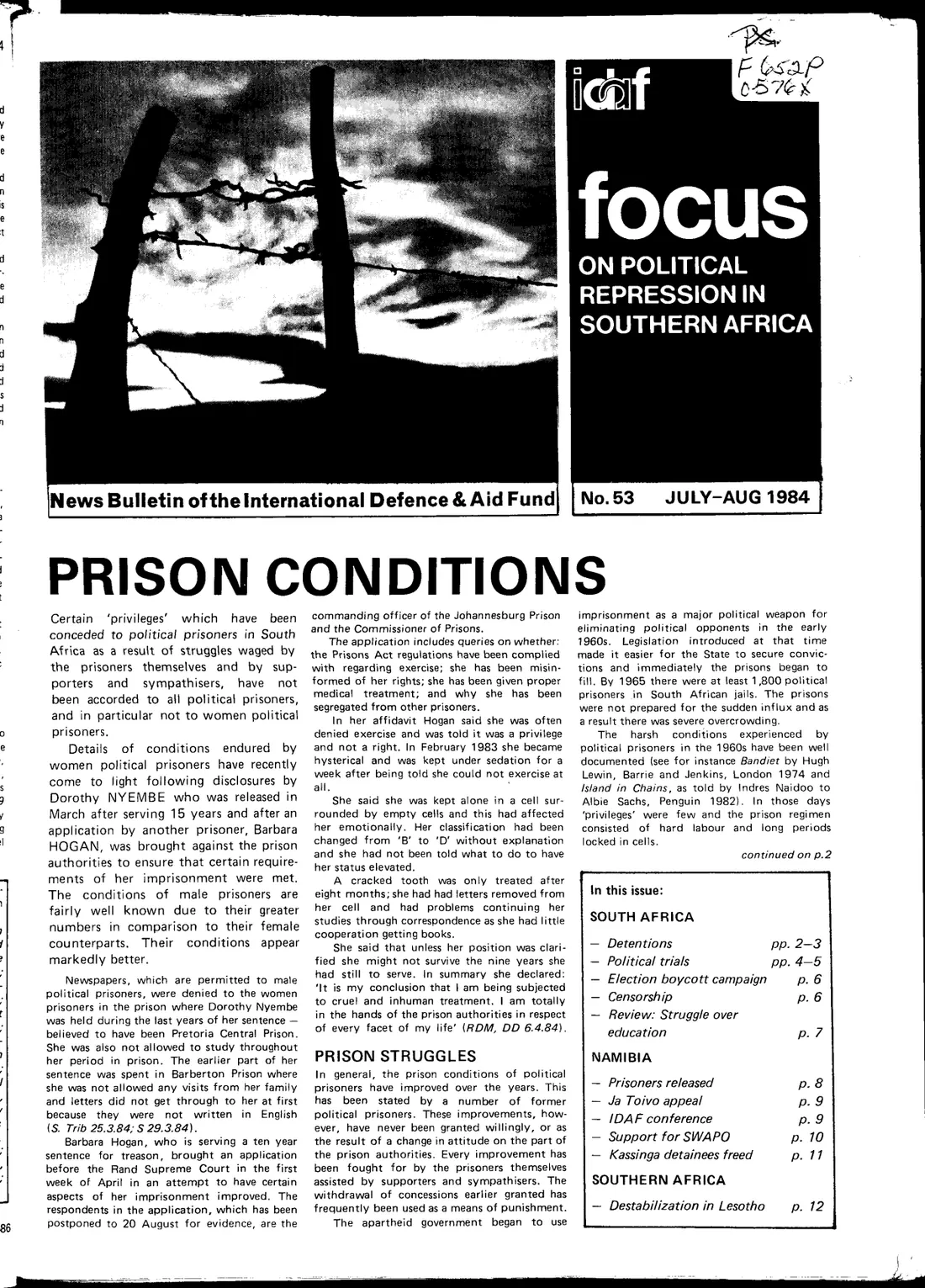
Certain 'privileges' which have been conceded to political prisoners in South Africa as a result of struggles waged by the prisoners themselves and by supporters and sympathisers, have not been accorded to all political prisoners, and in particular not to women political prisoners.
Details of conditions endured by women political prisoners have recently come to light following disclosures by Dorothy NYEMBE who was released in March after serving 15 years and after an application by another prisoner, Barbara HOGAN, was brought against the prison authorities to ensure that certain requirements of her imprisonment were met. The conditions of male prisoners are fairly well known due to their greater numbers in comparison to their female counterparts. Their conditions appear markedly better.
Newspapers, which are permitted to male political prisoners, were denied to the women prisoners in the prison where Dorothy Nyembe was held during the last years of her sentence – believed to have been Pretoria Central Prison. She was also not allowed to study throughout her period in prison. The earlier part of her sentence was spent in Barberton Prison where she was not allowed any visits from her family and letters did not get through to her at first because they were not written in English.
Barbara Hogan, who is serving a ten year sentence for treason, brought an application before the Rand Supreme Court in the first week of April in an attempt to have certain aspects of her imprisonment improved. The respondents in the application, which has been postponed to 20 August for evidence, are the commanding officer of the Johannesburg Prison and the Commissioner of Prisons.
The application includes queries on whether: the Prisons Act regulations have been complied with regarding exercise; she has been misinformed of her rights; she has been given proper medical treatment; and why she has been segregated from other prisoners.
In her affidavit Hogan said she was often denied exercise and was told it was a privilege and not a right. In February 1983 she became hysterical and was kept under sedation for a week after being told she could not exercise at all.
She said she was kept alone in a cell surrounded by empty cells and this had affected her emotionally. Her classification had been changed from 'B' to 'D' without explanation and she had not been told what to do to have her status elevated.
A cracked tooth was only treated after eight months; she had had letters removed from her cell and had problems continuing her studies through correspondence as she had little cooperation getting books.
She said that unless her position was clarified she might not survive the nine years she had still to serve. In summary she declared: 'It is my conclusion that I am being subjected to cruel and inhuman treatment. I am totally in the hands of the prison authorities in respect of every facet of my life'.
In general, the prison conditions of political prisoners have improved over the years. This has been stated by a number of former political prisoners. These improvements, however, have never been granted willingly, or as the result of a change in attitude on the part of the prison authorities. Every improvement has been fought for by the prisoners themselves assisted by supporters and sympathisers. The withdrawal of concessions earlier granted has frequently been used as a means of punishment.
The apartheid government began to use imprisonment as a major political weapon for eliminating political opponents in the early 1960s. Legislation introduced at that time made it easier for the State to secure convictions and immediately the prisons began to fill. By 1965 there were at least 1,800 political prisoners in South African jails. The prisons were not prepared for the sudden influx and as a result there was severe overcrowding.
The harsh conditions experienced by political prisoners in the 1960s have been well documented (see for instance Bandiet by Hugh Lewin, Barrie and Jenkins, London 1974 and Island in Chains, as told by Indres Naidoo to Albie Sachs, Penguin 1982). In those days 'privileges' were few and the prison regimen consisted of hard labour and long periods locked in cells.
Prisoners were only permitted to receive and write one letter every six months. Visits were severely restricted, especially for those on Robben Island which was usually a great distance from where prisoners' relatives lived. Food was poor and insufficient and clothing inadequate. By a process of attrition prisoners tackled each aspect of their condition and gradually won improvements. Many of these were achieved by direct confrontation and protests in the prisons. Others were achieved through lawyers, visitors, family and friends. Visits by the International Committee of the Red Cross became important for the prisoners and many improvements were achieved through its intervention.
Most severe for political prisoners was the absolute blackout on news of any kind from the outside world. Even the few family and sports magazines that were allowed were heavily censored of any reference to current events or changes taking place in society.
Prisoners' anger came to a head on this issue in 1978 when eight political prisoners brought a court case against the Minister of Justice and the Commissioner of Prisons. In their application they demanded the right to receive newspapers — in accordance with the requirements of the UN Minimum Rules for prisoners — to receive magazines and journals of their choice and that censorship of magazines, letters and visits be limited to that required for prison security. Although the case was dismissed by the court the prisoners won a moral victory as their plight became widely publicised. Shortly thereafter political prisoners were permitted censored newscasts over an intercom system. The case influenced dramatically the authorities' attitude toward censorship and two years later political prisoners were allowed to receive newspapers, uncensored. All the prisoners' demands in the case were ultimately granted, at least to male prisoners.
The right to study has been an issue most vigorously pursued by the prisoners and others. For many the most serious obstacle to study was lack of funds. This has been overcome to some extent by assistance from prisoner support organisations. The prison authorities have placed further obstacles in the way of prisoners through restrictions on which courses may be pursued and by petty administrative actions, such as preventing library books reaching the prisoners.
In 1977 it was announced that political prisoners would not be allowed to study beyond matriculation level while in prison. Prisoners studying post matric courses were allowed to complete their courses but not start further courses. The reason given by the authorities for stopping studies was that several prisoners had abused the 'privilege' by using study materials to write inciting documents and smuggle information out of the prisons.
Widespread protests and the setting up of a Prisoners Education Committee by sympathizers and supporters eventually forced the authorities to reconsider their decision. Prison study beyond matriculation level was restored in May 1980. Many of the earlier restrictions on which courses may be pursued were also removed.
The overall conditions of some political prisoners have deteriorated markedly. In particular the group of ANC leaders who were transferred from Robben Island to Pollsmoor Prison in April 1982 have now to endure much harsher conditions. These include Nelson Mandela, Walter Sisulu, Andrew Mlangeni and Raymond Mhlaba. Details of their conditions were passed on to Winnie Mandela during visit and made public at a hearing in London of the UN Ad Hoc Working Group on Human Rights. Of foremost concern was the lack of recreational facilities as Pollsmoor Prison was not designed for long-term prisoners. The prison is structurally closed with all its exercise areas in concrete quadrangles surrounded by the high walls of the prison building or on the roof.
Many other aspects of prison life have improved through continual protests, hunger strikes and petitions by the prisoners, along with international pressure. The latest 'reform' the granting of selective remission to political prisoners, is also the result of constant pressure. Opponents of the government have stated that this 'concession' is meaningless until life prisoners such as Nelson Mandela, Walter Sisulu and Denis Goldberg are released.