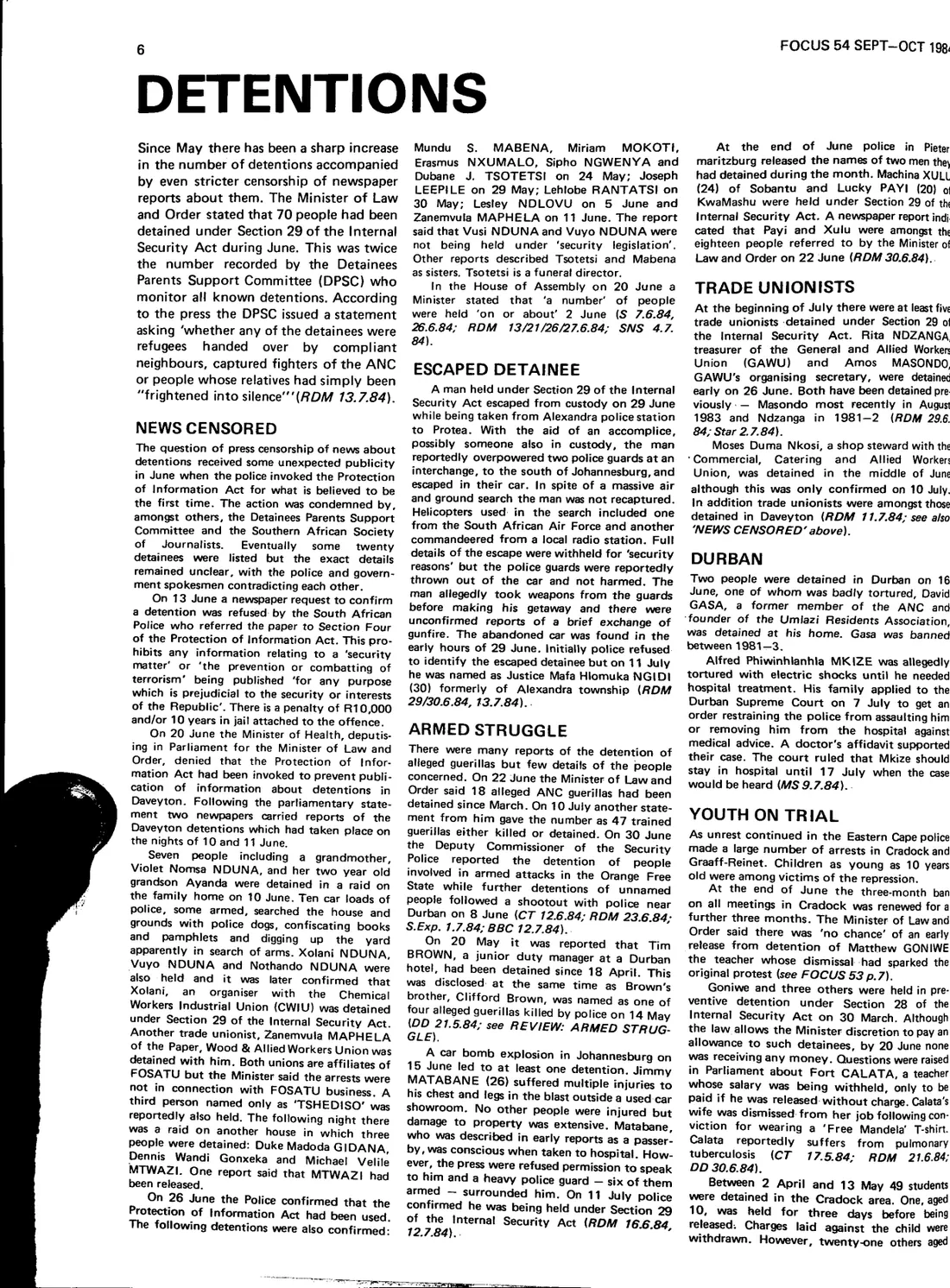
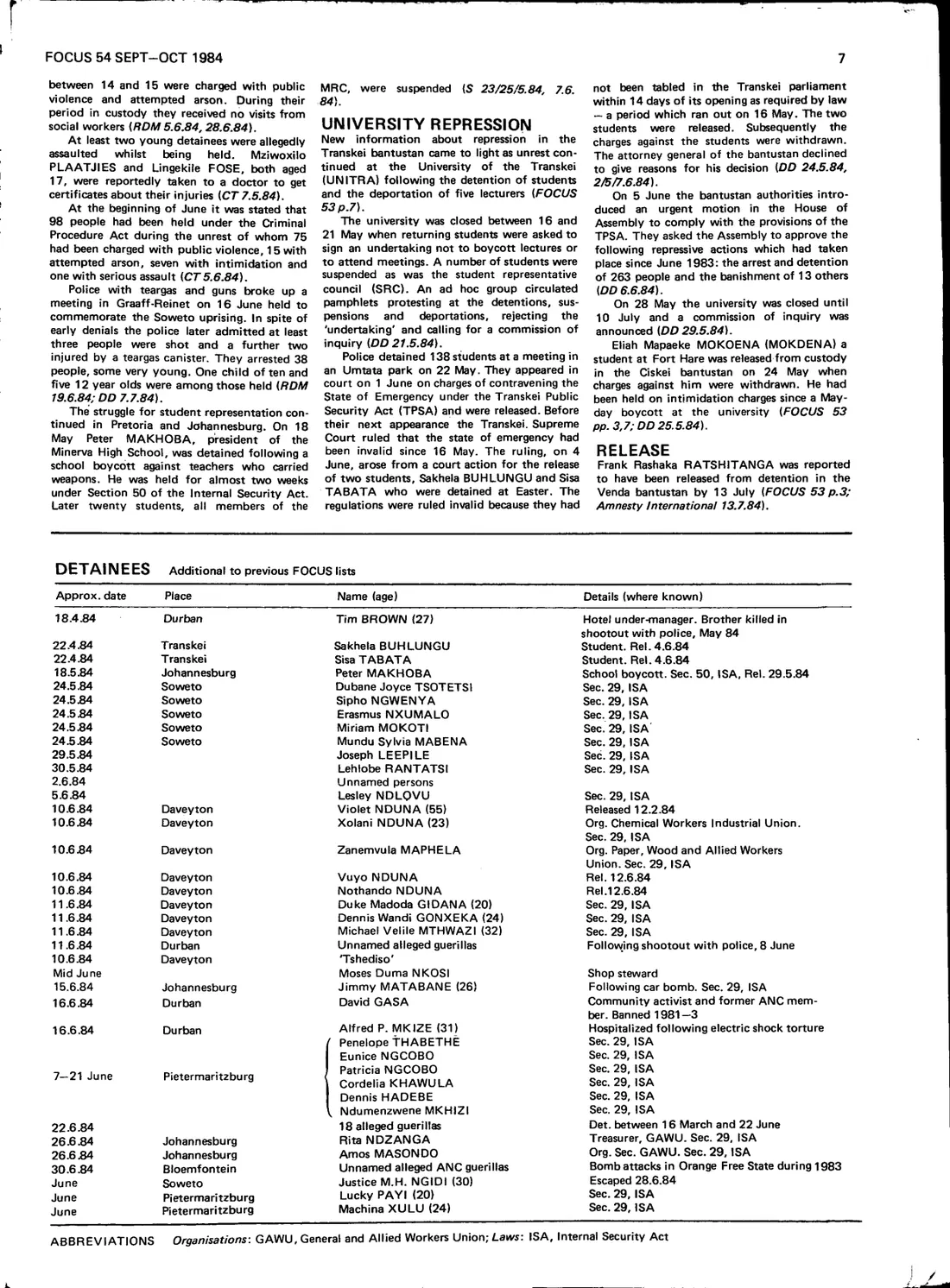
Since May there has been a sharp increase in the number of detentions accompanied by even stricter censorship of newspaper reports about them. The Minister of Law and Order stated that 70 people had been detained under Section 29 of the Internal Security Act during June. This was twice the number recorded by the Detainees Parents Support Committee (DPSC) who monitor all known detentions. According to the press the DPSC issued a statement asking 'whether any of the detainees were refugees handed over by compliant neighbours, captured fighters of the ANC or people whose relatives had simply been "frightened into silence"'(RDM 13.7.84).
The question of press censorship of news about detentions received some unexpected publicity in June when the police invoked the Protection of Information Act for what is believed to be the first time. The action was condemned by, amongst others, the Detainees Parents Support Committee and the Southern African Society of Journalists. Eventually some twenty detainees were listed but the exact details remained unclear, with the police and government spokesmen contradicting each other.
On 13 June a newspaper request to confirm a detention was refused by the South African Police who referred the paper to Section Four of the Protection of Information Act. This prohibits any information relating to a 'security matter' or 'the prevention or combatting of terrorism' being published 'for any purpose which is prejudicial to the security or interests of the Republic'. There is a penalty of R10,000 and/or 10 years in jail attached to the offence.
On 20 June the Minister of Health, deputising in Parliament for the Minister of Law and Order, denied that the Protection of Information Act had been invoked to prevent publication of information about detentions in Daveyton. Following the parliamentary statement two newpapers carried reports of the Daveyton detentions which had taken place on the nights of 10 and 11 June.
Seven people including a grandmother, Violet Nomsa NDUNA, and her two year old grandson Ayanda were detained in a raid on the family home on 10 June. Ten car loads of police, some armed, searched the house and grounds with police dogs, confiscating books and pamphlets and digging up the yard apparently in search of arms. Xolani NDUNA, Vuyo NDUNA and Nothando NDUNA were also held and it was later confirmed that Xolani, an organiser with the Chemical Workers Industrial Union (CWIU) was detained under Section 29 of the Internal Security Act. Another trade unionist, Zanemvula MAPHELA of the Paper, Wood & Allied Workers Union was detained with him. Both unions are affiliates of FOSATU but the Minister said the arrests were not in connection with FOSATU business. A third person named only as 'TSHEDISO' was reportedly also held. The following night there was a raid on another house in which three people were detained: Duke Madoda GIDANA, Dennis Wandi Gonxeka and Michael Velile MTWAZI. One report said that MTWAZI had been released.
On 26 June the Police confirmed that the Protection of Information Act had been used. The following detentions were also confirmed:
Mundu S. MABENA, Miriam MOKOTI, Erasmus NXUMALO, Sipho NGWENYA and Dubane J. TSOTETSI on 24 May; Joseph LEEPILE on 29 May; Lehlobe RANTATSI on 30 May; Lesley NDLOVU on 5 June and Zanemvula MAPHELA on 11 June. The report said that Vusi NDUNA and Vuyo NDUNA were not being held under 'security legislation'. Other reports described Tsotetsi and Mabena as sisters. Tsotetsi is a funeral director.
In the House of Assembly on 20 June a Minister stated that 'a number' of people were held 'on or about' 2 June (S 7.6.84, 26.6.84; RDM 13/21/26/27.6.84; SNS 4.7.84).
A man held under Section 29 of the Internal Security Act escaped from custody on 29 June while being taken from Alexandra police station to Protea. With the aid of an accomplice, possibly someone also in custody, the man reportedly overpowered two police guards at an interchange, to the south of Johannesburg, and escaped in their car. In spite of a massive air and ground search the man was not recaptured. Helicopters used in the search included one from the South African Air Force and another commandeered from a local radio station. Full details of the escape were withheld for 'security reasons' but the police guards were reportedly thrown out of the car and not harmed. The man allegedly took weapons from the guards before making his getaway and there were unconfirmed reports of a brief exchange of gunfire. The abandoned car was found in the early hours of 29 June. Initially police refused to identify the escaped detainee but on 11 July he was named as Justice Mafa Hlomuka NGIDI (30) formerly of Alexandra township (RDM 29/30.6.84, 13.7.84).
There were many reports of the detention of alleged guerillas but few details of the people concerned. On 22 June the Minister of Law and Order said 18 alleged ANC guerillas had been detained since March. On 10 July another statement from him gave the number as 47 trained guerillas either killed or detained. On 30 June the Deputy Commissioner of the Security Police reported the detention of people involved in armed attacks in the Orange Free State while further detentions of unnamed people followed a shootout with police near Durban on 8 June (CT 12.6.84; RDM 23.6.84; S.Exp. 1.7.84; BBC 12.7.84).
On 20 May it was reported that Tim BROWN, a junior duty manager at a Durban hotel, had been detained since 18 April. This was disclosed at the same time as Brown's brother, Clifford Brown, was named as one of four alleged guerillas killed by police on 14 May (DD 21.5.84; see REVIEW: ARMED STRUGGLE).
A car bomb explosion in Johannesburg on 15 June led to at least one detention. Jimmy MATABANE (26) suffered multiple injuries to his chest and legs in the blast outside a used car showroom. No other people were injured but damage to property was extensive. Matabane, who was described in early reports as a passer-by, was conscious when taken to hospital. However, the press were refused permission to speak to him and a heavy police guard — six of them armed — surrounded him. On 11 July police confirmed he was being held under Section 29 of the Internal Security Act (RDM 16.6.84, 12.7.84).
At the end of June police in Pietermaritzburg released the names of two men they had detained during the month. Machina XULU (24) of Sobantu and Lucky PAYI (20) of KwaMashu were held under Section 29 of the Internal Security Act. A newspaper report indicated that Payi and Xulu were amongst the eighteen people referred to by the Minister of Law and Order on 22 June (RDM 30.6.84).
At the beginning of July there were at least five trade unionists detained under Section 29 of the Internal Security Act. Rita NDZANGA, treasurer of the General and Allied Workers Union (GAWU) and Amos MASONDO, GAWU's organising secretary, were detained early on 26 June. Both have been detained previously — Masondo most recently in August 1983 and Ndzanga in 1981-2 (RDM 29.6.84; Star 2.7.84).
Moses Duma Nkosi, a shop steward with the Commercial, Catering and Allied Workers Union, was detained in the middle of June although this was only confirmed on 10 July. In addition trade unionists were amongst those detained in Daveyton (RDM 11.7.84; see also 'NEWS CENSORED' above).
Two people were detained in Durban on 16 June, one of whom was badly tortured, David GASA, a former member of the ANC and founder of the Umlazi Residents Association, was detained at his home. Gasa was banned between 1981-3.
Alfred Piwinhlanha MKIZE was allegedly tortured with electric shocks until he needed hospital treatment. His family applied to the Durban Supreme Court on 7 July to get an order restraining the police from assaulting him or removing him from the hospital against medical advice. A doctor's affidavit supported their case. The court ruled that Mkize should stay in hospital until 17 July when the case would be heard (MS 9.7.84).
As unrest continued in the Eastern Cape police made a large number of arrests in Cradock and Graaff-Reinet. Children as young as 10 years old were among victims of the repression.
At the end of June the three-month ban on all meetings in Cradock was renewed for a further three months. The Minister of Law and Order said there was 'no chance' of an early release from detention of Matthew GONIWE the teacher whose dismissal had sparked the original protest (see FOCUS 53 p.7).
Goniwe and three others were held in preventive detention under Section 28 of the Internal Security Act on 30 March. Although the law allows the Minister discretion to pay an allowance to such detainees, by 20 June none was receiving any money. Questions were raised in Parliament about Fort CALATA, a teacher whose salary was being withheld, only to be paid if he was released without charge. Calata's wife was dismissed from her job following conviction for wearing a 'Free Mandela' T-shirt. Calata reportedly suffers from pulmonary tuberculosis (CT 17.5.84; RDM 21.6.84; DD 30.6.84).
Between 2 April and 13 May 49 students were detained in the Cradock area. One, aged 10, was held for three days before being released. Charges laid against the child were withdrawn. However, twenty-one others aged between 14 and 15 were charged with public violence and attempted arson. During their period in custody they received no visits from social workers (RDM 5.6.84, 28.6.84).
At least two young detainees were allegedly assaulted whilst being held. Mziwoxilo PLAATJIES and Lingekile FOSE, both aged 17, were reportedly taken to a doctor to get certificates about their injuries (CT 7.5.84).
At the beginning of June it was stated that 98 people had been held under the Criminal Procedure Act during the unrest of whom 75 had been charged with public violence, 15 with attempted arson, seven with intimidation and one with serious assault (CT 5.6.84).
Police with teargas and guns broke up a meeting in Graaff-Reinet on 16 June held to commemorate the Soweto uprising. In spite of early denials the police later admitted at least three people were shot and a further two injured by a teargas canister. They arrested 38 people, some very young. One child of ten and five 12 year olds were among those held (RDM 19.6.84; DD 7.7.84).
The struggle for student representation continued in Pretoria and Johannesburg. On 18 May Peter MAKHOBA, president of the Minerva High School, was detained following a school boycott against teachers who carried weapons. He was held for almost two weeks under Section 50 of the Internal Security Act. Later twenty students, all members of the MRC, were suspended (S 23/25/5.84, 7.6.84).
New information about repression in the Transkei bantustan came to light as unrest continued at the University of the Transkei (UNITRA) following the detention of students and the deportation of five lecturers (FOCUS 53 p.7).
The university was closed between 16 and 21 May when returning students were asked to sign an undertaking not to boycott lectures or to attend meetings. A number of students were suspended as was the student representative council (SRC). An ad hoc group circulated pamphlets protesting at the detentions, suspensions and deportations, rejecting the 'undertaking' and calling for a commission of inquiry (DD 21.5.84).
Police detained 138 students at a meeting in an Umtata park on 22 May. They appeared in court on 1 June on charges of contravening the State of Emergency under the Transkei Public Security Act (TPSA) and were released. Before their next appearance the Transkei Supreme Court ruled that the state of emergency had been invalid since 16 May. The ruling, on 4 June, arose from a court action for the release of two students, Sakhela BUHLUNGU and Sisa TABATA who were detained at Easter. The regulations were ruled invalid because they had not been tabled in the Transkei parliament within 14 days of its opening as required by law – a period which ran out on 16 May. The two students were released. Subsequently the charges against the students were withdrawn. The attorney general of the bantustan declined to give reasons for his decision (DD 24.5.84, 2/5/7.6.84).
On 5 June the bantustan authorities introduced an urgent motion in the House of Assembly to comply with the provisions of the TPSA. They asked the Assembly to approve the following repressive actions which had taken place since June 1983: the arrest and detention of 263 people and the banishment of 13 others (DD 6.6.84).
On 28 May the university was closed until 10 July and a commission of inquiry was announced (DD 29.5.84).
Eliah Mapaeke MOKOENA (MOKDENA) a student at Fort Hare was released from custody in the Ciskei bantustan on 24 May when charges against him were withdrawn. He had been held on intimidation charges since a May-day boycott at the university (FOCUS 53 pp. 3,7; DD 25.5.84).
Frank Rashaka RATSHITANGA was reported to have been released from detention in the Venda bantustan by 13 July (FOCUS 53 p.3; Amnesty International 13.7.84).