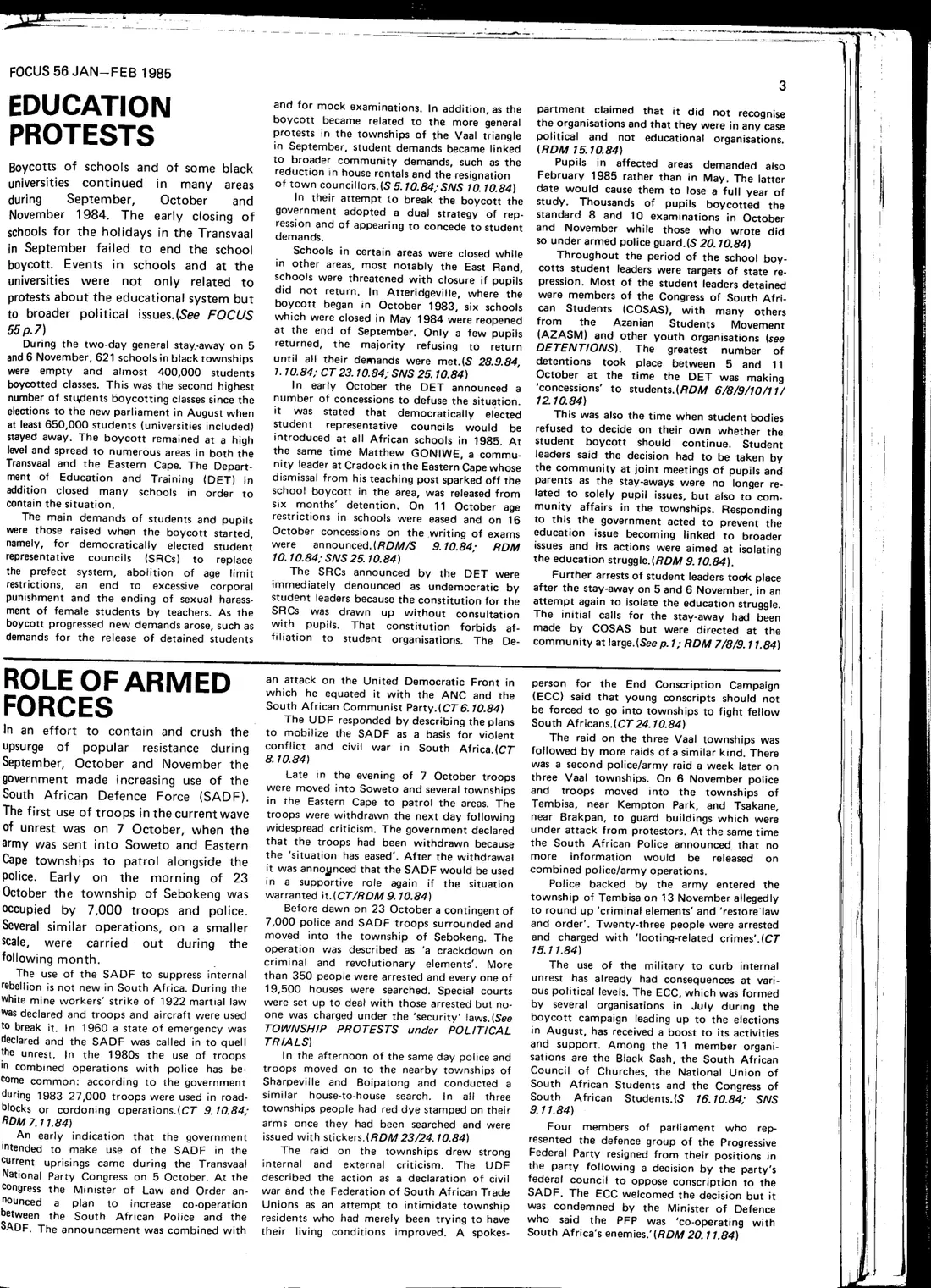
In an effort to contain and crush the upsurge of popular resistance during September, October and November the government made increasing use of the South African Defence Force (SADF). The first use of troops in the current wave of unrest was on 7 October, when the army was sent into Soweto and Eastern Cape townships to patrol alongside the police. Early on the morning of 23 October the township of Sebokeng was occupied by 7,000 troops and police. Several similar operations, on a smaller scale, were carried out during the following month.
The use of the SADF to suppress internal rebellion is not new in South Africa. During the white mine workers' strike of 1922 martial law was declared and troops and aircraft were used to break it. In 1960 a state of emergency was declared and the SADF was called in to quell the unrest. In the 1980s the use of troops in combined operations with police has become common: according to the government during 1983 27,000 troops were used in roadblocks or cordoning operations.
An early indication that the government intended to make use of the SADF in the current uprisings came during the Transvaal National Party Congress on 5 October. At the congress the Minister of Law and Order announced a plan to increase co-operation between the South African Police and the SADF. The announcement was combined with an attack on the United Democratic Front in which he equated it with the ANC and the South African Communist Party.
The UDF responded by describing the plans to mobilize the SADF as a basis for violent conflict and civil war in South Africa.
Late in the evening of 7 October troops were moved into Soweto and several townships in the Eastern Cape to patrol the areas. The troops were withdrawn the next day following widespread criticism. The government declared that the troops had been withdrawn because the 'situation has eased'. After the withdrawal it was announced that the SADF would be used in a supportive role again if the situation warranted it.
Before dawn on 23 October a contingent of 7,000 police and SADF troops surrounded and moved into the township of Sebokeng. The operation was described as 'a crackdown on criminal and revolutionary elements'. More than 350 people were arrested and every one of 19,500 houses were searched. Special courts were set up to deal with those arrested but none was charged under the 'security' laws.
In the afternoon of the same day police and troops moved on to the nearby townships of Sharpeville and Boipatong and conducted a similar house-to-house search. In all three townships people had red dye stamped on their arms once they had been searched and were issued with stickers.
The raid on the townships drew strong internal and external criticism. The UDF described the action as a declaration of civil war and the Federation of South African Trade Unions as an attempt to intimidate township residents who had merely been trying to have their living conditions improved. A spokesperson for the End Conscription Campaign (ECC) said that young conscripts should not be forced to go into townships to fight fellow South Africans.
The raid on the three Vaal townships was followed by more raids of a similar kind. There was a second police/army raid a week later on three Vaal townships. On 6 November police and troops moved into the townships of Tembisa, near Kempton Park, and Tsakane, near Brakpan, to guard buildings which were under attack from protesters. At the same time the South African Police announced that no more information would be released on combined police/army operations.
Police backed by the army entered the township of Tembisa on 13 November allegedly to round up 'criminal elements' and 'restore' law and order'. Twenty-three people were arrested and charged with 'looting-related crimes'.
The use of the military to curb internal unrest has already had consequences at various political levels. The ECC, which was formed by several organisations in July during the boycott campaign leading up to the elections in August, has received a boost to its activities and support. Among the 11 member organisations are the Black Sash, the South African Council of Churches, the National Union of South African Students and the Congress of South African Students.
Four members of parliament who represented the defence group of the Progressive Federal Party resigned from their positions in the party following a decision by the party's federal council to oppose conscription to the SADF. The ECC welcomed the decision but it was condemned by the Minister of Defence who said the PFP was 'co-operating with South Africa's enemies.'