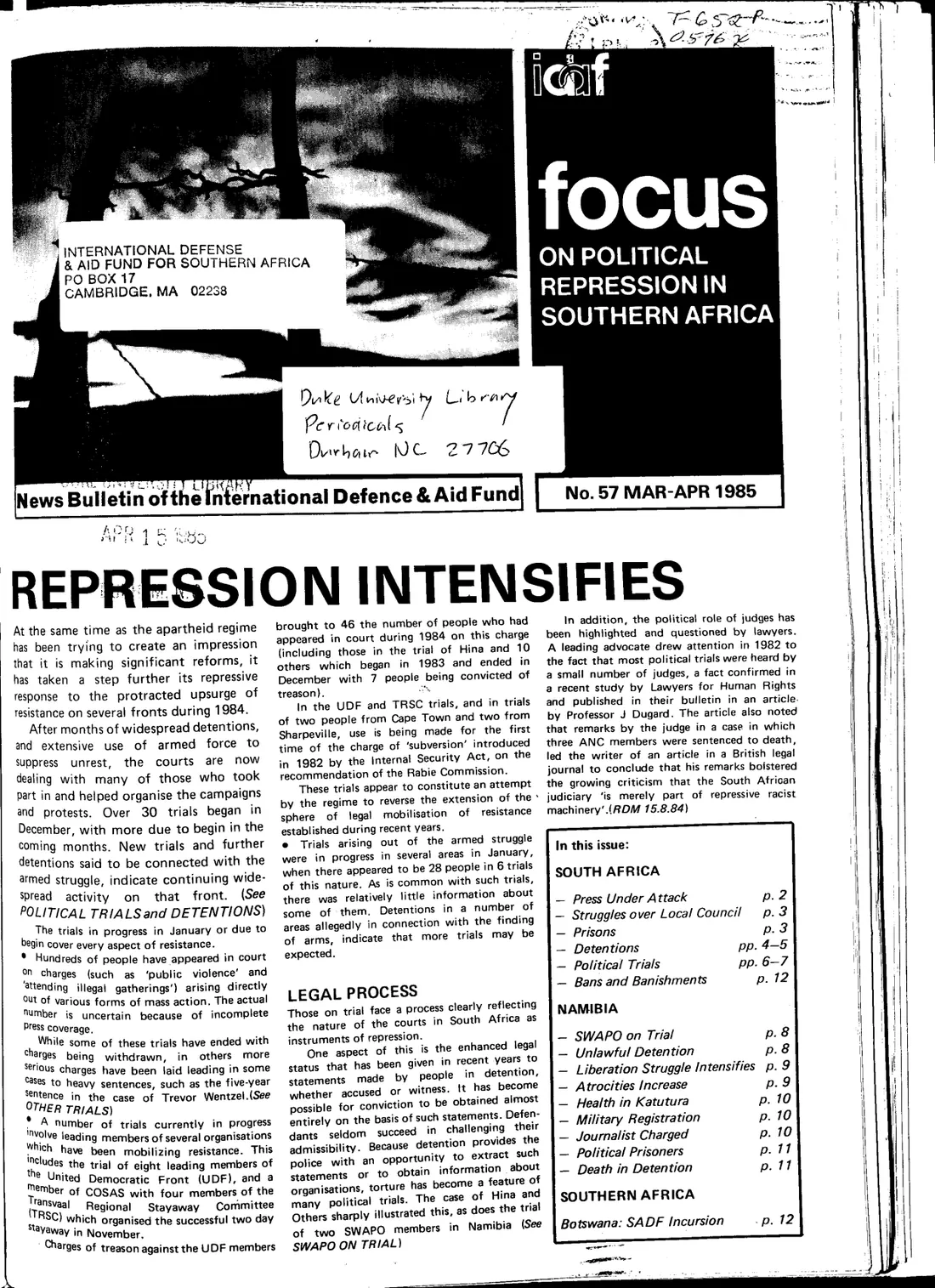
At the same time as the apartheid regime has been trying to create an impression that it is making significant reforms, it has taken a step further its repressive response to the protracted upsurge of resistance on several fronts during 1984.
After months of widespread detentions, and extensive use of armed force to suppress unrest, the courts are now dealing with many of those who took part in and helped organise the campaigns and protests. Over 30 trials began in December, with more due to begin in the coming months. New trials and further detentions said to be connected with the armed struggle, indicate continuing widespread activity on that front. (See POLITICAL TRIALS and DETENTIONS)
The trials in progress in January or due to begin cover every aspect of resistance.
- Hundreds of people have appeared in court on charges (such as 'public violence' and 'attending illegal gatherings') arising directly out of various forms of mass action. The actual number is uncertain because of incomplete press coverage.
While some of these trials have ended with charges being withdrawn, in others more serious charges have been laid leading in some cases to heavy sentences, such as the five-year sentence in the case of Trevor Wentzel. (See OTHER TRIALS)
- A number of trials currently in progress involve leading members of several organisations which have been mobilizing resistance. This includes the trial of eight leading members of the United Democratic Front (UDF), and a member of COSAS with four members of the Transvaal Regional Stayaway Committee (TRSC) which organised the successful two day stayaway in November.
Charges of treason against the UDF members brought to 46 the number of people who had appeared in court during 1984 on this charge (including those in the trial of Hina and 10 others which began in 1983 and ended in December with 7 people being convicted of treason).
In the UDF and TRSC trials, and in trials of two people from Cape Town and two from Sharpeville, use is being made for the first time of the charge of 'subversion' introduced in 1982 by the Internal Security Act, on the recommendation of the Rabie Commission.
These trials appear to constitute an attempt by the regime to reverse the extension of the sphere of legal mobilisation of resistance established during recent years.
- Trials arising out of the armed struggle were in progress in several areas in January, when there appeared to be 28 people in 6 trials of this nature. As is common with such trials, there was relatively little information about some of them. Detentions in a number of areas allegedly in connection with the finding of arms, indicate that more trials may be expected.
LEGAL PROCESS
Those on trial face a process clearly reflecting the nature of the courts in South Africa as instruments of repression.
One aspect of this is the enhanced legal status that has been given in recent years to statements made by people in detention, whether accused or witness. It has become possible for conviction to be obtained almost entirely on the basis of such statements. Deten- dants seldom succeed in challenging their admissibility. Because detention provides the police with an opportunity to extract such statements or to obtain information about organisations, torture has become a feature of many political trials. The case of Hina and Others sharply illustrated this, as does the trial of two SWAPO members in Namibia (See SWAPO ON TRIAL)
In addition, the political role of judges has been highlighted and questioned by lawyers. A leading advocate drew attention in 1982 to the fact that most political trials were heard by a small number of judges, a fact confirmed in a recent study by Lawyers for Human Rights and published in their bulletin in an article by Professor J Dugard. The article also noted that remarks by the judge in a case in which three ANC members were sentenced to death, led the writer of an article in a British legal journal to conclude that his remarks bolstered the growing criticism that the South African judiciary 'is merely part of repressive racist machinery'.