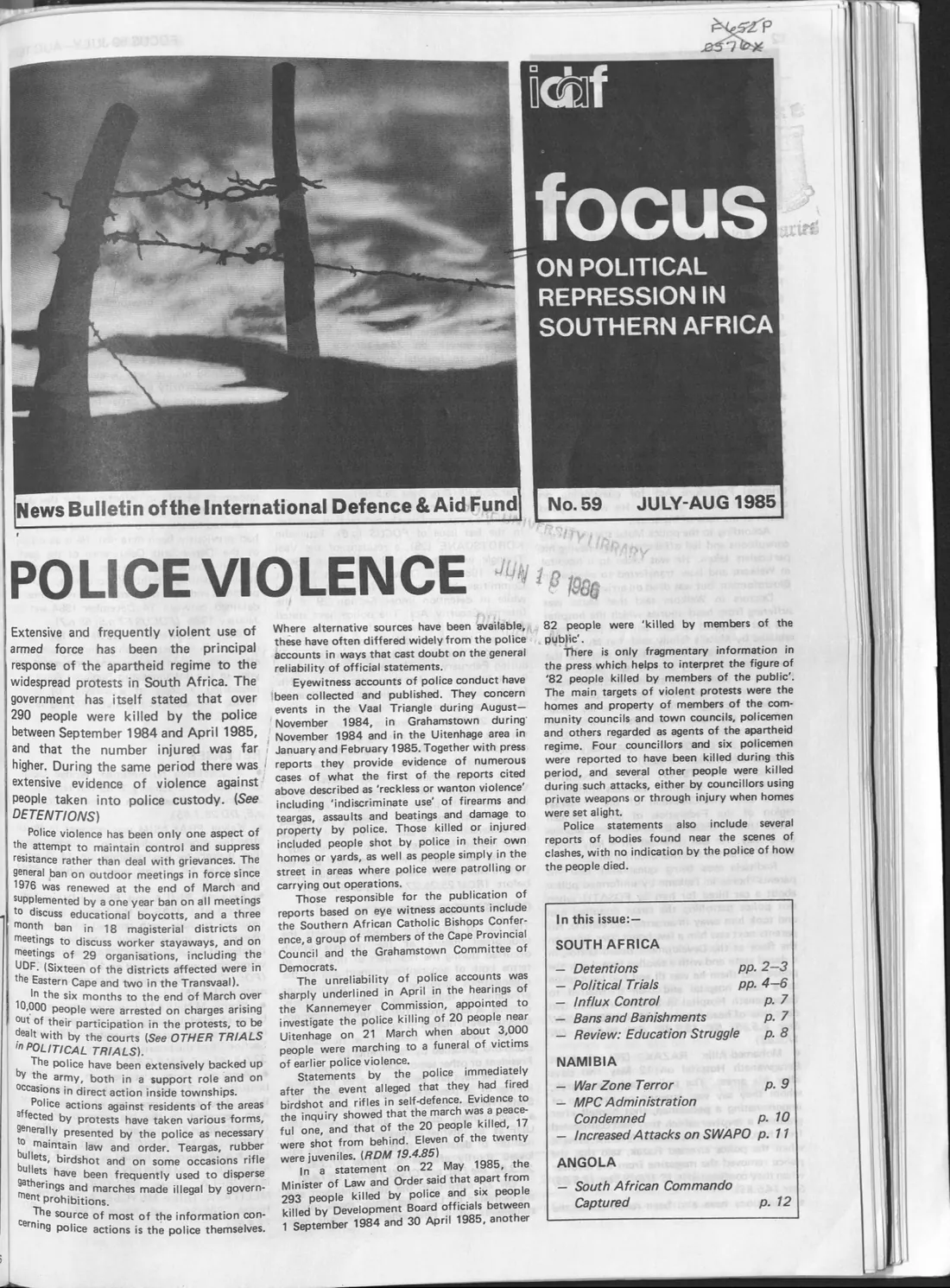
Extensive and frequently violent use of armed force has been the principal response of the apartheid regime to the widespread protests in South Africa. The government has itself stated that over 290 people were killed by the police between September 1984 and April 1985, and that the number injured was far higher. During the same period there was extensive evidence of violence against people taken into police custody. (See DETENTIONS)
Police violence has been only one aspect of the attempt to maintain control and suppress resistance rather than deal with grievances. The general ban on outdoor meetings in force since 1976 was renewed at the end of March and supplemented by a one year ban on all meetings to discuss educational boycotts, and a three month ban in 18 magisterial districts on meetings to discuss worker stayaways, and on meetings of 29 organisations, including the UDF. (Sixteen of the districts affected were in the Eastern Cape and two in the Transvaal).
In the six months to the end of March over 10,000 people were arrested on charges arising out of their participation in the protests, to be dealt with by the courts (See OTHER TRIALS in POLITICAL TRIALS).
The police have been extensively backed up by the army, both in a support role and on occasions in direct action inside townships.
Police actions against residents of the areas affected by protests have taken various forms, generally presented by the police as necessary to maintain law and order. Teargas, rubber bullets, birdshot and on some occasions rifle bullets have been frequently used to disperse gatherings and marches made illegal by government prohibitions.
The source of most of the information concerning police actions is the police themselves.
Where alternative sources have been available, these have often differed widely from the police accounts in ways that cast doubt on the general reliability of official statements.
Eyewitness accounts of police conduct have been collected and published. They concern events in the Vaal Triangle during August–November 1984, in Grahamstown during November 1984 and in the Uitenhage area in January and February 1985. Together with press reports they provide evidence of numerous cases of what the first of the reports cited above described as ‘reckless or wanton violence’ including ‘indiscriminate use’ of firearms and teargas, assaults and beatings and damage to property by police. Those killed or injured included people shot by police in their own homes or yards, as well as people simply in the street in areas where police were patrolling or carrying out operations.
Those responsible for the publication of reports based on eye witness accounts include the Southern African Catholic Bishops Conference, a group of members of the Cape Provincial Council and the Grahamstown Committee of Democrats.
The unreliability of police accounts was sharply underlined in April in the hearings of the Kannemeyer Commission, appointed to investigate the police killing of 20 people near Uitenhage on 21 March when about 3,000 people were marching to a funeral of victims of earlier police violence.
Statements by the police immediately after the event alleged that they had fired birdshot and rifles in self-defence. Evidence to the inquiry showed that the march was a peaceful one, and that of the 20 people killed, 17 were shot from behind. Eleven of the twenty were juveniles.
In a statement on 22 May 1985, the Minister of Law and Order said that apart from 293 people killed by police and six people killed by Development Board officials between 1 September 1984 and 30 April 1985, another 82 people were ‘killed by members of the public’.
There is only fragmentary information in the press which helps to interpret the figure of ‘82 people killed by members of the public’. The main targets of violent protests were the homes and property of members of the community councils and town councils, policemen and others regarded as agents of the apartheid regime. Four councillors and six policemen were reported to have been killed during this period, and several other people were killed during such attacks, either by councillors using private weapons or through injury when homes were set alight.
Police statements also include several reports of bodies found near the scenes of clashes, with no indication by the police of how the people died.