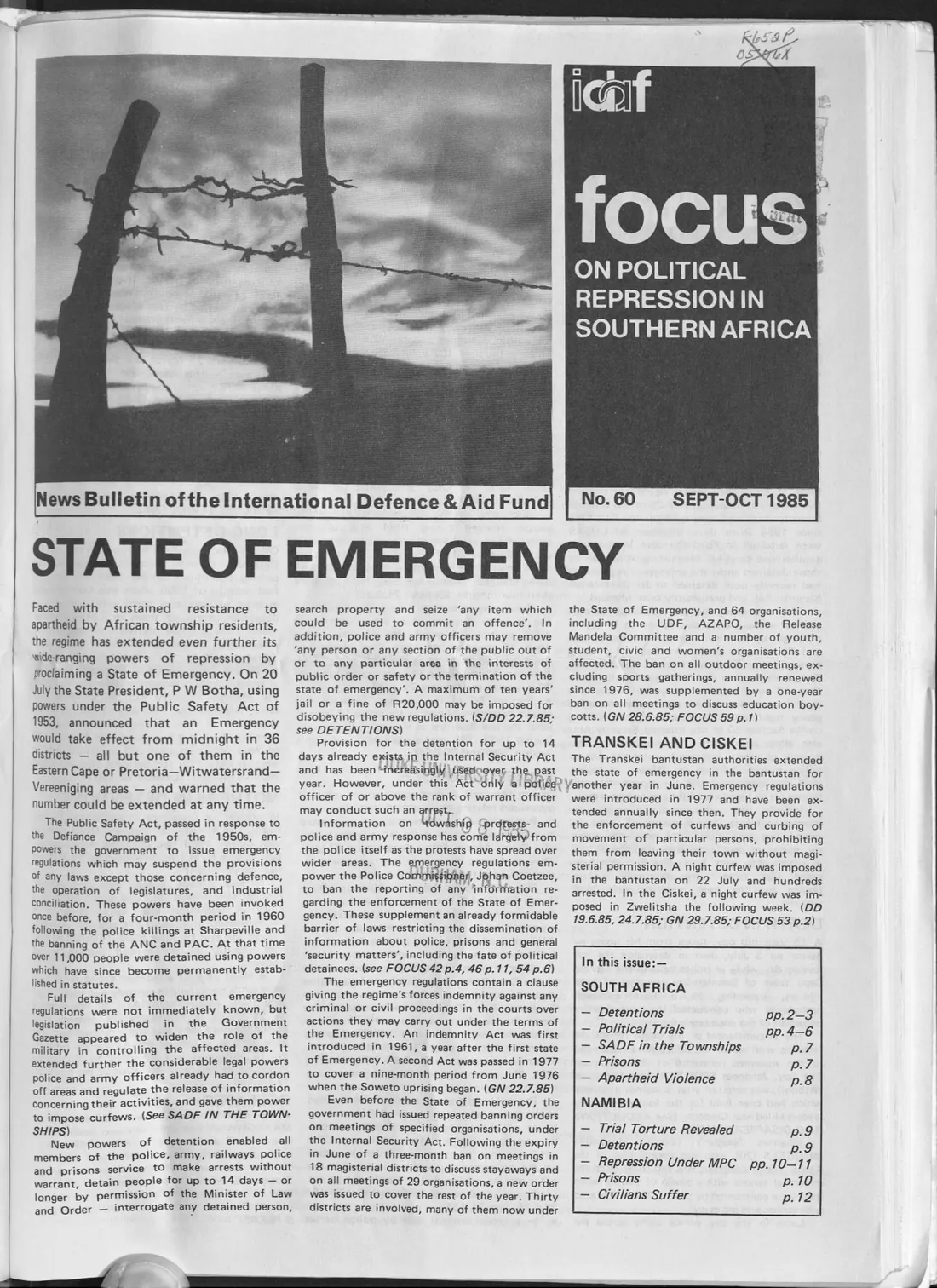
Faced with sustained resistance to apartheid by African township residents, the regime has extended even further its wide-ranging powers of repression by proclaiming a State of Emergency. On 20 July the State President, P W Botha, using powers under the Public Safety Act of 1953, announced that an Emergency would take effect from midnight in 36 districts - all but one of them in the Eastern Cape or Pretoria-Witwatersrand-Vereeniging areas - and warned that the number could be extended at any time.
The Public Safety Act, passed in response to the Defiance Campaign of the 1950s, empowers the government to issue emergency regulations which may suspend the provisions of any laws except those concerning defence, the operation of legislatures, and industrial conciliation. These powers have been invoked once before, for a four-month period in 1960 following the police killings at Sharpeville and the banning of the ANC and PAC. At that time over 11,000 people were detained using powers which have since become permanently established in statutes.
Full details of the current emergency regulations were not immediately known, but legislation published in the Government Gazette appeared to widen the role of the military in controlling the affected areas. It extended further the considerable legal powers police and army officers already had to cordon off areas and regulate the release of information concerning their activities, and gave them power to impose curfews. (See SADF IN THE TOWNSHIPS)
New powers of detention enabled all members of the police, army, railways police and prisons service to make arrests without warrant, detain people for up to 14 days - or longer by permission of the Minister of Law and Order - interrogate any detained person, search property and seize 'any item which could be used to commit an offence'. In addition, police and army officers may remove 'any person or any section of the public out of or to any particular area in the interests of public order or safety or the termination of the state of emergency'. A maximum of ten years' jail or a fine of R20,000 may be imposed for disobeying the new regulations. (S/DD 22.7.85; see DETENTIONS)
Provision for the detention for up to 14 days already exists in the Internal Security Act and has been increasingly used over the past year. However, under this Act, only a police officer of or above the rank of warrant officer may conduct such an arrest.
Information on township protests and police and army response has come largely from the police itself as the protests have spread over wider areas. The emergency regulations empower the Police Commissioner, Johan Coetzee, to ban the reporting of any information regarding the enforcement of the State of Emergency. These supplement an already formidable barrier of laws restricting the dissemination of information about police, prisons and general 'security matters', including the fate of political detainees. (see FOCUS 42 p.4, 46 p.11, 54 p.6)
The emergency regulations contain a clause giving the regime's forces indemnity against any criminal or civil proceedings in the courts over actions they may carry out under the terms of the Emergency. An indemnity Act was first introduced in 1961, a year after the first state of Emergency. A second Act was passed in 1977 to cover a nine-month period from June 1976 when the Soweto uprising began. (GN 22.7.85)
Even before the State of Emergency, the government had issued repeated banning orders on meetings of specified organisations, under the Internal Security Act. Following the expiry in June of a three-month ban on meetings in 18 magisterial districts to discuss stayaways and on all meetings of 29 organisations, a new order was issued to cover the rest of the year. Thirty districts are involved, many of them now under the State of Emergency, and 64 organisations, including the UDF, AZAPO, the Release Mandela Committee and a number of youth, student, civic and women's organisations are affected. The ban on all outdoor meetings, excluding sports gatherings, annually renewed since 1976, was supplemented by a one-year ban on all meetings to discuss education boycotts. (GN 28.6.85; FOCUS 59 p.1)