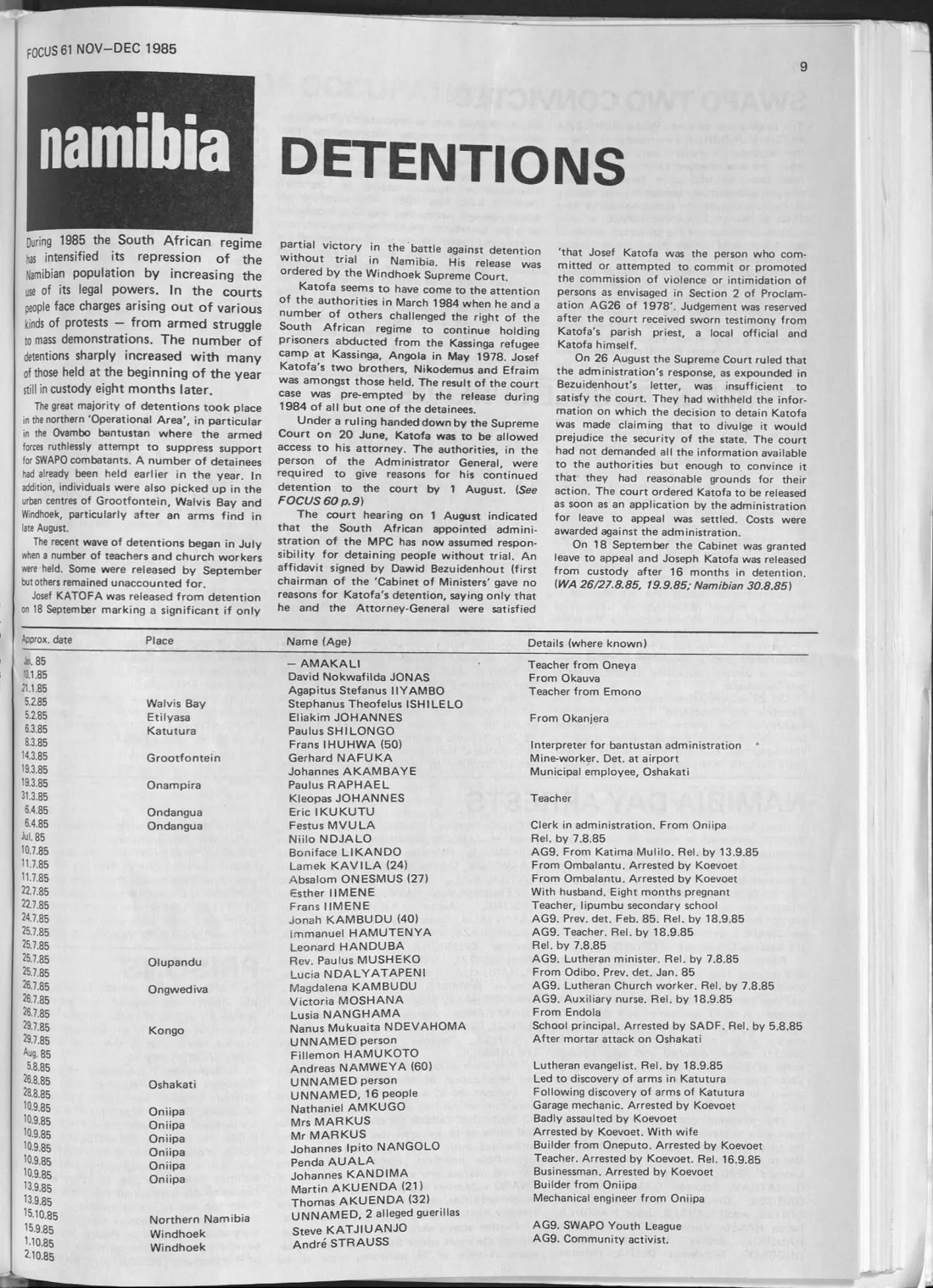
During 1985 the South African regime has intensified its repression of the Namibian population by increasing the use of its legal powers. In the courts people face charges arising out of various kinds of protests — from armed struggle to mass demonstrations. The number of detentions sharply increased with many of those held at the beginning of the year still in custody eight months later.
The great majority of detentions took place in the northern 'Operational Area', in particular in the Ovambo bantustan where the armed forces ruthlessly attempt to suppress support for SWAPO combatants. A number of detainees had already been held earlier in the year. In addition, individuals were also picked up in the urban centres of Grootfontein, Walvis Bay and Windhoek, particularly after an arms find in late August.
The recent wave of detentions began in July when a number of teachers and church workers were held. Some were released by September but others remained unaccounted for.
Josef KATOFA was released from detention on 18 September marking a significant if only partial victory in the battle against detention without trial in Namibia. His release was ordered by the Windhoek Supreme Court.
Katofa seems to have come to the attention of the authorities in March 1984 when he and a number of others challenged the right of the South African regime to continue holding prisoners abducted from the Kassinga refugee camp at Kassinga, Angola in May 1978. Josef Katofa's two brothers, Nikodemus and Efraim was amongst those held. The result of the court case was pre-empted by the release during 1984 of all but one of the detainees.
Under a ruling handed down by the Supreme Court on 20 June, Katofa was to be allowed access to his attorney. The authorities, in the person of the Administrator General, were required to give reasons for his continued detention to the court by 1 August.
The court hearing on 1 August indicated that the South African appointed administration of the MPC has now assumed responsibility for detaining people without trial. An affidavit signed by Dawid Bezuidenhout (first chairman of the 'Cabinet of Ministers' gave no reasons for Katofa's detention, saying only that he and the Attorney-General were satisfied 'that Josef Katofa was the person who committed or attempted to commit or promoted the commission of violence or intimidation of persons as envisaged in Section 2 of Proclamation AG26 of 1978'. Judgement was reserved after the court received sworn testimony from Katofa's parish priest, a local official and Katofa himself.
On 26 August the Supreme Court ruled that the administration's response, as expounded in Bezuidenhout's letter, was insufficient to satisfy the court. They had withheld the information on which the decision to detain Katofa was made claiming that to divulge it would prejudice the security of the state. The court had not demanded all the information available to the authorities but enough to convince it that they had reasonable grounds for their action. The court ordered Katofa to be released as soon as an application by the administration for leave to appeal was settled. Costs were awarded against the administration.
On 18 September the Cabinet was granted leave to appeal and Joseph Katofa was released from custody after 16 months in detention.