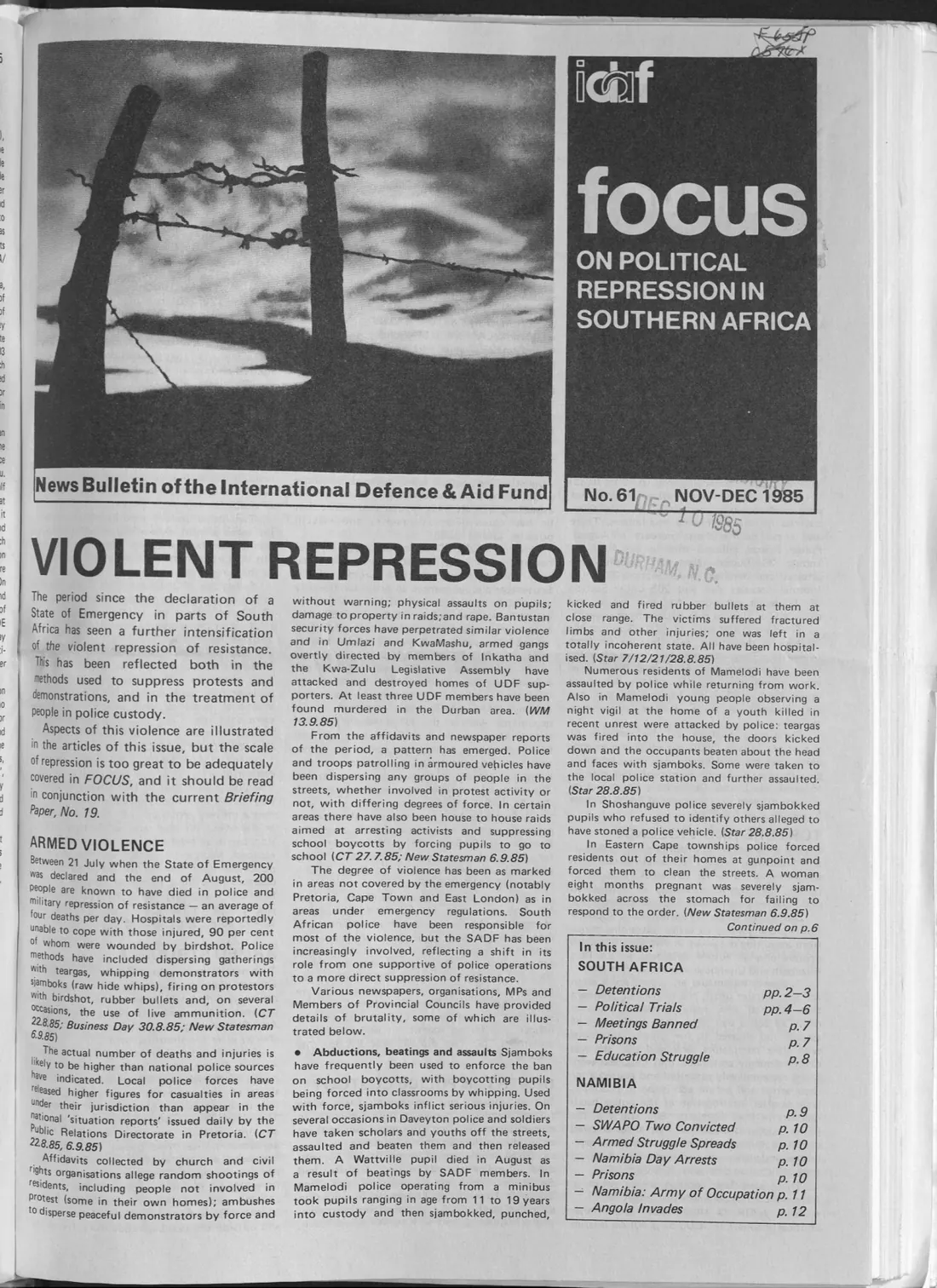
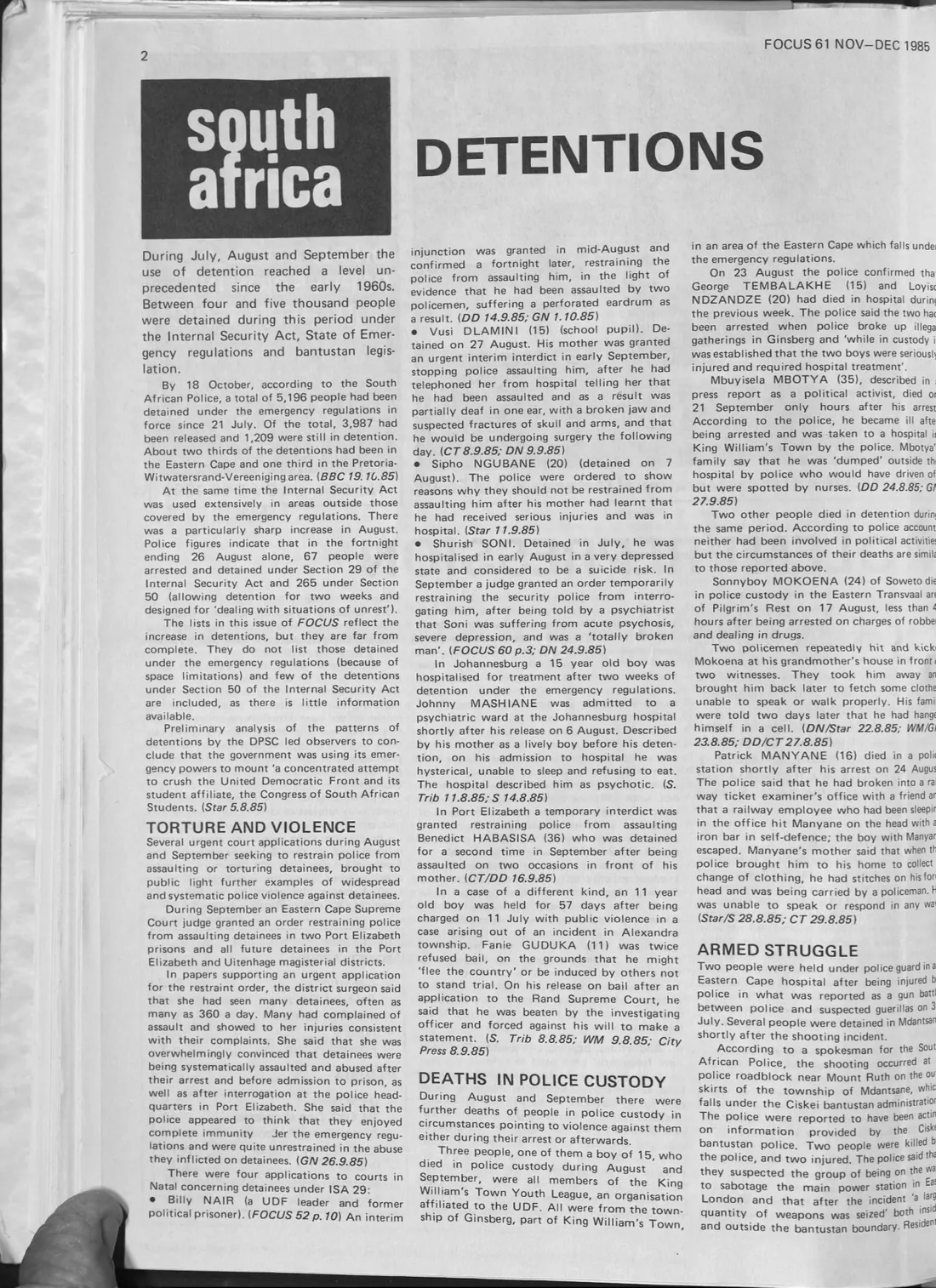
The period since the declaration of a State of Emergency in parts of South Africa has seen a further intensification of the violent repression of resistance. This has been reflected both in the methods used to suppress protests and demonstrations, and in the treatment of people in police custody.
Aspects of this violence are illustrated in the articles of this issue, but the scale of repression is too great to be adequately covered in FOCUS, and it should be read in conjunction with the current Briefing Paper, No. 19.
Between 21 July when the State of Emergency was declared and the end of August, 200 people are known to have died in police and military repression of resistance - an average of four deaths per day. Hospitals were reportedly unable to cope with those injured, 90 per cent of whom were wounded by birdshot. Police methods have included dispersing gatherings with teargas, whipping demonstrators with sjamboks (raw hide whips), firing on protesters with birdshot, rubber bullets and, on several occasions, the use of live ammunition.
The actual number of deaths and injuries is likely to be higher than national police sources have indicated. Local police forces have released higher figures for casualties in areas under their jurisdiction than appear in the national 'situation reports' issued daily by the Public Relations Directorate in Pretoria.
Affidavits collected by church and civil rights organisations allege random shootings of residents, including people not involved in protest (some in their own homes); ambushes to disperse peaceful demonstrators by force and without warning; physical assaults on pupils; damage to property in raids; and rape. Bantustan security forces have perpetrated similar violence and in Umlazi and KwaMashu, armed gangs overtly directed by members of Inkatha and the Kwa-Zulu Legislative Assembly have attacked and destroyed homes of UDF supporters. At least three UDF members have been found murdered in the Durban area.
From the affidavits and newspaper reports of the period, a pattern has emerged. Police and troops patrolling in armoured vehicles have been dispersing any groups of people in the streets, whether involved in protest activity or not, with differing degrees of force. In certain areas there have also been house to house raids aimed at arresting activists and suppressing school boycotts by forcing pupils to go to school.
The degree of violence has been as marked in areas not covered by the emergency (notably Pretoria, Cape Town and East London) as in areas under emergency regulations. South African police have been responsible for most of the violence, but the SADF has been increasingly involved, reflecting a shift in its role from one supportive of police operations to a more direct suppression of resistance.
Various newspapers, organisations, MPs and Members of Provincial Councils have provided details of brutality, some of which are illustrated below.
- Abductions, beatings and assaults Sjamboks have frequently been used to enforce the ban on school boycotts, with boycotting pupils being forced into classrooms by whipping. Used with force, sjamboks inflict serious injuries. On several occasions in Daveyton police and soldiers have taken scholars and youths off the streets, assaulted and beaten them and then released them. A Wattville pupil died in August as a result of beatings by SADF members. In Mamelodi police operating from a minibus took pupils ranging in age from 11 to 19 years into custody and then sjambokked, punched, kicked and fired rubber bullets at them at close range. The victims suffered fractured limbs and other injuries; one was left in a totally incoherent state. All have been hospitalised.
Numerous residents of Mamelodi have been assaulted by police while returning from work. Also in Mamelodi young people observing a night vigil at the home of a youth killed in recent unrest were attacked by police: teargas was fired into the house, the doors kicked down and the occupants beaten about the head and faces with sjamboks. Some were taken to the local police station and further assaulted.
In Shoshanguve police severely sjambokked pupils who refused to identify others alleged to have stoned a police vehicle.
In Eastern Cape townships police forced residents out of their homes at gunpoint and forced them to clean the streets. A woman eight months pregnant was severely sjambokked across the stomach for failing to respond to the order.