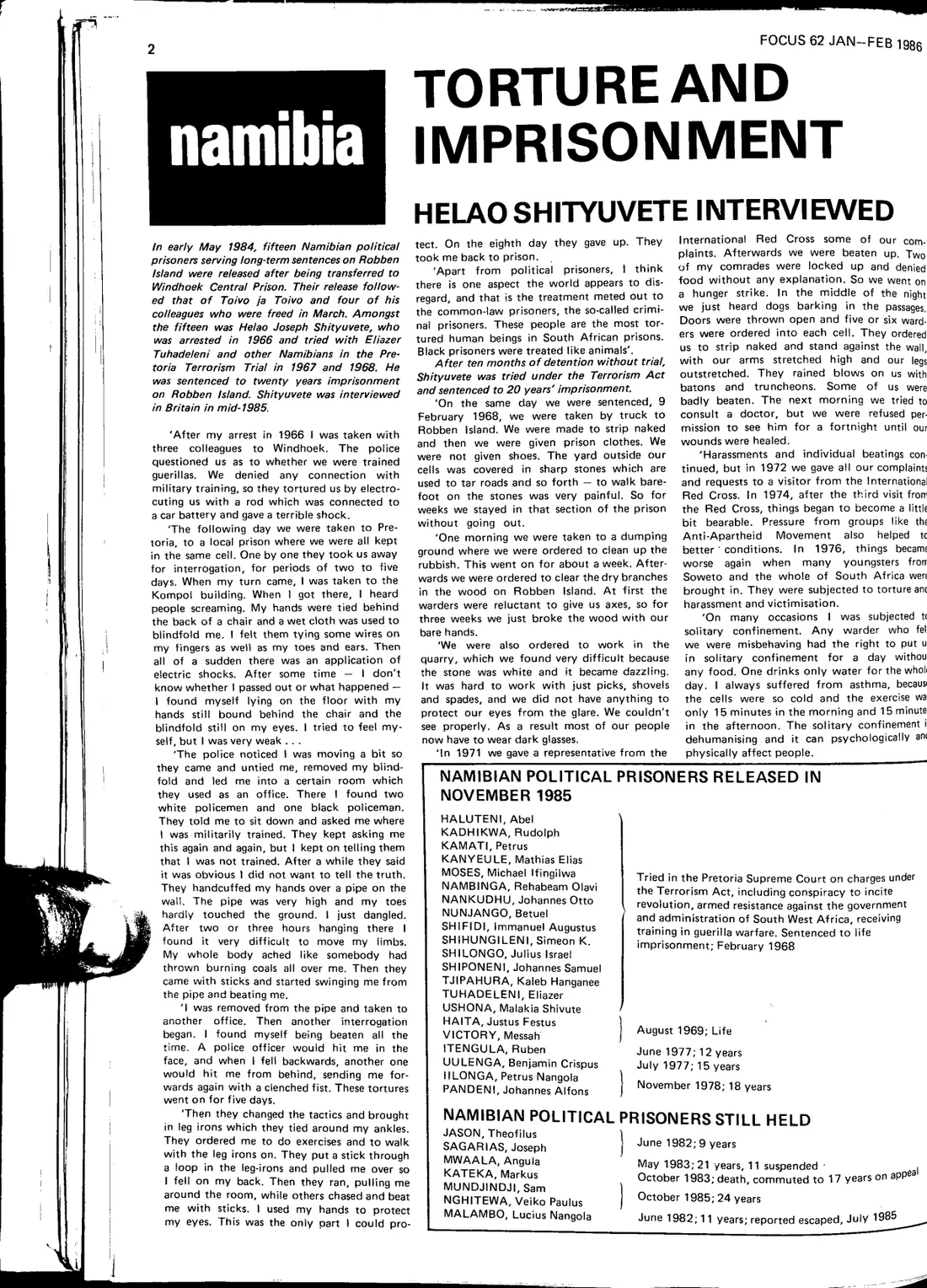
In early May 1984, fifteen Namibian political prisoners serving long-term sentences on Robben Island were released after being transferred to Windhoek Central Prison. Their release followed that of Toivo ja Toivo and four of his colleagues who were freed in March. Amongst the fifteen was Helao Joseph Shityuvete, who was arrested in 1966 and tried with Eliazer Tuhadeleni and other Namibians in the Pretoria Terrorism Trial in 1967 and 1968. He was sentenced to twenty years imprisonment on Robben Island. Shityuvete was interviewed in Britain in mid-1985.
'After my arrest in 1966 I was taken with three colleagues to Windhoek. The police questioned us as to whether we were trained guerillas. We denied any connection with military training, so they tortured us by electrocuting us with a rod which was connected to a car battery and gave a terrible shock.
'The following day we were taken to Pretoria, to a local prison where we were all kept in the same cell. One by one they took us away for interrogation, for periods of two to five days. When my turn came, I was taken to the Kompol building. When I got there, I heard people screaming. My hands were tied behind the back of a chair and a wet cloth was used to blindfold me. I felt them tying some wires on my fingers as well as my toes and ears. Then all of a sudden there was an application of electric shocks. After some time — I don't know whether I passed out or what happened — I found myself lying on the floor with my hands still bound behind the chair and the blindfold still on my eyes. I tried to feel myself, but I was very weak...
'The police noticed I was moving a bit so they came and untied me, removed my blindfold and led me into a certain room which they used as an office. There I found two white policemen and one black policeman. They told me to sit down and asked me where I was militarily trained. They kept asking me this again and again, but I kept on telling them that I was not trained. After a while they said it was obvious I did not want to tell the truth. They handcuffed my hands over a pipe on the wall. The pipe was very high and my toes hardly touched the ground. I just dangled. After two or three hours hanging there I found it very difficult to move my limbs. My whole body ached like somebody had thrown burning coals all over me. Then they came with sticks and started swinging me from the pipe and beating me.
'I was removed from the pipe and taken to another office. Then another interrogation began. I found myself being beaten all the time. A police officer would hit me in the face, and when I fell backwards, another one would hit me from behind, sending me forwards again with a clenched fist. These tortures went on for five days.
'Then they changed the tactics and brought in leg irons which they tied around my ankles. They ordered me to do exercises and to walk with the leg irons on. They put a stick through a loop in the leg-irons and pulled me over so I fell on my back. Then they ran, pulling me around the room, while others chased and beat me with sticks. I used my hands to protect my eyes. This was the only part I could protect.
'Apart from political prisoners, I think there is one aspect the world appears to disregard, and that is the treatment meted out to the common-law prisoners, the so-called criminal prisoners. These people are the most tortured human beings in South African prisons. Black prisoners were treated like animals'.
After ten months of detention without trial, Shityuvete was tried under the Terrorism Act and sentenced to 20 years' imprisonment.
'On the same day we were sentenced, 9 February 1968, we were taken by truck to Robben Island. We were made to strip naked and then we were given prison clothes. We were not given shoes. The yard outside our cells was covered in sharp stones which are used to tar roads and so forth — to walk barefoot on the stones was very painful. So for weeks we stayed in that section of the prison without going out.
'One morning we were taken to a dumping ground where we were ordered to clean up the rubbish. This went on for about a week. Afterwards we were ordered to clear the dry branches in the wood on Robben Island. At first the warders were reluctant to give us axes, so for three weeks we just broke the wood with our bare hands.
'We were also ordered to work in the quarry, which we found very difficult because the stone was white and it became dazzling. It was hard to work with just picks, shovels and spades, and we did not have anything to protect our eyes from the glare. We couldn't see properly. As a result most of our people now have to wear dark glasses.
'In 1971 we gave a representative from the International Red Cross some of our complaints. Afterwards we were beaten up. Two of my comrades were locked up and denied food without any explanation. So we went on a hunger strike. In the middle of the night we just heard dogs barking in the passages. Doors were thrown open and five or six warders were ordered into each cell. They ordered us to strip naked and stand against the wall, with our arms stretched high and our legs outstretched. They rained blows on us with batons and truncheons. Some of us were badly beaten. The next morning we tried to consult a doctor, but we were refused permission to see him for a fortnight until our wounds were healed.
'Harassments and individual beatings continued, but in 1972 we gave all our complaints and requests to a visitor from the International Red Cross. In 1974, after the third visit from the Red Cross, things began to become a little bit bearable. Pressure from groups like the Anti-Apartheid Movement also helped to better conditions. In 1976, things became worse again when many youngsters from Soweto and the whole of South Africa were brought in. They were subjected to torture and harassment and victimisation.
'On many occasions I was subjected to solitary confinement. Any warder who fell we were misbehaving had the right to put us in solitary confinement for a day without any food. One drinks only water for the whole day. I always suffered from asthma, because the cells were so cold and the exercise was only 15 minutes in the morning and 15 minutes in the afternoon. The solitary confinement in dehumanising and it can psychologically and physically affect people.'