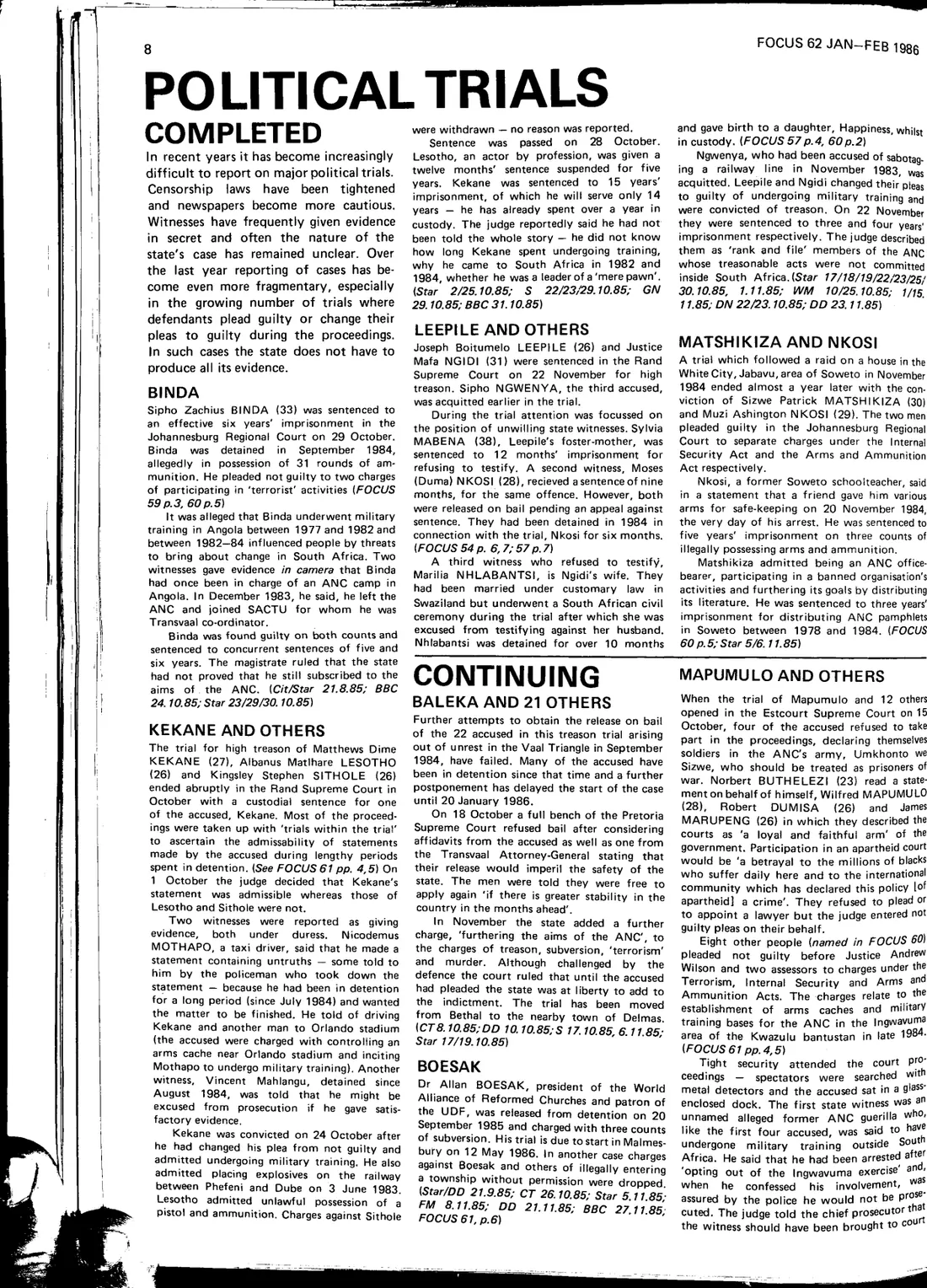
In recent years it has become increasingly difficult to report on major political trials. Censorship laws have been tightened and newspapers become more cautious. Witnesses have frequently given evidence in secret and often the nature of the state's case has remained unclear. Over the last year reporting of cases has become even more fragmentary, especially in the growing number of trials where defendants plead guilty or change their pleas to guilty during the proceedings. In such cases the state does not have to produce all its evidence.
BINDA Sipho Zachius BINDA (33) was sentenced to an effective six years' imprisonment in the Johannesburg Regional Court on 29 October. Binda was detained in September 1984, allegedly in possession of 31 rounds of ammunition. He pleaded not guilty to two charges of participating in 'terrorist' activities.
It was alleged that Binda underwent military training in Angola between 1977 and 1982 and between 1982–84 influenced people by threats to bring about change in South Africa. Two witnesses gave evidence in camera that Binda had once been in charge of an ANC camp in Angola. In December 1983, he said, he left the ANC and joined SACTU for whom he was Transvaal co-ordinator.
Binda was found guilty on both counts and sentenced to concurrent sentences of five and six years. The magistrate ruled that the state had not proved that he still subscribed to the aims of the ANC.
KEKANE AND OTHERS The trial for high treason of Matthews Dime KEKANE (27), Albanus Matlhare LESOTHO (26) and Kingsley Stephen SITHOLE (26) ended abruptly in the Rand Supreme Court in October with a custodial sentence for one of the accused, Kekane. Most of the proceedings were taken up with 'trials within the trial' to ascertain the admissability of statements made by the accused during lengthy periods spent in detention. On 1 October the judge decided that Kekane's statement was admissible whereas those of Lesotho and Sithole were not.
Two witnesses were reported as giving evidence, both under duress. Nicodemus MOTHAPO, a taxi driver, said that he made a statement containing untruths — some told to him by the policeman who took down the statement — because he had been in detention for a long period (since July 1984) and wanted the matter to be finished. He told of driving Kekane and another man to Orlando stadium (the accused were charged with controlling an arms cache near Orlando stadium and inciting Mothapo to undergo military training). Another witness, Vincent Mahlangu, detained since August 1984, was told that he might be excused from prosecution if he gave satisfactory evidence.
Kekane was convicted on 24 October after he had changed his plea from not guilty and admitted undergoing military training. He also admitted placing explosives on the railway between Phefeni and Dube on 3 June 1983. Lesotho admitted unlawful possession of a pistol and ammunition. Charges against Sithole were withdrawn — no reason was reported.
Sentence was passed on 28 October. Lesotho, an actor by profession, was given a twelve months' sentence suspended for five years. Kekane was sentenced to 15 years' imprisonment, of which he will serve only 14 years — he has already spent over a year in custody. The judge reportedly said he had not been told the whole story — he did not know how long Kekane spent undergoing training, why he came to South Africa in 1982 and 1984, whether he was a leader of a 'mere pawn'.
LEEPILE AND OTHERS Joseph Boitumelo LEEPILE (26) and Justice Mafa NGIDI (31) were sentenced in the Rand Supreme Court on 22 November for high treason. Sipho NGWENYA, the third accused, was acquitted earlier in the trial.
During the trial attention was focussed on the position of unwilling state witnesses. Sylvia MABENA (38), Leepile's foster-mother, was sentenced to 12 months' imprisonment for refusing to testify. A second witness, Moses (Duma) NKOSI (28), received a sentence of nine months, for the same offence. However, both were released on bail pending an appeal against sentence. They had been detained in 1984 in connection with the trial, Nkosi for six months.
A third witness who refused to testify, Marilia NHLABANTSI, is Ngidi's wife. They had been married under customary law in Swaziland but underwent a South African civil ceremony during the trial after which she was excused from testifying against her husband. Nhlabantsi was detained for over 10 months and gave birth to a daughter, Happiness, whilst in custody.
Ngwenya, who had been accused of sabotaging a railway line in November 1983, was acquitted. Leepile and Ngidi changed their pleas to guilty of undergoing military training and were convicted of treason. On 22 November they were sentenced to three and four years' imprisonment respectively. The judge described them as 'rank and file' members of the ANC whose treasonable acts were not committed inside South Africa.
MATSHIKIZA AND NKOSI A trial which followed a raid on a house in the White City, Jabavu, area of Soweto in November 1984 ended almost a year later with the conviction of Sizwe Patrick MATSHIKIZA (30) and Muzi Ashington Nkosi (29). The two men pleaded guilty in the Johannesburg Regional Court to separate charges under the Internal Security Act and the Arms and Ammunition Act respectively.
Nkosi, a former Soweto schoolteacher, said in a statement that a friend gave him various arms for safe-keeping on 20 November 1984, the very day of his arrest. He was sentenced to five years' imprisonment on three counts of illegally possessing arms and ammunition.
Matshikiza admitted being an ANC office-bearer, participating in a banned organisation's activities and furthering its goals by distributing its literature. He was sentenced to three years' imprisonment for distributing ANC pamphlets in Soweto between 1978 and 1984.