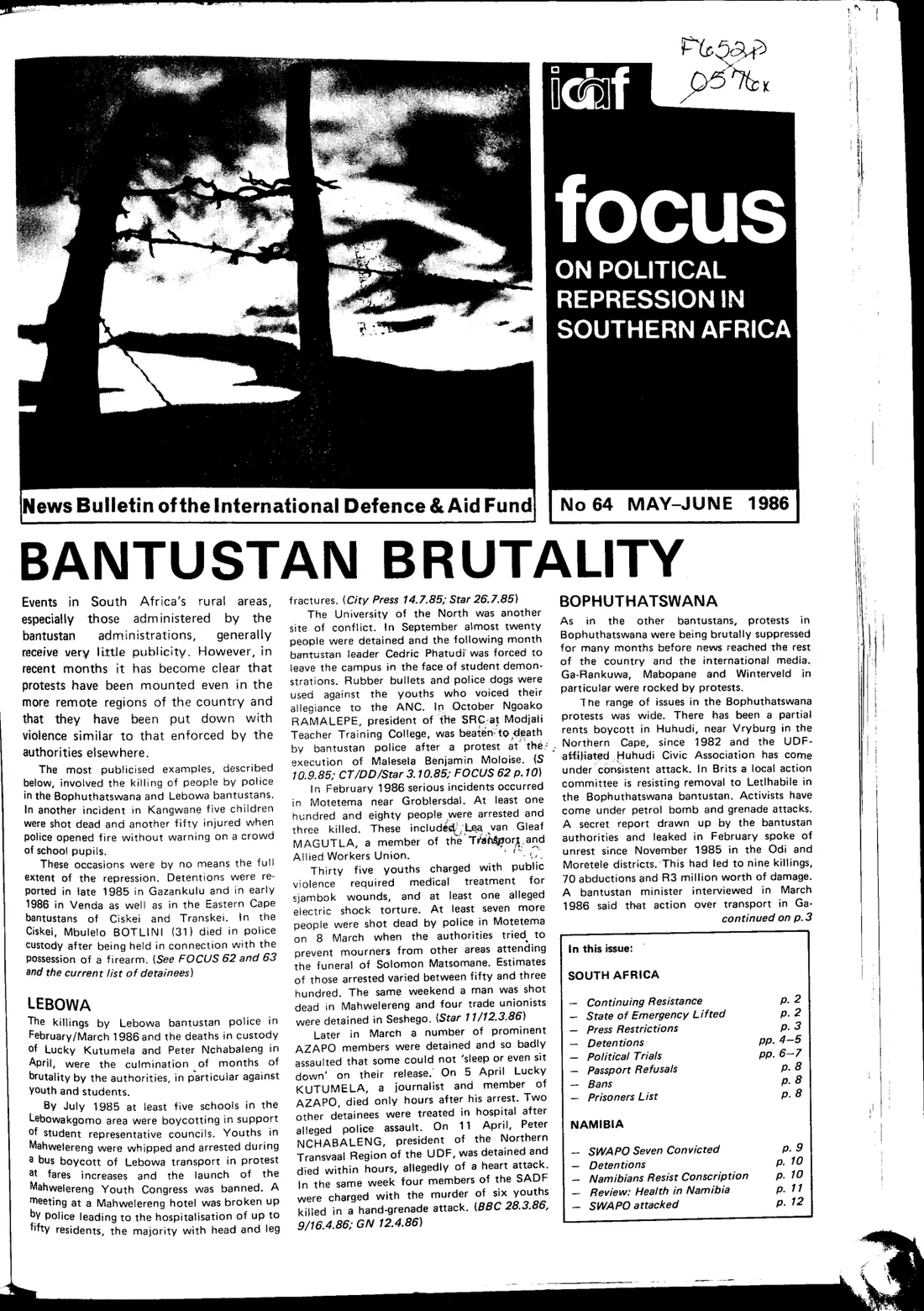
Events in South Africa's rural areas, especially those administered by the bantustan administrations, generally receive very little publicity. However, in recent months it has become clear that protests have been mounted even in the more remote regions of the country and that they have been put down with violence similar to that enforced by the authorities elsewhere.
The most publicised examples, described below, involved the killing of people by police in the Bophuthatswana and Lebowa bantustans. In another incident in Kangwane five children were shot dead and another fifty injured when police opened fire without warning on a crowd of school pupils.
These occasions were by no means the full extent of the repression. Detentions were reported in late 1985 in Gazankulu and in early 1986 in Venda as well as in the Eastern Cape bantustans of Ciskei and Transkei. In the Ciskei, Mbulelo BOTLINI (31) died in police custody after being held in connection with the possession of a firearm.
LEBOWA
The killings by Lebowa bantustan police in February/March 1986 and the deaths in custody of Lucky Kutumela and Peter Nchabaleng in April, were the culmination of months of brutality by the authorities, in particular against youth and students.
By July 1985 at least five schools in the Lebowakgomo area were boycotting in support of student representative councils. Youths in Mahwelereng were whipped and arrested during a bus boycott of Lebowa transport in protest at fares increases and the launch of the Mahwelereng Youth Congress was banned. A meeting at a Mahwelereng hotel was broken up by police leading to the hospitalisation of up to fifty residents, the majority with head and leg fractures.
The University of the North was another site of conflict. In September almost twenty people were detained and the following month bantustan leader Cedric Phatudi was forced to leave the campus in the face of student demonstrations. Rubber bullets and police dogs were used against the youths who voiced their allegiance to the ANC. In October Ngoako RAMALEPE, president of the SRC at Modjali Teacher Training College, was beaten to death by bantustan police after a protest at the execution of Malesela Benjamin Moloise.
In February 1986 serious incidents occurred in Motetema near Groblersdal. At least one hundred and eighty people were arrested and three killed. These included Lea van Gleaf MAGUTLA, a member of the Transport and Allied Workers Union.
Thirty five youths charged with public violence required medical treatment for sjambok wounds, and at least one alleged electric shock torture. At least seven more people were shot dead by police in Motetema on 8 March when the authorities tried to prevent mourners from other areas attending the funeral of Solomon Matsomane. Estimates of those arrested varied between fifty and three hundred. The same weekend a man was shot dead in Mahwelereng and four trade unionists were detained in Seshego.
Later in March a number of prominent AZAPO members were detained and so badly assaulted that some could not 'sleep or even sit down' on their release. On 5 April Lucky KUTUMELA, a journalist and member of AZAPO, died only hours after his arrest. Two other detainees were treated in hospital after alleged police assault. On 11 April, Peter NCHABALENG, president of the Northern Transvaal Region of the UDF, was detained and died within hours, allegedly of a heart attack. In the same week four members of the SADF were charged with the murder of six youths killed in a hand-grenade attack.
BOPHUTHATSWANA
As in the other bantustans, protests in Bophuthatswana were being brutally suppressed for many months before news reached the rest of the country and the international media. Ga-Rankuwa, Mabopane and Winterveld in particular were rocked by protests.
The range of issues in the Bophuthatswana protests was wide. There has been a partial rents boycott in Huhudi, near Vryburg in the Northern Cape, since 1982 and the UDF-affiliated Huhudi Civic Association has come under consistent attack. In Brits a local action committee is resisting removal to Letlhabile in the Bophuthatswana bantustan. Activists have come under petrol bomb and grenade attacks. A secret report drawn up by the bantustan authorities and leaked in February spoke of unrest since November 1985 in the Odi and Moretele districts. This had led to nine killings, 70 abductions and R3 million worth of damage. A bantustan minister interviewed in March 1986 said that action over transport in Ga-Rankuwa had cost Bophuthatswana Transport Holdings R2 million and the loss of 88 buses. In addition the very first day of the year saw a strike by 30,000 mineworkers and subsequent mass dismissals at the Impala platinum mine.
Funeral arrangements for Solomon Baloyi, killed on 31 December, were severely disrupted. During the night-vigil the house was cleared using teargas, causing the mourners, including Baloyi's heavily pregnant wife, to flee. Mourners were stripped and assaulted and an uncle of the dead man, a TB out-patient, was too severely injured to even attend the funeral. Police prevented the church service from taking place and dispersed the five thousand mourners, forcing them to walk a distance of ten kilometres back to Mabopane. The Mabopane Crisis Committee subsequently planned legal action over the assaults.
School protests continued into 1986. A man was shot dead at the Malatse-Motsepe school, at Mmakau near Ga-Rankuwa, on 4 February and scores of Winterveld residents stripped and beaten before the funeral.
The scale of the brutality was first revealed at a press conference in February. Tshini Mulondo of the Mabopane/Winterveld Crisis Committee said about fifty people had disappeared so far in 1986 and five hundred had been detained. The Ga-Rankuwa Youth Organisation detailed sexual assaults on detainees using pliers and electric shocks, rape of women in custody and whippings lasting for several hours. On 6 March the Bophuthatswana Supreme Court issued an interdict preventing illegal detention and assault. The Roman Catholic Bishop of Pretoria presented 50 affidavits alleging torture and harassment, particularly of members of the Catholic church and the Metal and Allied Workers Union.
Even more tragic evidence of the authorities' brutality was provided on 26 March when at least eleven people were shot dead during a meeting on a football pitch in Winterveld. Police alleged they 'came across' the illegal meeting while on a routine anti-crime operation and shot at the crowd of between five and ten thousand after ordering them to disperse. Residents said the local police commandant himself set the date for the meeting to explain the recent mass arrests of youths in the area. As well as the injured, hundreds of people were arrested and came before hastily convened midnight courts for sentencing.