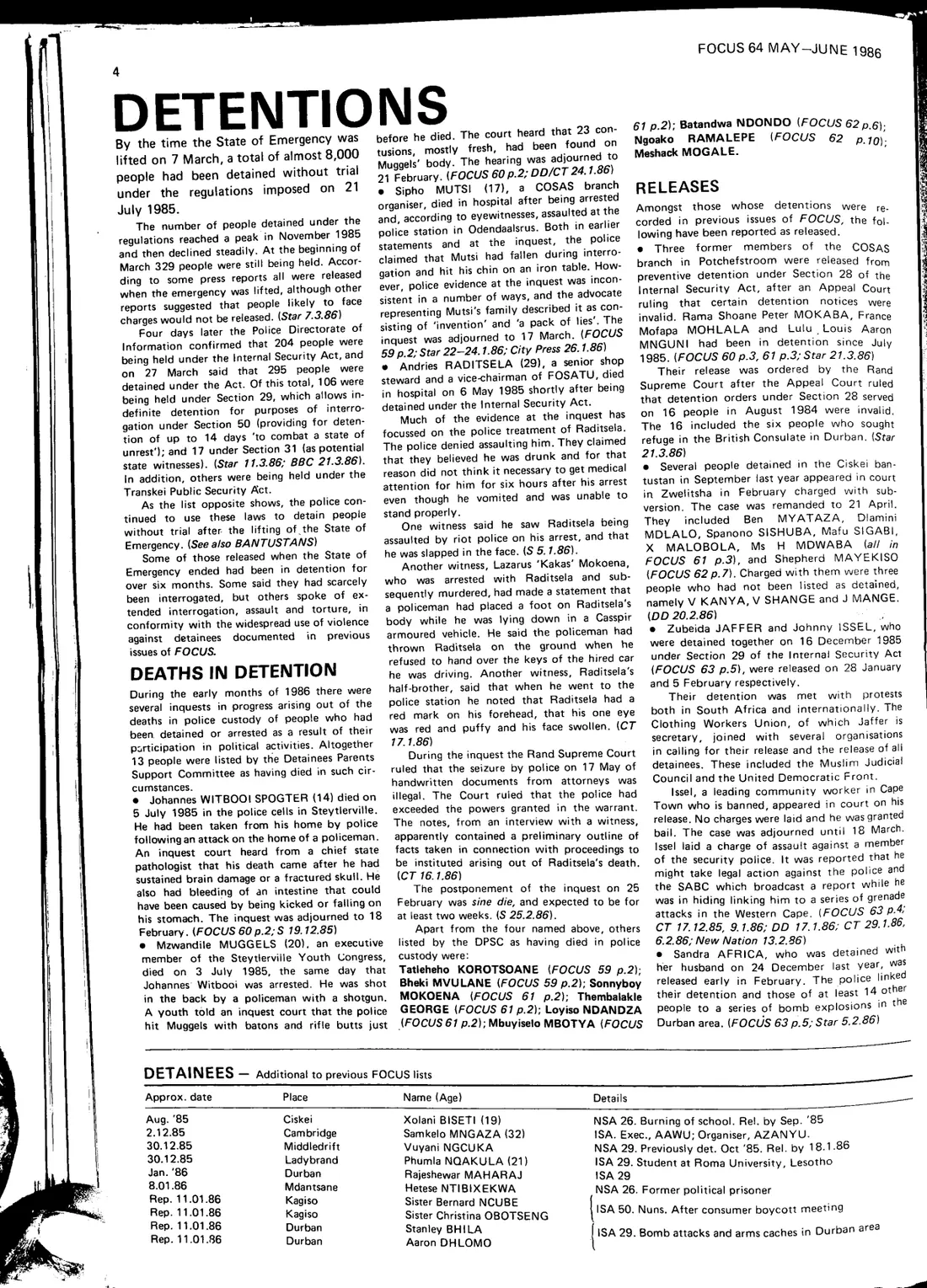
By the time the State of Emergency was lifted on 7 March, a total of almost 8,000 people had been detained without trial under the regulations imposed on 21 July 1985.
The number of people detained under the regulations reached a peak in November 1985 and then declined steadily. At the beginning of March 329 people were still being held. According to some press reports all were released when the emergency was lifted, although other reports suggested that people likely to face charges would not be released.
Four days later the Police Directorate of Information confirmed that 204 people were being held under the Internal Security Act, and on 27 March said that 295 people were detained under the Act. Of this total, 106 were being held under Section 29, which allows indefinite detention for purposes of interrogation under Section 50 (providing for detention of up to 14 days 'to combat a state of unrest'); and 17 under Section 31 (as potential state witnesses). In addition, others were being held under the Transkei Public Security Act.
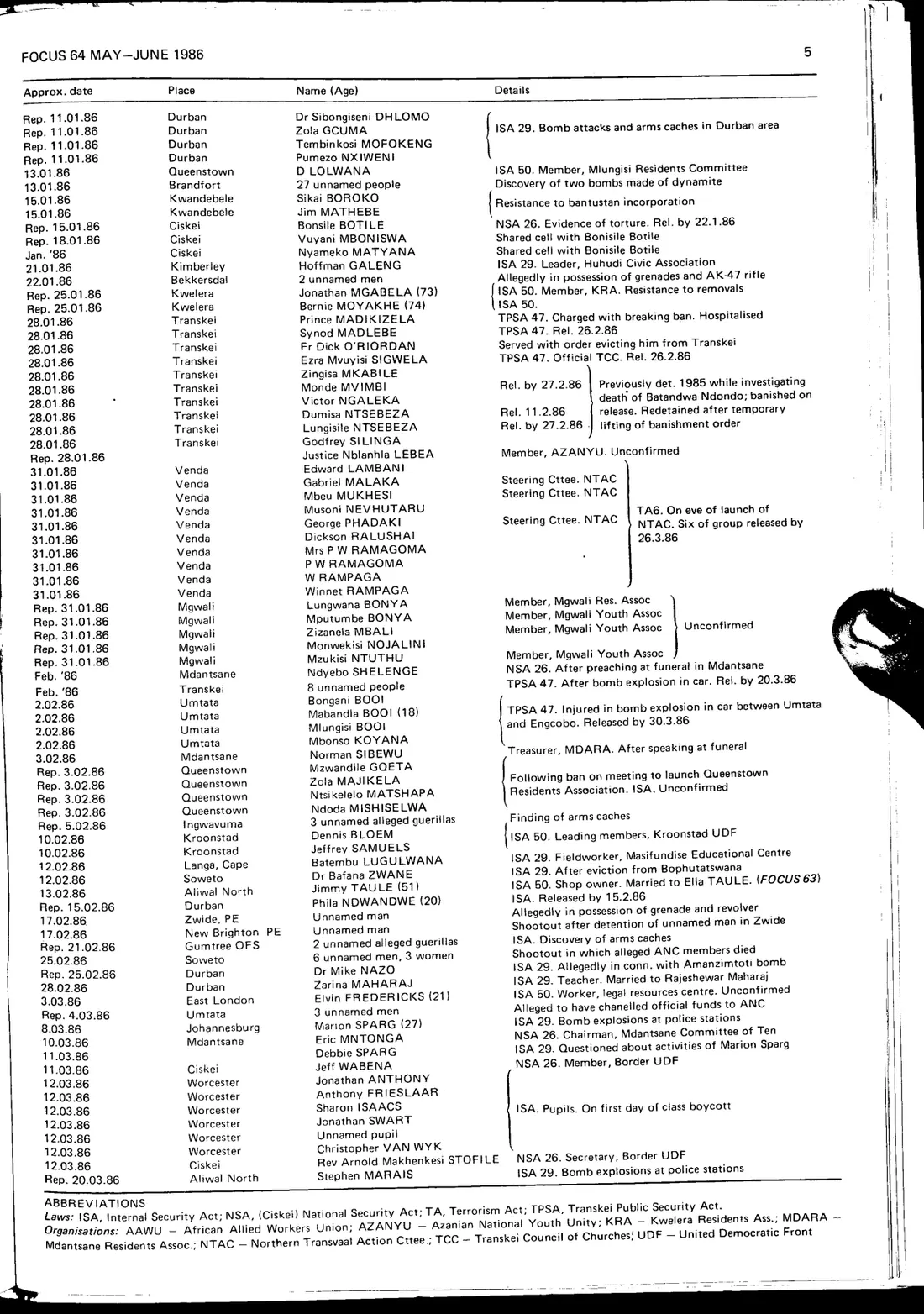
As the list opposite shows, the police continued to use these laws to detain people without trial after the lifting of the State of Emergency.
Some of those released when the State of Emergency ended had been in detention for over six months. Some said they had scarcely been interrogated, but others spoke of extended interrogation, assault and torture, in conformity with the widespread use of violence against detainees documented in previous issues of FOCUS.
DEATHS IN DETENTION
During the early months of 1986 there were several inquests in progress arising out of the deaths in police custody of people who had been detained or arrested as a result of their participation in political activities. Altogether 13 people were listed by the Detainees Parents Support Committee as having died in such circumstances.
- Johannes WITBOOI SPOGTER (14) died on 5 July 1985 in the police cells in Steytlerville. He had been taken from his home by police following an attack on the home of a policeman. An inquest court heard from a chief state pathologist that his death came after he had sustained brain damage or a fractured skull. He also had bleeding by an intestine that could have been caused by being kicked or falling on his stomach. The inquest was adjourned to 18 February.
- Mzwandile MUGGELS (20), an executive member of the Steytlerville Youth Congress, died on 3 July 1985, the same day that Johannes Witbooi was arrested. He was shot in the back by a policeman with a shotgun. A youth told an inquest court that the police hit Muggels with batons and rifle butts just before he died. The court heard that 23 contusions, mostly fresh, had been found on Muggels' body. The hearing was adjourned to 21 February.
- Sipho MUTSI (17), a COSAS branch organiser, died in hospital after being arrested and, according to eyewitnesses, assaulted at the police station in Odendaalsrus. Both in earlier statements and at the inquest, the police claimed that Mutsi had fallen during interrogation and hit his chin on an iron table. However, police evidence at the inquest was inconsistent in a number of ways, and the advocate representing Mutsi's family described it as consisting of 'invention' and 'a pack of lies'. The inquest was adjourned to 17 March.
- Andries RADITSELA (29), a senior shop steward and a vice-chairman of FOSATU, died in hospital on 6 May 1985 shortly after being detained under the Internal Security Act.
Much of the evidence at the inquest has focussed on the police treatment of Raditsela. The police denied assaulting him. They claimed that they believed he was drunk and for that reason did not think it necessary to get medical attention for him for six hours after his arrest even though he vomited and was unable to stand properly.
One witness said he saw Raditsela being assaulted by riot police on his arrest, and that he was slapped in the face.
Another witness, Lazarus 'Kakas' Mokoena, who was arrested with Raditsela and subsequently murdered, had made a statement that a policeman had placed a foot on Raditsela's body while he was lying down in a Casspir armoured vehicle. He said the policeman had thrown Raditsela on the ground when he refused to hand over the keys of the hired car he was driving. Another witness, Raditsela's half-brother, said that when he went to the police station he noted that Raditsela had a red mark on his forehead, that his one eye was red and puffy and his face swollen.
During the inquest the Rand Supreme Court ruled that the seizure by police on 17 May of handwritten documents from attorneys was illegal. The Court ruled that the police had exceeded the powers granted in the warrant. The notes, from an interview with a witness, apparently contained a preliminary outline of facts taken in connection with proceedings to be instituted arising out of Raditsela's death.
The postponement of the inquest on 25 February was sine die, and expected to be for at least two weeks.
Apart from the four named above, others listed by the DPSC as having died in police custody were: Tatteheho KOROTSOANE; Bheki MVULANE; Sonnyboy MOKOENA; Thembalakle GEORGE; Loyiso NDANDZA; Mbuyiselo MBOTYA; Batandwa NDONDO; Ngoako RAMALEPE; Meshack MOGALE.
RELEASES
Amongst those whose detentions were recorded in previous issues of FOCUS, the following have been reported as released.
- Three former members of the COSAS branch in Potchefstroom were released from preventive detention under Section 28 of the Internal Security Act, after an Appeal Court ruling that certain detention notices were invalid. Rama Shoane Peter MOKABA, France Mofapa MOHLALA and Lulu Louis Aaron MNGUNI had been in detention since July 1985.
Their release was ordered by the Rand Supreme Court after the Appeal Court ruled that detention orders under Section 28 served on 16 people in August 1984 were invalid. The 16 included the six people who sought refuge in the British Consulate in Durban.
- Several people detained in the Ciskei bandustan in September last year appeared in court in Zwelitsha in February charged with subversion. The case was remanded to 21 April. They included Ben MYATAZA, Dlamini MDLALO, Spanono SISHUBA, Mafu SIGABI, X MALOBOLA, Ms H MDWABA, and Shepherd MAYEKISO. Charged with them were three people who had not been listed as detained, namely V KANYA, V SHANGE and J MANGE.
- Zubeida JAFFER and Johnny ISSEL, who were detained together on 16 December 1985 under Section 29 of the Internal Security Act, were released on 28 January and 5 February respectively.
Their detention was met with protests both in South Africa and internationally. The Clothing Workers Union, of which Jaffer is secretary, joined with several organisations in calling for their release and the release of all detainees. These included the Muslim Judicial Council and the United Democratic Front.
Issel, a leading community worker in Cape Town who is banned, appeared in court on his release. No charges were laid and he was granted bail. The case was adjourned until 18 March. Issel laid a charge of assault against a member of the security police. It was reported that he might take legal action against the police and the SABC which broadcast a report while he was in hiding linking him to a series of grenade attacks in the Western Cape.
- Sandra AFRICA, who was detained with her husband on 24 December last year, was released early in February. The police linked their detention and those of at least 14 other people to a series of bomb explosions in the Durban area.