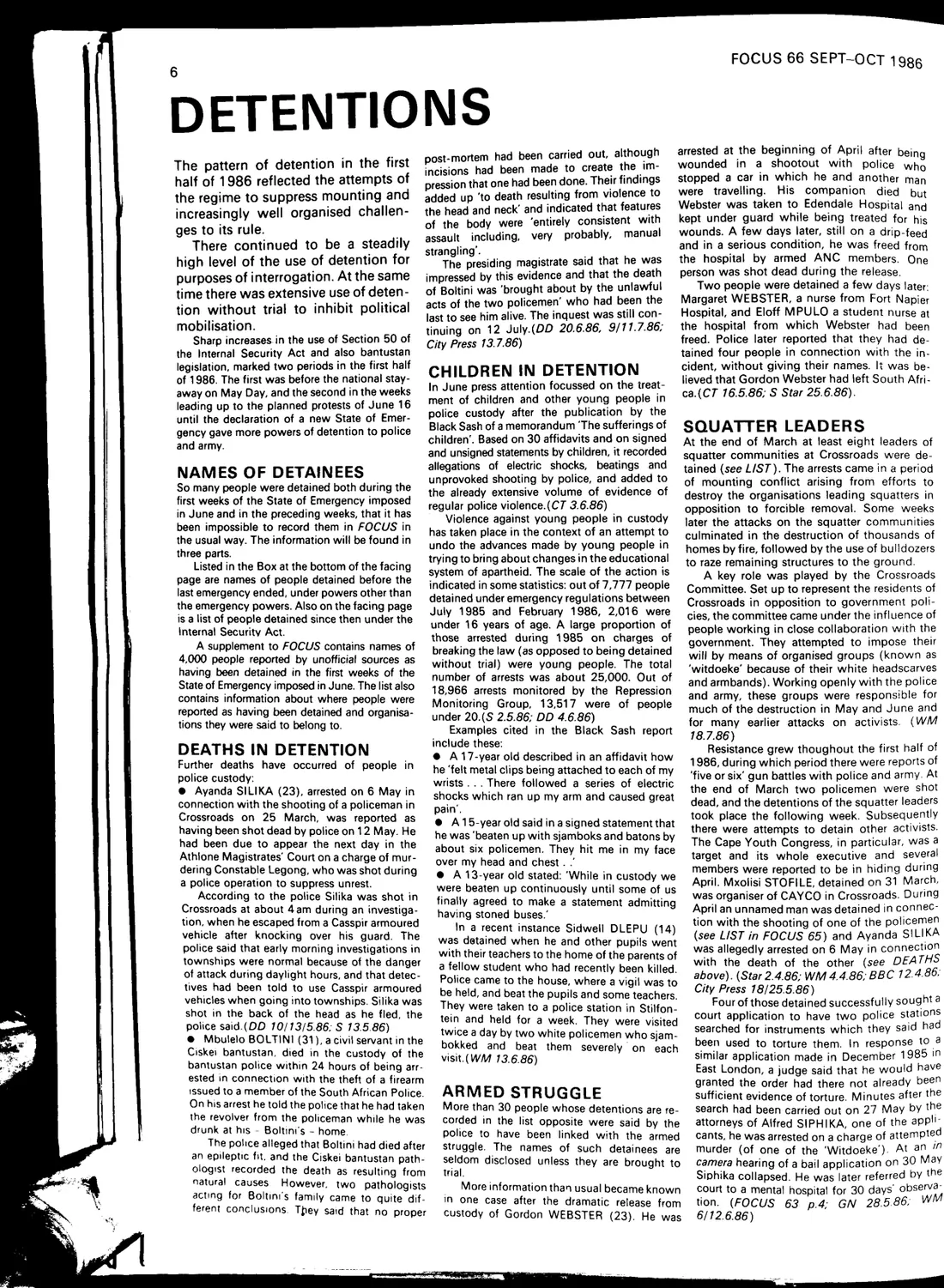
The pattern of detention in the first half of 1986 reflected the attempts of the regime to suppress mounting and increasingly well organised challenges to its rule.
There continued to be a steadily high level of the use of detention for purposes of interrogation. At the same time there was extensive use of detention without trial to inhibit political mobilisation.
Sharp increases in the use of Section 50 of the Internal Security Act and also bantustan legislation, marked two periods in the first half of 1986. The first was before the national stay-away on May Day, and the second in the weeks leading up to the planned protests of June 16 until the declaration of a new State of Emergency gave more powers of detention to police and army.
NAMES OF DETAINES
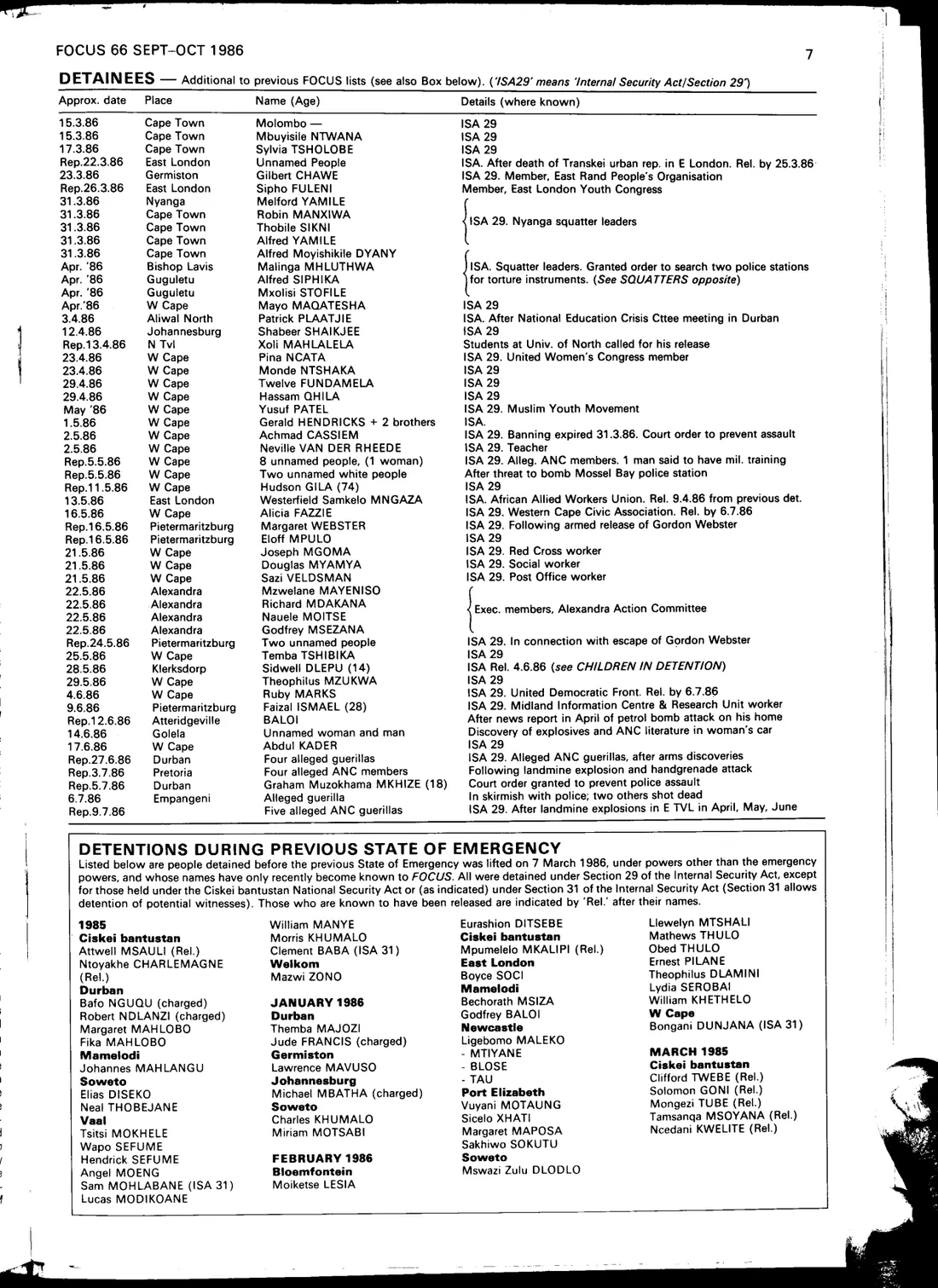
So many people were detained both during the first weeks of the State of Emergency imposed in June and in the preceding weeks, that it has been impossible to record them in FOCUS in the usual way. The information will be found in three parts.
Listed in the Box at the bottom of the facing page are names of people detained before the last emergency ended, under powers other than the emergency powers. Also on the facing page is a list of people detained since then under the Internal Security Act.
A supplement to FOCUS contains names of 4,000 people reported by unofficial sources as having been detained in the first weeks of the State of Emergency imposed in June. The list also contains information about where people were reported as having been detained and organisations they were said to belong to.
DEATHS IN DETENTION
Further deaths have occurred of people in police custody.
- Ayanda SILIKA (23), arrested on 6 May in connection with the shooting of a policeman in Crossroads on 25 March, was reported as having been shot dead by police on 12 May. He had been due to appear the next day in the Athlone Magistrates' Court on a charge of murdering Constable Legong, who was shot during a police operation to suppress unrest.
According to the police Silika was shot in Crossroads at about 4 am during an investigation, when he escaped from a Casspir armoured vehicle after knocking over his guard. The police said that early morning investigations in townships were normal because of the danger of attack during daylight hours, and that detectives had been told to use Casspir armoured vehicles when going into townships. Silika was shot in the back of the head as he fled, the police said. (DD 10/13/5.86; S 13.5.86)
- Mbulelo BOLTINI (31), a civil servant in the Ciskei bantustan, died in the custody of the bantustan police within 24 hours of being arrested in connection with the theft of a firearm issued to a member of the South African Police. On his arrest he told the police that he had taken the revolver from the policeman while he was drunk at his - Boltini's - home.
The police alleged that Boltini had died after an epileptic fit, and the Ciskei bantustan pathologist recorded the death as resulting from natural causes. However, two pathologists acting for Boltini's family came to quite different conclusions. They said that no proper post-mortem had been carried out, although incisions had been made to create the impression that one had been done. Their findings added up 'to death resulting from violence to the head and neck' and indicated that features of the body were 'entirely consistent with assault including, very probably, manual strangling'.
The presiding magistrate said that he was impressed by this evidence and that the death of Boltini was 'brought about by the unlawful acts of the two policemen' who had been the last to see him alive. The inquest was still continuing on 12 July. (DD 20.6.86; 9/11.7.86; City Press 13.7.86)
CHILDREN IN DETENTION
In June press attention focussed on the treatment of children and other young people in police custody after the publication by the Black Sash of a memorandum 'The sufferings of children'. Based on 30 affidavits and on signed and unsigned statements by children, it recorded allegations of electric shocks, beatings and unprovoked shooting by police, and added to the already extensive volume of evidence of regular police violence. (CT 3.6.86)
Violence against young people in custody has taken place in the context of an attempt to undo the advances made by young people in trying to bring about changes in the educational system of apartheid. The scale of the action is indicated in some statistics: out of 7,777 people detained under emergency regulations between July 1985 and February 1986, 2,016 were under 16 years of age. A large proportion of those arrested during 1985 on charges of breaking the law (as opposed to being detained without trial) were young people. The total number of arrests was about 25,000. Out of 18,966 arrests monitored by the Repression Monitoring Group, 13,517 were of people under 20. (S 2.5.86; DD 4.6.86)
Examples cited in the Black Sash report include these:
- A 17-year old described in an affidavit how he 'felt metal clips being attached to each of my wrists... There followed a series of electric shocks which ran up my arm and caused great pain'.
- A 15-year old said in a signed statement that he was 'beaten up with sjamboks and batons by about six policemen. They hit me in my face over my head and chest...'
- A 13-year old stated: 'While in custody we were beaten up continuously until some of us finally agreed to make a statement admitting having stoned buses.'
In a recent instance Sidwell DLEPU (14) was detained when he and other pupils went with their teachers to the home of the parents of a fellow student who had recently been killed. Police came to the house, where a vigil was to be held, and beat the pupils and some teachers. They were taken to a police station in Stilfontein and held for a week. They were visited twice a day by two white policemen who sjambokked and beat them severely on each visit. (WM 13.6.86)
ARMED STRUGGLE
More than 30 people whose detentions are recorded in the list opposite were said by the police to have been linked with the armed struggle. The names of such detainees are seldom disclosed unless they are brought to trial.
More information than usual became known in one case after the dramatic release from custody of Gordon WEBSTER (23). He was arrested at the beginning of April after being wounded in a shootout with police who stopped a car in which he and another man were travelling. His companion died but Webster was taken to Edendale Hospital and kept under guard while being treated for his wounds. A few days later, still on a drip-feed and in a serious condition, he was freed from the hospital by armed ANC members. One person was shot dead during the release.
Two people were detained a few days later: Margaret WEBSTER, a nurse from Fort Napier Hospital, and Eloff MPULO a student nurse at the hospital from which Webster had been freed. Police later reported that they had detained four people in connection with the incident, without giving their names. It was believed that Gordon Webster had left South Africa. (CT 16.5.86; S Star 25.6.86).
SQUATTER LEADERS
At the end of March at least eight leaders of squatter communities at Crossroads were detained (see LIST). The arrests came in a period of mounting conflict arising from efforts to destroy the organisations leading squatters in opposition to forcible removal. Some weeks later the attacks on the squatter communities culminated in the destruction of thousands of homes by fire, followed by the use of bulldozers to raze remaining structures to the ground.
A key role was played by the Crossroads Committee. Set up to represent the residents of Crossroads in opposition to government policies, the committee came under the influence of people working in close collaboration with the government. They attempted to impose their will by means of organised groups (known as 'witdoeke' because of their white headscarves and armbands). Working openly with the police and army, these groups were responsible for much of the destruction in May and June and for many earlier attacks on activists. (WM 18.7.86)
Resistance grew throughout the first half of 1986, during which period there were reports of 'five or six' gun battles with police and army. At the end of March two policemen were shot dead, and the detentions of the squatter leaders took place the following week. Subsequently there were attempts to detain other activists. The Cape Youth Congress, in particular, was a target and its whole executive and several members were reported to be in hiding during April. Mxolisi STOFILE, detained on 31 March, was organiser of CAYCO in Crossroads. During April an unnamed man was detained in connection with the shooting of one of the policemen (see LIST in FOCUS 65) and Ayanda SILIKA was allegedly arrested on 6 May in connection with the death of the other (see DEATHS above). (Star 2.4.86; WM 4.4.86; BBC 12.4.86; City Press 18/25.5.86)
Four of those detained successfully sought a court application to have two police stations searched for instruments which they said had been used to torture them. In response to a similar application made in December 1985 in East London, a judge said that he would have granted the order had there not already been sufficient evidence of torture. Minutes after the search had been carried out on 27 May by the attorneys of Alfred SIPHIKA, one of the applicants, he was arrested on a charge of attempted murder (of one of the 'Witdoeke'). At an in camera hearing of a bail application on 30 May Siphika collapsed. He was later referred by the court to a mental hospital for 30 days' observation. (FOCUS 63 p.4; GN 28.5.86; WM 6/12.6.86)