Detention without trial continued to be used against apartheid's opponents in Namibia with an apparent increase in the use of Section 6 of the Terrorism Act for long-term detentions. The introduction of a Bill of Rights with the inauguration of the Multi-Party Conference administration has given a focus to opposition to all repressive legislation in force in Namibia and there have been a number of challenges to it in the courts.
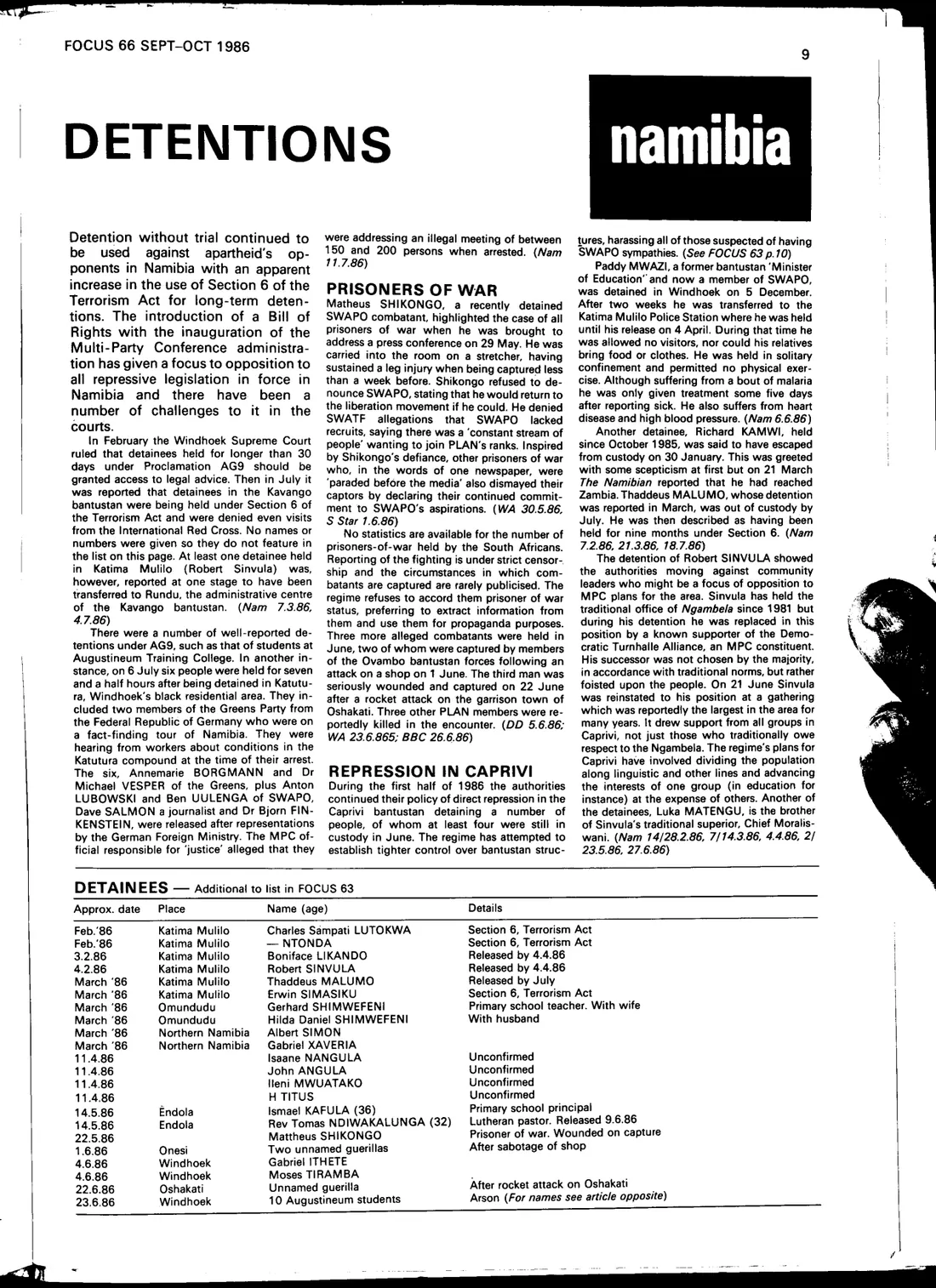
In February the Windhoek Supreme Court ruled that detainees held for longer than 30 days under Proclamation AG9 should be granted access to legal advice. Then in July it was reported that detainees in the Kavango bantustan were being held under Section 6 of the Terrorism Act and were denied even visits from the International Red Cross. No names or numbers were given so they do not feature in the list on this page. At least one detainee held in Katima Mulilo (Robert Sinvula) was, however, reported at one stage to have been transferred to Rundu, the administrative centre of the Kavango bantustan. (Nam 7.3.86, 4.7.86)
There were a number of well-reported detentions under AG9, such as that of students at Augustineum Training College. In another instance, on 6 July six people were held for seven and a half hours after being detained in Katutura, Windhoek's black residential area. They included two members of the Greens Party from the Federal Republic of Germany who were on a fact-finding tour of Namibia. They were hearing from workers about conditions in the Katutura compound at the time of their arrest. The six, Annemarie BORGMANN and Dr Michael VESPER of the Greens, plus Anton LUBOWSKI and Ben UULENGA of SWAPO, Dave SALMON a journalist and Dr Bjorn FINKENSTEIN, were released after representations by the German Foreign Ministry. The MPC official responsible for 'justice' alleged that they were addressing an illegal meeting of between 150 and 200 persons when arrested. (Nam 11.7.86)
PRISONERS OF WAR
Matheus SHIKONGO, a recently detained SWAPO combatant, highlighted the case of all prisoners of war when he was brought to address a press conference on 29 May. He was carried into the room on a stretcher, having sustained a leg injury when being captured less than a week before. Shikongo refused to denounce SWAPO, stating that he would return to the liberation movement if he could. He denied SWATF allegations that SWAPO lacked recruits, saying there was a 'constant stream of people' wanting to join PLAN's ranks. Inspired by Shikongo's defiance, other prisoners of war who, in the words of one newspaper, were 'paraded before the media' also dismayed their captors by declaring their continued commitment to SWAPO's aspirations. (WA 30.5.86, S Star 1.6.86)
No statistics are available for the number of prisoners-of-war held by the South Africans. Reporting of the fighting is under strict censorship and the circumstances in which combatants are captured are rarely publicised. The regime refuses to accord them prisoner of war status, preferring to extract information from them and use them for propaganda purposes. Three more alleged combatants were held in June, two of whom were captured by members of the Ovambo bantustan forces following an attack on a shop on 1 June. The third man was seriously wounded and captured on 22 June after a rocket attack on the garrison town of Oshakati. Three other PLAN members were reportedly killed in the encounter. (DD 5.6.86; WA 23.6.86; BBC 26.6.86)
REPRESSION IN CAPRIVI
During the first half of 1986 the authorities continued their policy of direct repression in the Caprivi bantustan detaining a number of people, of whom at least four were still in custody in June. The regime has attempted to establish tighter control over bantustan structures, harassing all of those suspected of having SWAPO sympathies. (See FOCUS 63 p.10)
Paddy MWAZI, a former bantustan 'Minister of Education' and now a member of SWAPO, was detained in Windhoek on 5 December. After two weeks he was transferred to the Katima Mulilo Police Station where he was held until his release on 4 April. During that time he was allowed no visitors, nor could his relatives bring food or clothes. He was held in solitary confinement and permitted no physical exercise. Although suffering from a bout of malaria he was only given treatment some five days after reporting sick. He also suffers from heart disease and high blood pressure. (Nam 6.6.86)
Another detainee, Richard KAMWI, held since October 1985, was said to have escaped from custody on 30 January. This was greeted with some scepticism at first but on 21 March The Namibian reported that he had reached Zambia. Thaddeus MALUMO, whose detention was reported in March, was out of custody by July. He was then described as having been held for nine months under Section 6. (Nam 7.2.86, 21.3.86, 18.7.86)
The detention of Robert SINVULA showed the authorities moving against community leaders who might be a focus of opposition to MPC plans for the area. Sinvula has held the traditional office of Ngambela since 1981 but during his detention he was replaced in this position by a known supporter of the Democratic Turnhalle Alliance, an MPC constituent. His successor was not chosen by the majority, in accordance with traditional norms, but rather foisted upon the people. On 21 June Sinvula was reinstated to his position at a gathering which was reportedly the largest in the area for many years. It drew support from all groups in Caprivi, not just those who traditionally owe respect to the Ngambela. The regime's plans for Caprivi have involved dividing the population along linguistic and other lines and advancing the interests of one group (in education for instance) at the expense of others. Another of the detainees, Luka MATENGU, is the brother of Sinvula's traditional superior, Chief Moraliswani. (Nam 14/28.2.86, 7/14.3.86, 4.4.86, 2/23.5.86, 27.6.86)