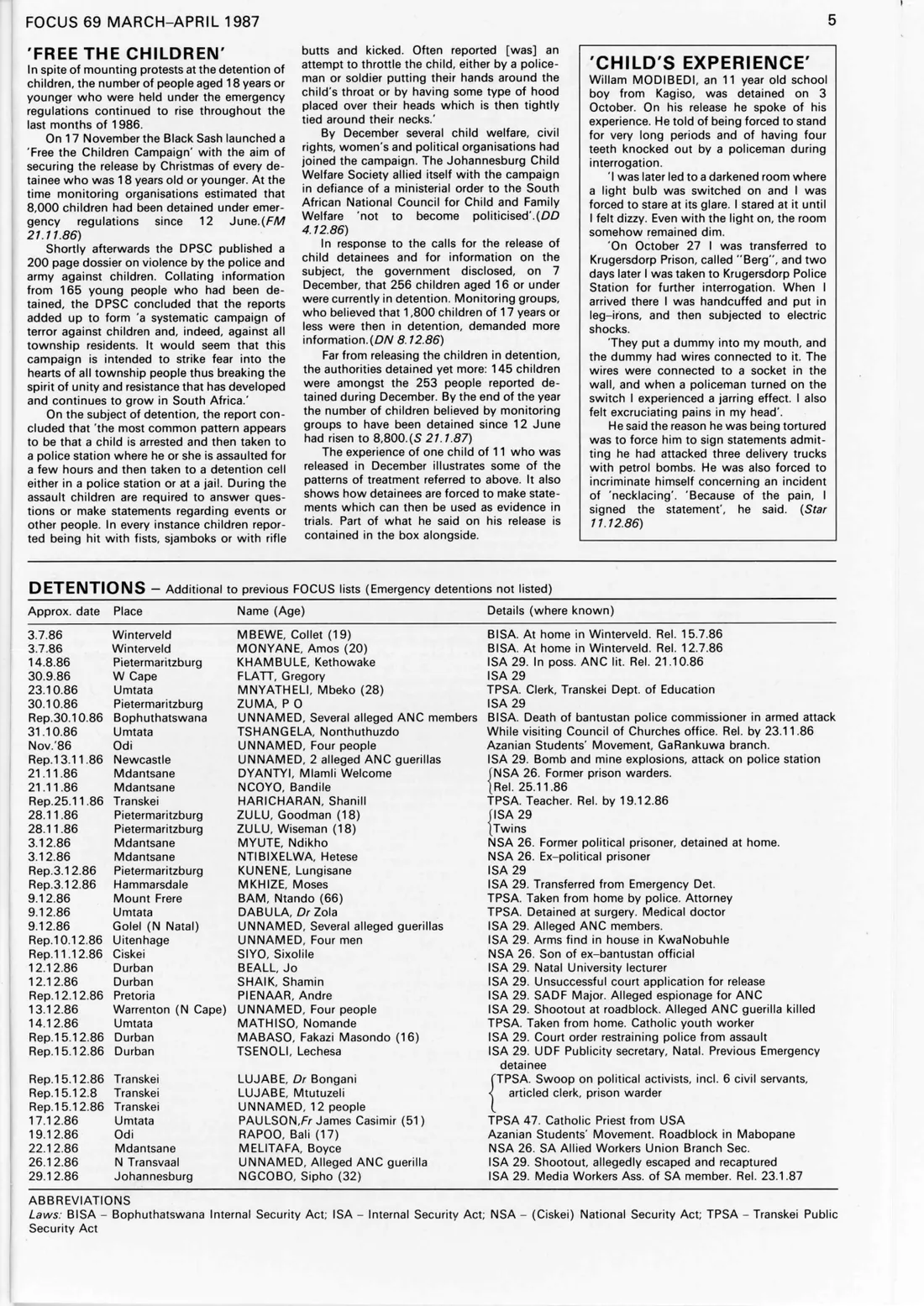
In spite of mounting protests at the detention of children, the number of people aged 18 years or younger who were held under the emergency regulations continued to rise throughout the last months of 1986.
On 17 November the Black Sash launched a 'Free the Children Campaign' with the aim of securing the release by Christmas of every detainee who was 18 years old or younger. At the time monitoring organisations estimated that 8,000 children had been detained under emergency regulations since 12 June.
Shortly afterwards the DPSC published a 200 page dossier on violence by the police and army against children. Collating information from 165 young people who had been detained, the DPSC concluded that the reports added up to form 'a systematic campaign of terror against children and, indeed, against all township residents. It would seem that this campaign is intended to strike fear into the hearts of all township people thus breaking the spirit of unity and resistance that has developed and continues to grow in South Africa.
On the subject of detention, the report concluded that 'the most common pattern appears to be that a child is arrested and then taken to a police station where he or she is assaulted for a few hours and then taken to a detention cell either in a police station or at a jail. During the assault children are required to answer questions or make statements regarding events or other people. In every instance children reported being hit with fists, sjamboks or with rifle butts and kicked. Often reported [was] an attempt to throttle the child, either by a policeman or soldier putting their hands around the child's throat or by having some type of hood placed over their heads which is then tightly tied around their necks.'
By December several child welfare, civil rights, women's and political organisations had joined the campaign. The Johannesburg Child Welfare Society allied itself with the campaign in defiance of a ministerial order to the South African National Council for Child and Family Welfare 'not to become politicised'.
In response to the calls for the release of child detainees and for information on the subject, the government disclosed, on 7 December, that 256 children aged 16 or under were currently in detention. Monitoring groups, who believed that 1,800 children of 17 years or less were then in detention, demanded more information.
Far from releasing the children in detention, the authorities detained yet more: 145 children were amongst the 253 people reported detained during December. By the end of the year the number of children believed by monitoring groups to have been detained since 12 June had risen to 8,800.
The experience of one child of 11 who was released in December illustrates some of the patterns of treatment referred to above. It also shows how detainees are forced to make statements which can then be used as evidence in trials. Part of what he said on his release is contained in the box alongside.
'CHILD'S EXPERIENCE'
William MODIBEDI, an 11 year old school boy from Kagiso, was detained on 3 October. On his release he spoke of his experience. He told of being forced to stand for very long periods and of having four teeth knocked out by a policeman during interrogation.
'I was later led to a darkened room where a light bulb was switched on and I was forced to stare at its glare. I stared at it until I felt dizzy. Even with the light on, the room somehow remained dim.
'On October 27 I was transferred to Krugersdorp Prison, called "Berg", and two days later I was taken to Krugersdorp Police Station for further interrogation. When I arrived there I was handcuffed and put in leg-irons, and then subjected to electric shocks.
'They put a dummy into my mouth, and the dummy had wires connected to it. The wires were connected to a socket in the wall, and when a policeman turned on the switch I experienced a jarring effect. I also felt excruciating pains in my head'.
He said the reason he was being tortured was to force him to sign statements admitting he had attacked three delivery trucks with petrol bombs. He was also forced to incriminate himself concerning an incident of 'necklacing'. 'Because of the pain, I signed the statement', he said.