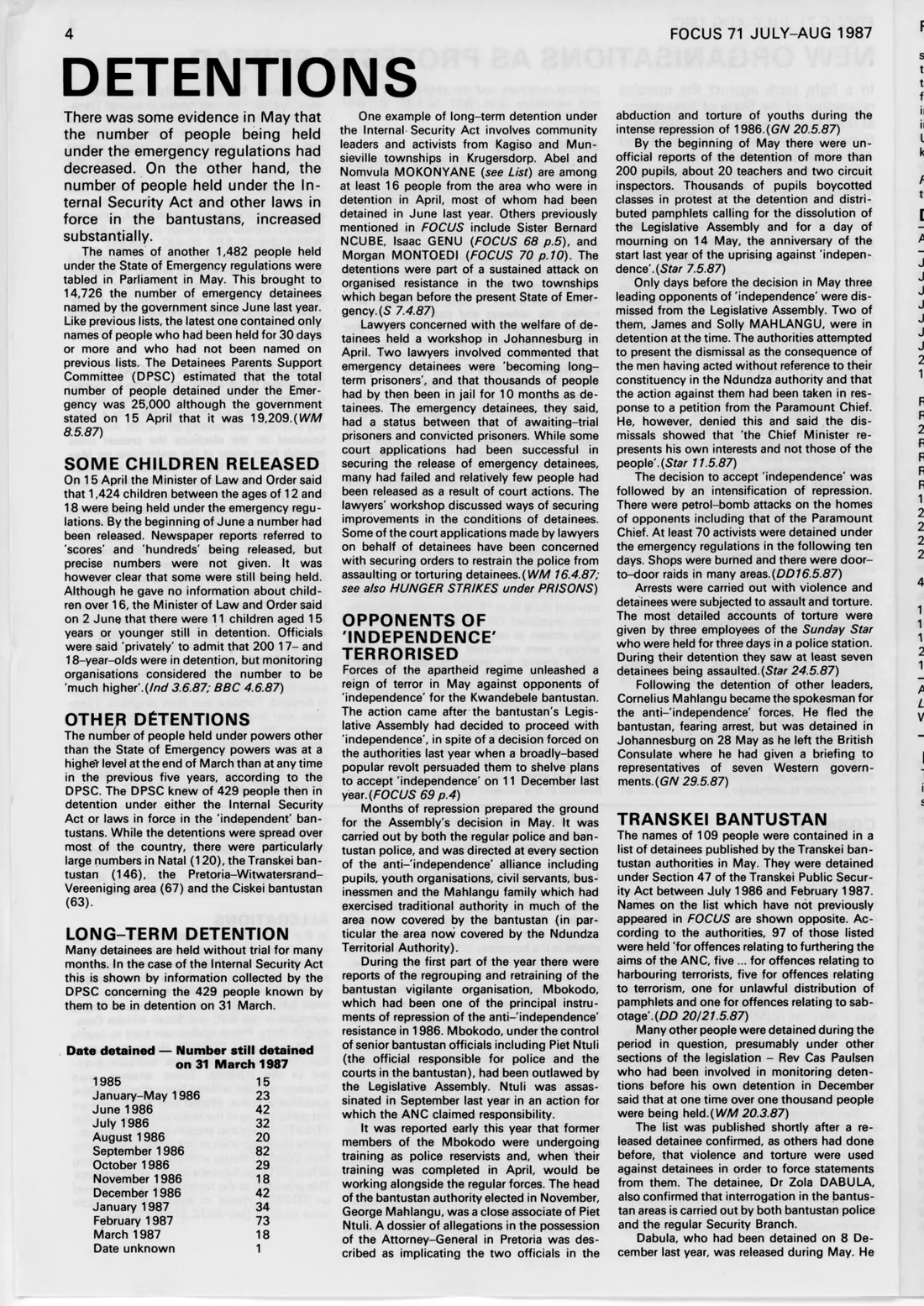
There was some evidence in May that the number of people being held under the emergency regulations had decreased. On the other hand, the number of people held under the Internal Security Act and other laws in force in the bantustans, increased substantially.
The names of another 1,482 people held under the State of Emergency regulations were tabled in Parliament in May. This brought to 14,726 the number of emergency detainees named by the government since June last year. Like previous lists, the latest one contained only names of people who had been held for 30 days or more and who had not been named on previous lists. The Detainees Parents Support Committee (DPSC) estimated that the total number of people detained under the Emergency was 25,000 although the government stated on 15 April that it was 19,209.
On 15 April the Minister of Law and Order said that 1,424 children between the ages of 12 and 18 were being held under the emergency regulations. By the beginning of June a number had been released. Newspaper reports referred to 'scores' and 'hundreds' being released, but precise numbers were not given. It was however clear that some were still being held. Although he gave no information about children over 16, the Minister of Law and Order said on 2 June that there were 11 children aged 15 years or younger still in detention. Officials were said 'privately' to admit that 200 17- and 18-year-olds were in detention, but monitoring organisations considered the number to be 'much higher'.
The number of people held under powers other than the State of Emergency powers was at a higher level at the end of March than at any time in the previous five years, according to the DPSC. The DPSC knew of 429 people then in detention under either the Internal Security Act or laws in force in the 'independent' bantustans. While the detentions were spread over most of the country, there were particularly large numbers in Natal (120), the Transkei bantustan (146), the Pretoria-Witwatersrand-Vereeniging area (67) and the Ciskei bantustan (63).
Many detainees are held without trial for many months. In the case of the Internal Security Act this is shown by information collected by the DPSC concerning the 429 people known by them to be in detention on 31 March.
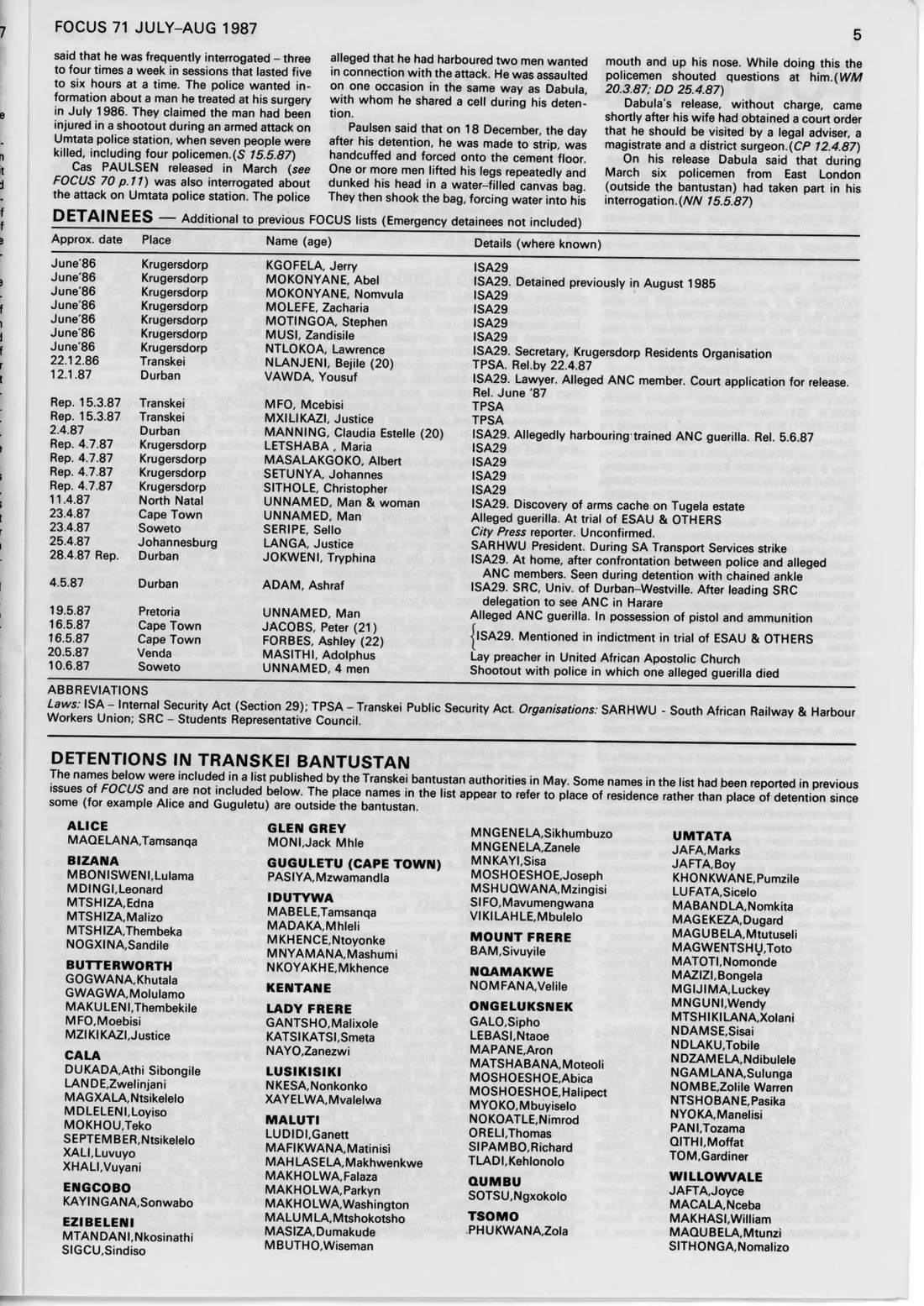
One example of long-term detention under the Internal Security Act involves community leaders and activists from Kagiso and Munsieville townships in Krugersdorp. Abel and Nomvula MOKONYANE are among at least 16 people from the area who were in detention in April, most of whom had been detained in June last year. Others previously mentioned in FOCUS include Sister Bernard NCUBE, Isaac GENU, and Morgan MONTOEDI. The detentions were part of a sustained attack on organised resistance in the two townships which began before the present State of Emergency.
Lawyers concerned with the welfare of detainees held a workshop in Johannesburg in April. Two lawyers involved commented that emergency detainees were 'becoming long-term prisoners', and that thousands of people had by then been in jail for 10 months as detainees. The emergency detainees, they said, had a status between that of awaiting-trial prisoners and convicted prisoners. While some court applications had been successful in securing the release of emergency detainees, many had failed and relatively few people had been released as a result of court actions. The lawyers' workshop discussed ways of securing improvements in the conditions of detainees. Some of the court applications made by lawyers on behalf of detainees have been concerned with securing orders to restrain the police from assaulting or torturing detainees.
Forces of the apartheid regime unleashed a reign of terror in May against opponents of 'independence' for the Kwandebele bantustan. The action came after the bantustan's Legislative Assembly had decided to proceed with 'independence', in spite of a decision forced on the authorities last year when a broadly-based popular revolt persuaded them to shelve plans to accept 'independence' on 11 December last year.
Months of repression prepared the ground for the Assembly's decision in May. It was carried out by both the regular police and bantustan police, and was directed at every section of the anti-'independence' alliance including pupils, youth organisations, civil servants, businessesmen and the Mahlangu family which had exercised traditional authority in much of the area now covered by the bantustan (in particular the area now covered by the Ndunda Territorial Authority).
During the first part of the year there were reports of the regrouping and retraining of the bantustan vigilante organisation, Mbokodo, which had been one of the principal instruments of repression of the anti-'independence' resistance in 1986. Mbokodo, under the control of senior bantustan officials including Piet Ntuli (the official responsible for police and the courts in the bantustan), had been outlawed by the Legislative Assembly. Ntuli was assassinated in September last year in an action for which the ANC claimed responsibility.
It was reported early this year that former members of the Mbokodo were undergoing training as police reservists and, when their training was completed in April, would be working alongside the regular forces. The head of the bantustan authority elected in November, George Mahlangu, was a close associate of Piet Ntuli. A dossier of allegations in the possession of the Attorney-General in Pretoria was described as implicating the two officials in the abduction and torture of youths during the intense repression of 1986.
By the beginning of May there were unofficial reports of the detention of more than 200 pupils, about 20 teachers and two circuit inspectors. Thousands of pupils boycotted classes in protest at the detention and distributed pamphlets calling for the dissolution of the Legislative Assembly and for a day of mourning on 14 May, the anniversary of the start last year of the uprising against 'independence'.
Only days before the decision in May three leading opponents of 'independence' were dismissed from the Legislative Assembly. Two of them, James and Solly MAHLANGU, were in detention at the time. The authorities attempted to present the dismissal as the consequence of the men having acted without reference to their constituency in the Ndunda authority and that the action against them had been taken in response to a petition from the Paramount Chief. He, however, denied this and said the dismissals showed that 'the Chief Minister represents his own interests and not those of the people'.
The decision to accept 'independence' was followed by an intensification of repression. There were petrol-bomb attacks on the homes of opponents including that of the Paramount Chief. At least 70 activists were detained under the emergency regulations in the following ten days. Shops were burned and there were door-to-door raids in many areas.
Arrests were carried out with violence and detainees were subjected to assault and torture. The most detailed accounts of torture were given by three employees of the Sunday Star who were held for three days in a police station. During their detention they saw at least seven detainees being assaulted.
Following the detention of other leaders, Cornelius Mahlangu became the spokesman for the anti-'independence' forces. He fled the bantustan, fearing arrest, but was detained in Johannesburg on 28 May as he left the British Consultative where he had given a briefing to representatives of seven Western governments.
The names of 109 people were contained in a list of detainees published by the Transkei bantustan authorities in May. They were detained under Section 47 of the Transkei Public Security Act between July 1986 and February 1987. According to the authorities, 97 of those listed were held 'for offences relating to furthering the aims of the ANC, five ... for offences relating to harbouring terrorists, five for offences relating to terrorism, one for unlawful distribution of pamphlets and one for offences relating to sabotage'.
Many other people were detained during the period in question, presumably under other sections of the legislation - Rev Cas Paulsen who had been involved in monitoring detentions before his own detention in December said that at one time over one thousand people were being held.
The list was published shortly after a released detainee confirmed, as others had done before, that violence and torture were used against detainees in order to force statements from them. The detainee, Dr Zola DABULA, also confirmed that interrogation in the bantustan areas is carried out by both bantustan police and the regular Security Branch. Dabula, who had been detained on 8 December last year, was released during May. He said that he was frequently interrogated – three to four times a week in sessions that lasted five to six hours at a time. The police wanted information about a man he treated at his surgery in July 1986. They claimed the man had been injured in a shootout during an armed attack on Umtata police station, when seven people were killed, including four policemen.
Cas PAULSEN released in March was also interrogated about the attack on Umtata police station. The police alleged that he had harboured two men wanted in connection with the attack. He was assaulted on one occasion in the same way as Dabula, with whom he shared a cell during his detention. Paulsen said that on 18 December, the day after his detention, he was made to strip, was handcuffed and forced onto the cement floor. One or more men lifted his legs repeatedly and dunked his head in a water-filled canvas bag. They then shook the bag, forcing water into his mouth and up his nose. While doing this the policemen shouted questions at him.
Dabula's release, without charge, came shortly after his wife had obtained a court order that he should be visited by a legal adviser, a magistrate and a district surgeon. On his release Dabula said that during March six policemen from East London (outside the bantustan) had taken part in his interrogation.