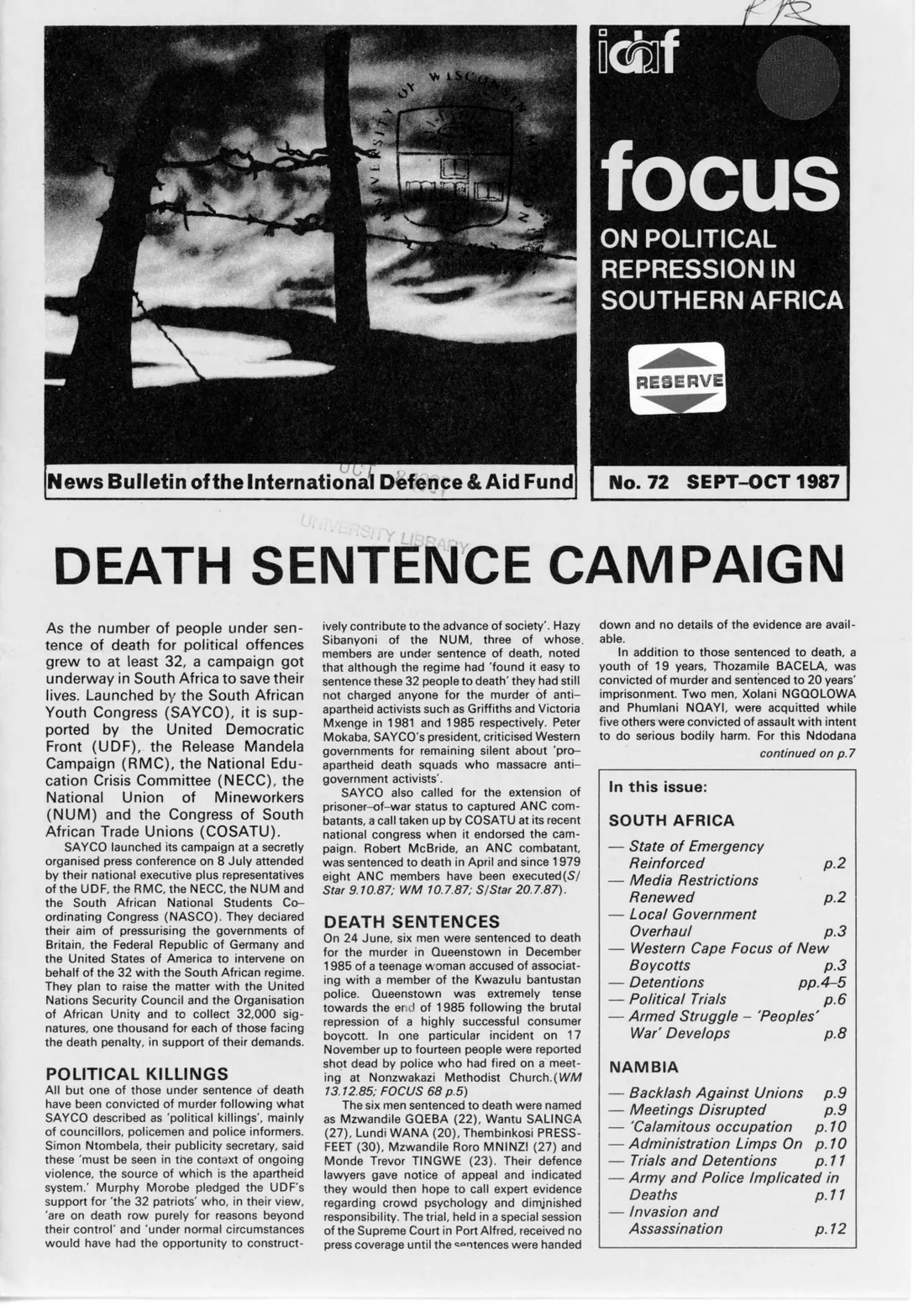
As the number of people under sentence of death for political offences grew to at least 32, a campaign got underway in South Africa to save their lives. Launched by the South African Youth Congress (SAYCO), it is supported by the United Democratic Front (UDF), the Release Mandela Campaign (RMC), the National Education Crisis Committee (NECC), the National Union of Mineworkers (NUM) and the Congress of South African Trade Unions (COSATU).
SAYCO launched its campaign at a secretly organised press conference on 8 July attended by their national executive plus representatives of the UDF, the RMC, the NECC, the NUM and the South African National Students Co-ordinating Congress (NASCO). They declared their aim of pressurising the governments of Britain, the Federal Republic of Germany and the United States of America to intervene on behalf of the 32 with the South African regime. They plan to raise the matter with the United Nations Security Council and the Organisation of African Unity and to collect 32,000 signatures, one thousand for each of those facing the death penalty, in support of their demands.
All but one of those under sentence of death have been convicted of murder following what SAYCO described as 'political killings', mainly of councillors, policemen and police informers. Simon Ntombela, their publicity secretary, said these 'must be seen in the context of ongoing violence, the source of which is the apartheid system.' Murphy Morobe pledged the UDF's support for 'the 32 patriots' who, in their view, 'are on death row purely for reasons beyond their control' and 'under normal circumstances would have had the opportunity to constructively contribute to the advance of society'. Hazy Sibanyoni of the NUM, three of whose members are under sentence of death, noted that although the regime had 'found it easy to sentence these 32 people to death' they had still not charged anyone for the murder of anti-apartheid activists such as Griffiths and Victoria Mxenge in 1981 and 1985 respectively. Peter Mokaba, SAYCO's president, criticised Western governments for remaining silent about 'pro-apartheid death squads who massacre anti-government activists'.
SAYCO also called for the extension of prisoner-of-war status to captured ANC combatants, a call taken up by COSATU at its recent national congress when it endorsed the campaign. Robert McBride, an ANC combatant, was sentenced to death in April and since 1979 eight ANC members have been executed.
On 24 June, six men were sentenced to death for the murder in Queenstown in December 1985 of a teenage woman accused of associating with a member of the Kwazulu bantustan police. Queenstown was extremely tense towards the end of 1985 following the brutal repression of a highly successful consumer boycott. In one particular incident on 17 November up to fourteen people were reported shot dead by police who had fired on a meeting at Nonzwakazi Methodist Church.
The six men sentenced to death were named as Mzwandile GQEBA (22), Wantu SALINGA (27), Lundi WANA (20), Thembinkosi PRESS-FEET (30), Mzwandile Roro MNINZI (27) and Monde Trevor TINGWE (23). Their defence lawyers gave notice of appeal and indicated they would then hope to call expert evidence regarding crowd psychology and diminished responsibility. The trial, held in a special session of the Supreme Court in Port Alfred, received no press coverage until the sentences were handed down and no details of the evidence are available.
In addition to those sentenced to death, a youth of 19 years, Thozamile BACELA, was convicted of murder and sentenced to 20 years' imprisonment. Two men, Xolani NGQOLOWA and Phumlani NQAYI, were acquitted while five others were convicted of assault with intent to do serious bodily harm.