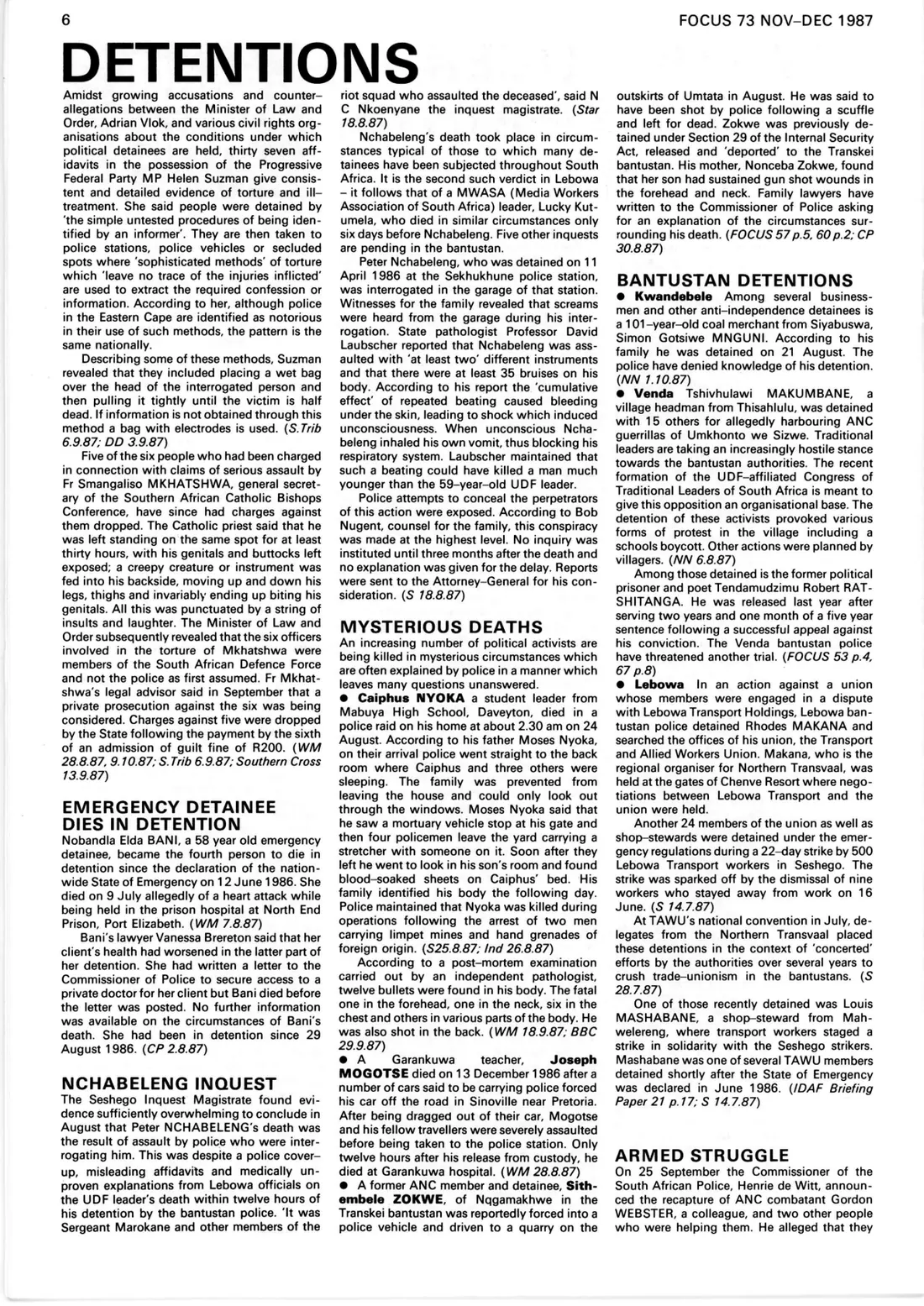
Amidst growing accusations and counter-allegations between the Minister of Law and Order, Adrian Vlok, and various civil rights organisations about the conditions under which political detainees are held, thirty seven affidavits in the possession of the progressive Federal Party MP Helen Suzman give consistent and detailed evidence of torture and ill-treatment. She said people were detained by 'the simple untested procedures of being identified by an informer'. They are then taken to police stations, police vehicles or secluded spots where 'sophisticated methods' of torture which 'leave no trace of the injuries inflicted' are used to extract the required confession or information. According to her, although police in the Eastern Cape are identified as notorious in their use of such methods, the pattern is the same nationally.
Describing some of these methods, Suzman revealed that they included placing a wet bag over the head of the interrogated person and then pulling it tightly until the victim is half dead. If information is not obtained through this method a bag with electrodes is used.
Five of the six people who had been charged in connection with claims of serious assault by Fr Smangaliso MKHATSHWA, general secretary of the Southern African Catholic Bishops Conference, have since had charges against them dropped. The Catholic priest said that he was left standing on the same spot for at least thirty hours, with his genitals and buttocks left exposed; a creepy creature or instrument was fed into his backside, moving up and down his legs, thighs and invariably ending up biting his genitals. All this was punctuated by a string of insults and laughter. The Minister of Law and Order subsequently revealed that the six officers involved in the torture of Mkhhatshwa were members of the South African Defence Force and not the police as first assumed. Fr Mkhatshwa's legal advisor said in September that a private prosecution against the six was being considered. Charges against five were dropped by the State following the payment by the sixth of an admission of guilt fine of R200.
EMERGENCY DETAINEE DIES IN DETENTION Nobandla Elda BANI, a 58 year old emergency detainee, became the fourth person to die in detention since the declaration of the nationwide State of Emergency on 12 June 1986. She died on 9 July allegedly of a heart attack while being held in the prison hospital at North End Prison, Port Elizabeth.
Bani's lawyer Vanessa Brereton said that her client's health had worsened in the latter part of her detention. She had written a letter to the Commissioner of Police to secure access to a private doctor for her client but Bani died before the letter was posted. No further information was available on the circumstances of Bani's death. She had been in detention since 29 August 1986.
NCHABELENG INQUEST The Seshego Inquest Magistrate found evidence sufficiently overwhelming to conclude in August that Peter NCHABELENG's death was the result of assault by police who were interrogating him. This was despite a police cover-up, misleading affidavits and medically unproven explanations from Lebowa officials on the UDF leader's death within twelve hours of his detention by the bantustan police. 'It was Sergeant Marokane and other members of the riot squad who assaulted the deceased', said N C Nkoenyane the inquest magistrate.
Nchabeleng's death took place in circumstances typical of those to which many detainees have been subjected throughout South Africa. It is the second such verdict in Lebowa - it follows that of a MWASA (Media Workers Association of South Africa) leader, Lucky Kutumela, who died in similar circumstances only six days before Nchabeleng. Five other inquests are pending in the bantustan.
Peter Nchabeleng, who was detained on 11 April 1986 at the Sekhukhune police station, was interrogated in the garage of that station. Witnesses for the family revealed that screams were heard from the garage during his interrogation. State pathologist Professor David Laubscher reported that Nchabeleng was assaulted with 'at least two' different instruments and that there were at least 35 bruises on his body. According to his report the 'cumulative effect' of repeated beating caused bleeding under the skin, leading to shock which induced unconsciousness. When unconscious Nchabeleng inhaled his own vomit, thus blocking his respiratory system. Laubscher maintained that such a beating could have killed a man much younger than the 59-year-old UDF leader.
Police attempts to conceal the perpetrators of this action were exposed. According to Bob Nugent, counsel for the family, this conspiracy was made at the highest level. No inquiry was instituted until three months after the death and no explanation was given for the delay. Reports were sent to the Attorney-General for his consideration.
MYSTERIOUS DEATHS An increasing number of political activists are being killed in mysterious circumstances which are often explained by police in a manner which leaves many questions unanswered.
- Caiphus NYOKA a student leader from Mabuya High School, Daveyton, died in a police raid on his home at about 2.30 am on 24 August. According to his father Moses Nyoka, on their arrival police went straight to the back room where Caiphus and three others were sleeping. The family was prevented from leaving the house and could only look out through the windows. Moses Nyoka said that he saw a mortuary vehicle stop at his gate and then four policemen leave the yard carrying a stretcher with someone on it. Soon after they left he went to look in his son's room and found blood-soaked sheets on Caiphus' bed. His family identified his body the following day. Police maintained that Nyoka was killed during operations following the arrest of two men carrying limpet mines and hand grenades of foreign origin.
According to a post-mortem examination carried out by an independent pathologist, twelve bullets were found in his body. The fatal one in the forehead, one in the neck, six in the chest and others in various parts of the body. He was also shot in the back.
- A Garankuwa teacher, Joseph MOGOTSE died on 13 December 1986 after a number of cars said to be carrying police forced his car off the road in Sinoville near Pretoria. After being dragged out of their car, Mogotse and his fellow travellers were severely assaulted before being taken to the police station. Only twelve hours after his release from custody, he died at Garankuwa hospital.
- A former ANC member and detainee, Sithiembele ZOKWE, of Nqgamakhwe in the Transkei bantustan was reportedly forced into a police vehicle and driven to a quarry on the outskirts of Umtata in August. He was said to have been shot by police following a scuffle and left for dead. Zokwe was previously detained under Section 29 of the Internal Security Act, released and 'deported' to the Transkei bantustan. His mother, Nonceba Zokwe, found that her son had sustained gun shot wounds in the forehead and neck. Family lawyers have written to the Commissioner of Police asking for an explanation of the circumstances surrounding his death.
BANTUSTAN DETENTIONS * Kwandebele Among several businessmen and other anti-independence detainees is a 101-year-old coal merchant from Siyabuswa, Simon Gotsiwe MNGUNI. According to his family he was detained on 21 August. The police have denied knowledge of his detention.
- Venda Tshivhulawi MAKUMBANE, a village headman from Thisahlulu, was detained with 15 others for allegedly harbouring ANC guerrillas of Umkhonto we Sizwe. Traditional leaders are taking an increasingly hostile stance towards the bantustan authorities. The recent formation of the UDF-affiliated Congress of Traditional Leaders of South Africa is meant to give this opposition an organisational base. The detention of these activists provoked various forms of protest in the village including a schools boycott. Other actions were planned by villagers.
Among those detained is the former political prisoner and poet Tendamudzimu Robert RATSHITANGA. He was released last year after serving two years and one month of a five year sentence following a successful appeal against his conviction. The Venda bantustan police have threatened another trial.
- Lebowa In an action against a union whose members were engaged in a dispute with Lebowa Transport Holdings, Lebowa bantustan police detained Rhodes MAKANA and searched the offices of his union, the Transport and Allied Workers Union. Makana, who is the regional organiser for Northern Transvaal, was held at the gates of Chenve Resort where negotiations between Lebowa Transport and the union were held.
Another 24 members of the union as well as shop-stewards were detained under the emergency regulations during a 22-day strike by 500 Lebowa Transport workers in Seshego. The strike was sparked off by the dismissal of nine workers who stayed away from work on 16 June.
At TAWU's national convention in July, delegates from the Northern Transvaal placed these detentions in the context of 'concerted' efforts by the authorities over several years to crush trade-unionism in the bantustans.
One of those recently detained was Louis MASHABANE, a shop-steward from Mahwelereng, where transport workers staged a strike in solidarity with the Seshego strikers. Mashabane was one of several TAWU members detained shortly after the State of Emergency was declared in June 1986.
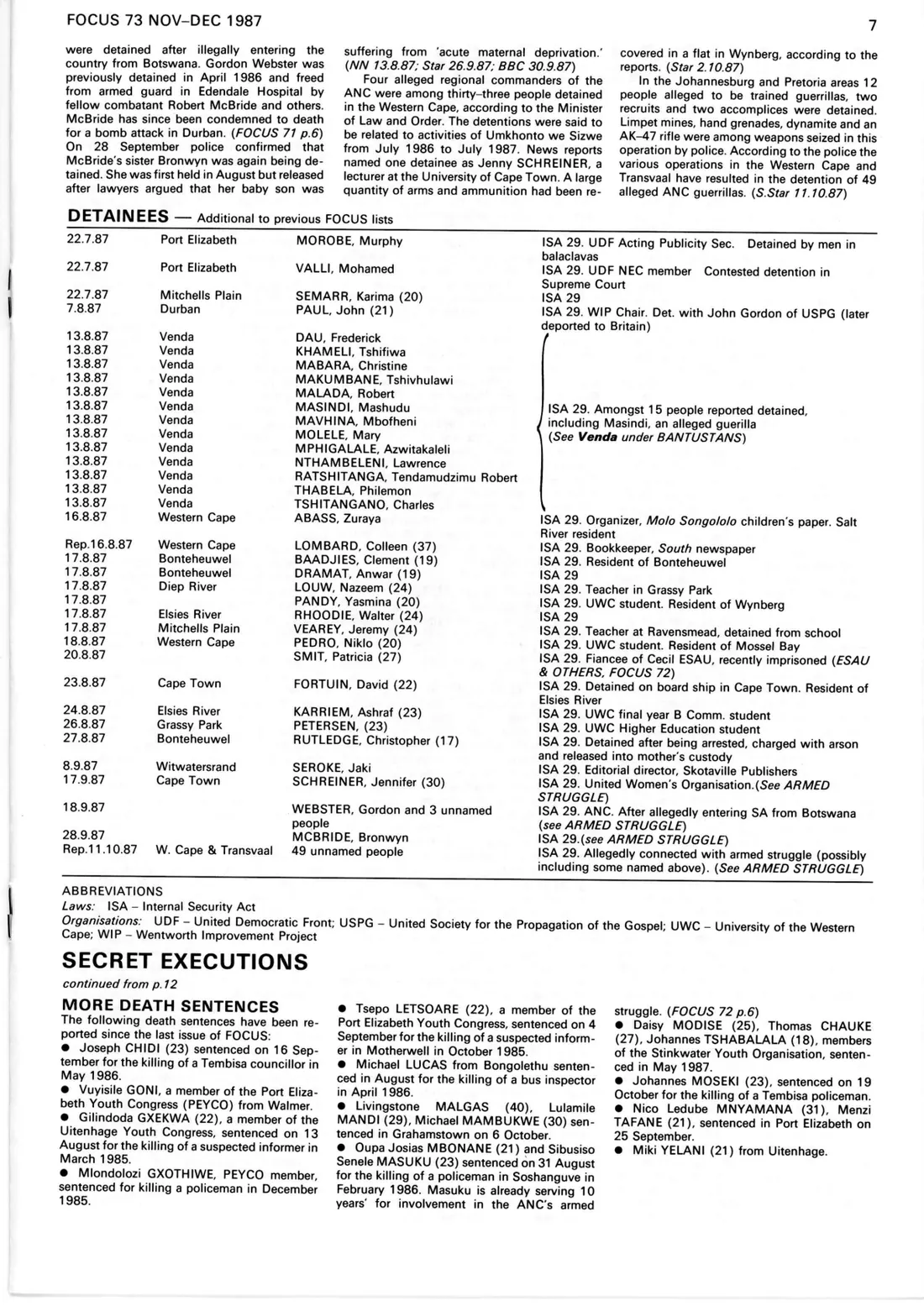
ARMED STRUGGLE On 25 September the Commissioner of the South African Police, Henrie de Witt, announced the recapture of ANC combatant Gordon WEBSTER, a colleague, and two other people who were helping them. He alleged that they were detained after illegally entering the country from Botswana. Gordon Webster was previously detained in April 1986 and freed from armed guard in Edendale Hospital by fellow combatant Robert McBride and others. McBride has since been condemned to death for a bomb attack in Durban. On 28 September police confirmed that McBride's sister Bronwyn was again being detained. She was first held in August but released after lawyers argued that her baby son was suffering from 'acute maternal deprivation.'
Four alleged regional commanders of the ANC were among thirty-three people detained in the Western Cape, according to the Minister of Law and Order. The detentions were said to be related to activities of Umkhonto we Sizwe from July 1986 to July 1987. News reports named one detainee as Jenny SCHREINER, a lecturer at the University of Cape Town. A large quantity of arms and ammunition had been recovered in a flat in Wynberg, according to the reports.
In the Johannesburg and Pretoria areas 12 people alleged to be trained guerrillas, two recruits and two accomplices were detained. Limpet mines, hand grenades, dynamite and an AK-47 rifle were among weapons seized in this operation by police. According to the police the various operations in the Western Cape and Transvaal have resulted in the detention of 49 alleged ANC guerrillas.